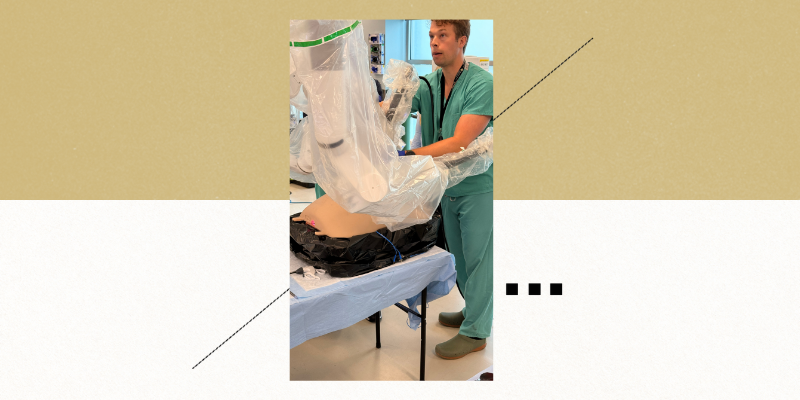
Sixteen University of Colorado Department of Surgery residents completed the department’s annual robotic acute care surgery course in July, with four residents participating in each eight-hour training day. Intuitive, the robotic surgery manufacturer, provided two robotic systems, allowing residents to work in pairs and maximize their hands-on console time while developing skills they can apply in the operating room.
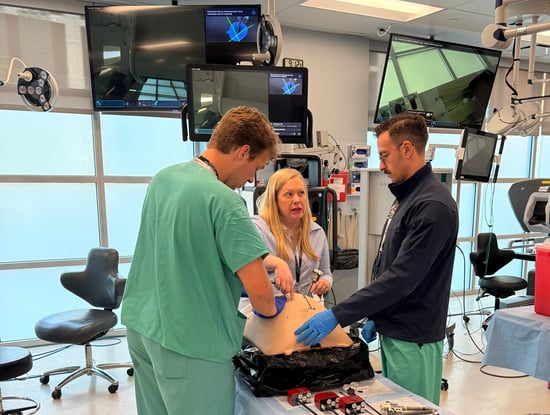 Kristy Hawley, MD, MPH, trains residents on placing ports for the robotic arms.
“It's some of the most uninterrupted time on the console that we've had so far,” said third-year clinical resident Jakob Durden, MD. “We have a console where we can do virtual training, but it's always different working with actual sutures. And having only two people to a robot is very favorable for getting hands-on experience that's going to make an impact when you get your chance on the robot in the OR.”
Robotic-assisted techniques are increasingly used across surgical specialties. For trainees, the platform requires a distinct skill set in addition to those used in open and laparoscopic surgery, including operating with a magnified three-dimensional view, controlling wristed instruments, and coordinating hand and foot movements at the console.
Shared View, Immediate Feedback
Representatives from Intuitive, were on hand to answer questions at the training, while Kristy Hawley, MD, MPH, director of robotic surgery education for the General Surgery Residency Program, led the bedside clinical instruction. Using the system’s teaching interface and touchscreen monitors, she could see the same view as the residents and point directly to anatomy, dissection planes, and the next operative step as they worked at the console.
“It's really helpful for training, because the faculty can point to exactly where they want you to go on the screen and be looking at the exact same view as you, compared to an open case, where you can never have the same view as someone else because you can't put your skull where their skull is,” Durden said. “It's really helpful for coming to a shared understanding of anatomy and what you actually need to execute.”
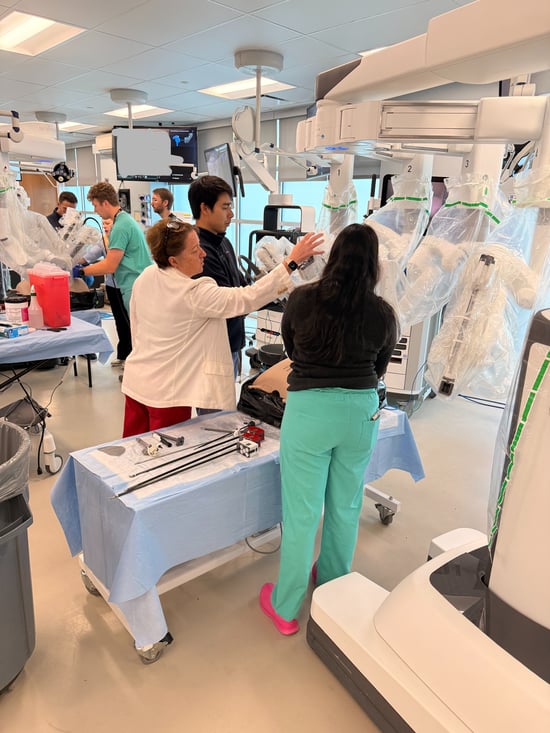 Visiting faculty member Jennifer Knight Davis, from Ohio State University, works with residents on the surgical robot.
Under faculty supervision, the residents practiced key portions of two operations: an inguinal hernia repair and a hemicolectomy, a procedure that removes part of the colon. The exercises required them to integrate camera control, tissue handling, dissection, and suturing while receiving immediate faculty feedback.
“We host this course every year for the senior residents,” said Hawley, assistant professor of GI, trauma, and endocrine surgery. “The use of robotic surgery is increasing, and we see it as another tool in our toolbox in general surgery that's becoming more popular. In addition to needing open skills and laparoscopic skills, our trainees also need foundational robotic skills and a working knowledge of the console before entering fellowship training.”
Practice in a Low-Stakes Setting
Fifth-year resident Lavanya Easwaran, MD, said dedicated console time can be difficult to obtain during routine clinical care, making simulation-based sessions especially valuable. The course allowed residents to identify weaknesses, repeat technical steps, and learn from mistakes in a non-clinical environment.
“[Practice console time] makes you feel more prepared. It gives you an idea of where you might be struggling, whether that’s suturing or dissection,” Easwaran said. “And it’s low stakes.”
The residents in this class had previously trained in the bedside-assistant role, including port placement, robot docking, and exchanging instruments attached to the robotic arms. Console practice develops a complementary skill set: translating hand and foot controls into precise instrument movement while maintaining awareness of anatomy, tissue tension, and the overall operative plan.
“Every time you get on the robot, you learn something new about technique [and] about how different people do things,” Easwaran said. “Robotic surgery is being incorporated into every surgical field. Learning to be good at it is going to be really important for upcoming trainees.”