In an emergency, giving patients lifesaving medications, fluids, or blood intravenously can be challenging. Sometimes, drilling a needle directly into the patient’s bone – a procedure known as intraosseous or IO infusion – can be the fastest or only way to deliver lifesaving fluids or medications.
However, when the patient is an infant or small child, the procedure can be tricky, and has lower rates of success than in adults.
So how does a provider master IO skills under realistic conditions without involving a real child?
One answer is a new IO trainer that was invented by Anne Adema, MD, a University of Colorado Anschutz School of Medicine faculty member.
Adema is an assistant professor of pediatric emergency medicine and an attending physician in the emergency department of Children’s Hospital Colorado at CU Anschutz. Her research focuses on using simulation technology to help frontline providers prepare for pediatric emergencies.
Her new trainer is called COMPLETE-IO, and it consists of replicas of a child’s knee and adjacent leg areas – replicas that are realistic in look and feel, and are sized to match the legs of children at various stages of development.
“When kids and adults are critically ill, sometimes you can't get an IV placed, so the fastest way to get them medications, fluids, or blood is to drill a needle into the bone,” Adema says. “Fortunately, for the most part, kids are pretty healthy, so overall paramedics and emergency providers see fewer very sick kids compared to very sick adults. That means placing an IO in an infant or kid is a high-acuity, low-frequency event.”
Anatomical issues
IO infusion involves inserting a needle into the bone marrow cavity, where the marrow’s vascular network rapidly absorbs fluids and drugs and puts them in circulation. Usually, a special powered drill is used, or the procedure can be done by hand.
IOs are used as an alternative to intravenous infusion in emergency situations when time is short and when IV access has failed or is difficult. Sometimes that’s because of massive blood loss, extensive burns, or collapsed veins in a patient in shock.
“There are anatomic issues that make IOs more difficult in kids and infants,” Adema says. “An infant’s tibia or femur is only about the width of an adult pinky finger, so placing an IO needle correctly requires an immense amount of finesse under extremely challenging conditions. We needed a way for teams to train with meaningful feedback on their procedural performance, to have that finesses when it matters most.”
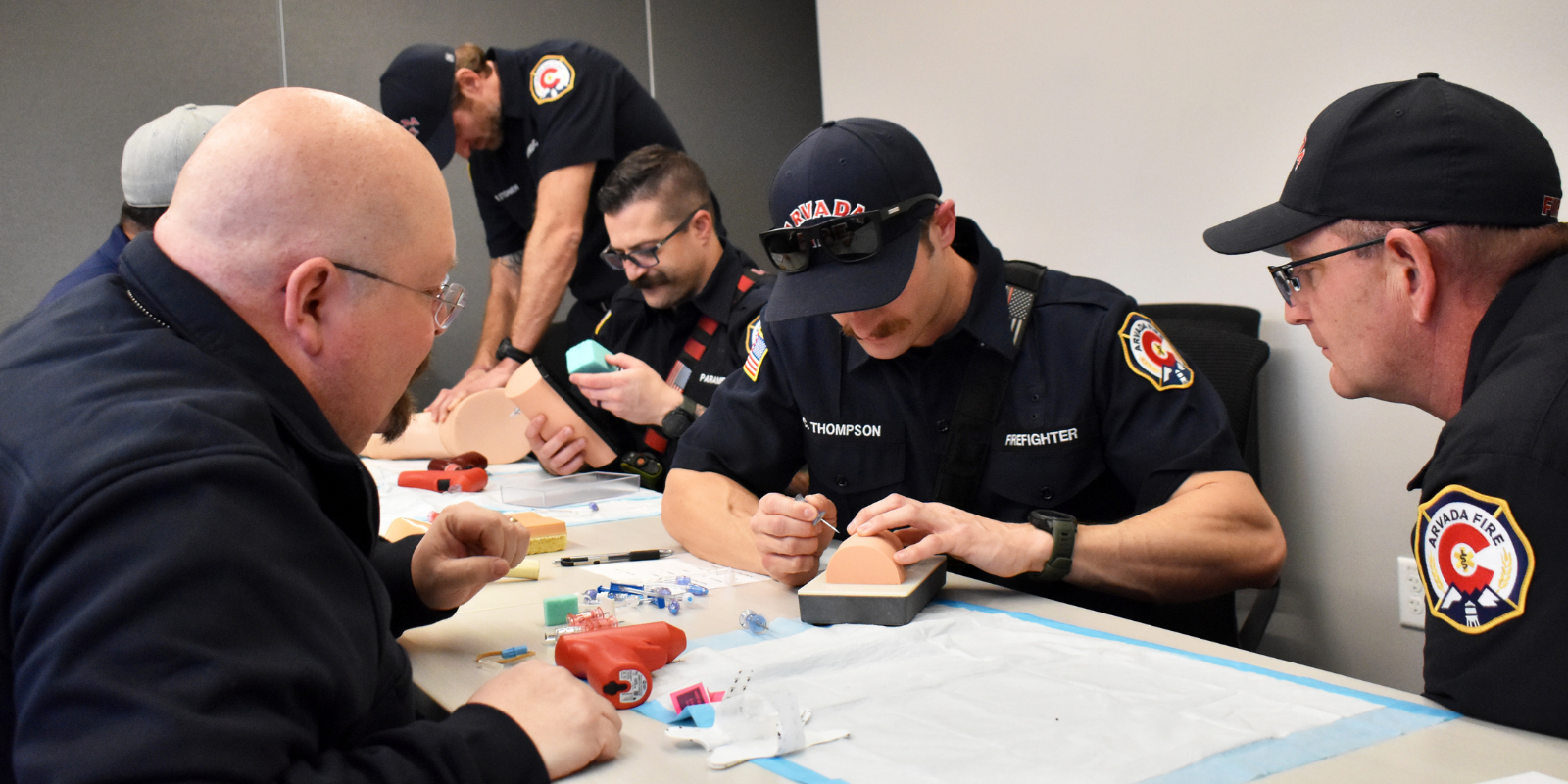
Photo at top: Arvada Fire personnel train for intraosseous infusion using COMPLETE-IO trainers. Photo provided by Anne Adema, MD.
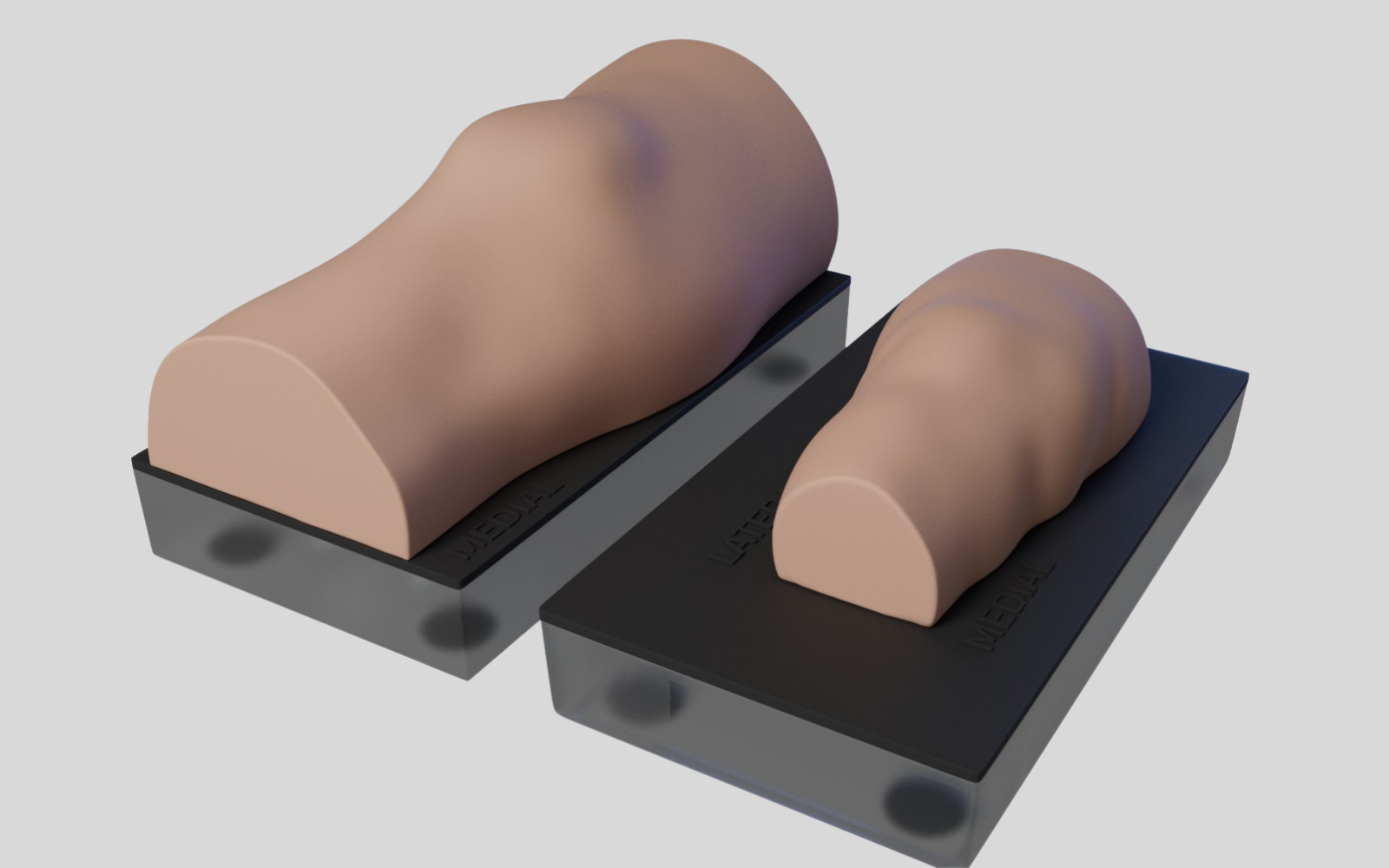
The COMPLETE-IO trainer. Photo provided by Anne Adema, MD.
‘We could do better’
Through Adema’s outreach education work with EDs and EMS agencies across Colorado, and a review of the literature, she identified major gaps in pediatric IO placement and use, including delays in care; high rates of IO needles placed out of position, especially in children under 3; and increased complications. She also found existing training methods to be inadequate.
Traditional IO training often relies on chicken bones or simple synthetic blocks, but Adema says that method fails to teach critical skills like needle selection and “landmarking” – exploring a leg by touch to locate the safest, most effective point to drill. “There are so many factors that contribute to successful IO placement. I thought we could do better.”
Starting with napkin sketches of child anatomy, Adema partnered with mechanical and biomedical engineers, using scaled CT scan data, and called on actual children as models to create anatomically realistic trainers.
Development also drew on expertise from Adema’s co-founder, Berrien Chidsey, MS, CMI, a medical illustrator and animator at the CU Anschutz Center for Children’s Surgery.
“When we started this project, I had no idea that Berrien’s skills were exactly what we needed to help perfect the look and feel of our trainers,” she says. “That’s one of the best parts of innovation – learning about all the cool work people are doing and how it can be applied to solve different problems.”
She adds, with a smile, “Our team now knows way more about silicone and plastic than we ever wanted to know.”
Lots of learning
Through the process of creating COMLETE-IO, Adema has confronted challenges that don’t typically get covered in medical school, from materials and production to launching a business, which she did last July. “There’s been lots of learning along the way, a few failures, but overall it’s been a really interesting process,” she says.
With COMPLETE-IO, providers can practice all steps of IO placement and use in either the proximal tibia (upper shinbone) or distal femur (lower thighbone above the knee). The trainers let learners experience how landmarks on the leg feel, where the needle should be placed, and how the needle feels going into the bone, among other factors.
“Without a doubt, this is the most realistic IO trainer on the market,” says Maria Mandt, MD, a professor of pediatrics and chief medical director of critical care transport at Children’s Colorado.
Mandt says that after the hospital’s emergency flight transport team trained on COMPLETE-IO, “I am confident that our team has a better working understanding of how to find landmarks on a pediatric patient, where to place the needle, and how to determine correct placement than they had previously.”
The gold standard
Adema has received helpful feedback from nurses, EMS medics, and faculty colleagues along the way. Support from the CU Anschutz Combat Medicine Research Center at the Department of Emergency Medicine has been integral to this project, she says.
Adema credits the CU Anschutz Chancellor’s Discovery and Innovation Fund and the state of Colorado’s Office of Economic Development & International Trade grant programs for accelerating development. Also, she says, CU Anschutz Innovations, the campus biomedical technology commercialization resource – and especially Gali Baler, PhD; Doreen Molk, MS; and Tom Utley PHD, MBA – provided invaluable advice and ultimately helped to secure an exclusive license with CU Anschutz.
“They’ve been wonderful partners, and being able to access funding mechanisms has been the key to taking this project from a 3D-printed prototype to a fully realized, manufactured product,” she says.
COMPLETE-IO is Colorado made, Adema says. “We probably could have made these models overseas, but the flow of materials and fluctuating tariffs made that process extremely challenging. With the help of our engineering design partner K1C Consulting, we were able to identify businesses such as V&S Molding, GeoTech, and Zak Pine Designs to make our device locally. We’re really proud of that.”
The company has started shipping models to EMS agencies and emergency departments across the country. Adema is particularly proud to supply the Children’s Colorado flight team with trainers and hopes that COMPLETE-IO becomes the gold standard to train IO placement and use for infants and pediatric patients. She has plans to expand the product line to include adult versions of the tibia, femur, and humerus (upper shoulder).
“A lot of my research work is in improving pediatric readiness,” Adema says. “I’m all about brief, frequent, hands-on training to improve familiarity with pediatric medications, equipment, resources, and skills so that people are ready to care for kids in emergency situations.”
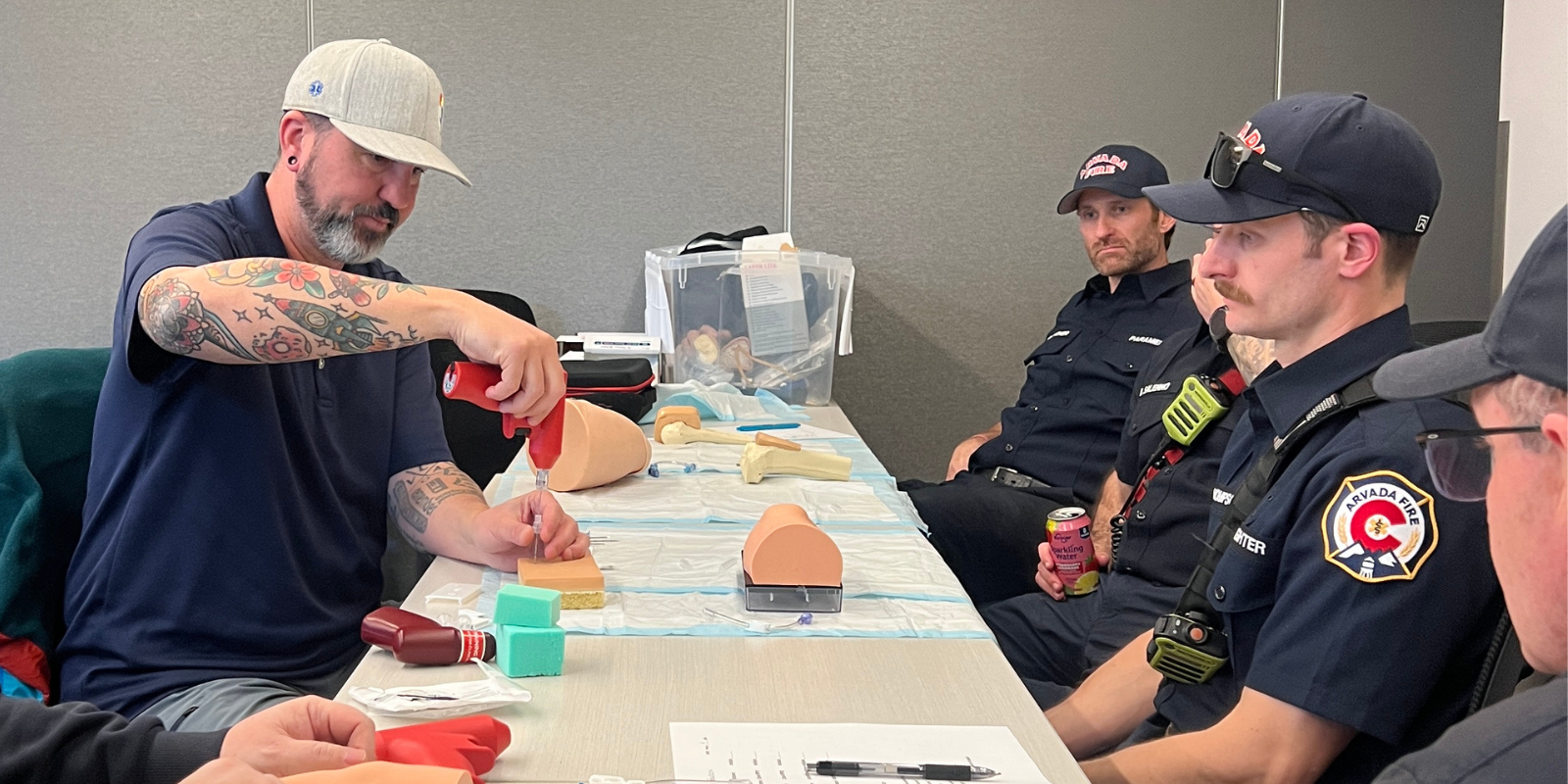
Arvada Fire personnel train for intraosseous infusion using COMPLETE-IO trainers. Photo provided by Anne Adema, MD.