An initiative in Tennessee showed that people on all sides of the firearms debate can overcome polarization and find common ground on responses to violence. A University of Colorado program, which has worked on similar issues since it launched in 2023, showcased the Tennessee project and its own work in Colorado at a June 22 forum.
Panelists with diverse views on firearms shared their thoughts at the event, which was hosted by the CU Firearm Injury Prevention Initiative (FIPI), a program of the CU Department of Emergency Medicine.
The panel’s discussion at the Sie FilmCenter in Denver followed a screening of The Tennessee 11, a documentary about an initiative in that state to find consensus on firearm-related issues following the deadliest school shooting in Tennessee’s history.
At FIPI, “we believe strongly that we all have a role to play in firearm injury prevention,” Emmy Betz, MD, MPH, a professor of emergency medicine and FIPI’s founding director, told the audience in introducing the evening’s program.
“We seek to use collaboration, education, and research to prevent all types of firearm injury, from suicide to domestic violence, unintentional shootings, community shootings, and mass shootings,” Betz added. “We think there is a path forward for us to be doing this together, to be learning and listening to each other.”
She emphasized that, as a non-partisan organization, FIPI “does not do direct lobbying or advocacy, although we hope to serve as a resource for policymakers.”
Finding ‘citizen solutions’
The Tennessee 11 opens with an account of a mass shooting at a school in Nashville in 2023 in which three students and three teachers were killed.
Afterward, Builders Network, a nonprofit organization that seeks to bridge divides on contentious issues, brought together 11 Tennesseans with diverse views on firearms issues to share their perspectives and then reach a consensus on a set of firearms rights and safety recommendations.
The Tennessee “Citizen Solutions” group ranged from a firearms instructor and self-described “Second Amendment absolutist” to a high school teacher who lost two of her students to firearms violence, along with pastors, a veteran, a student, a former police officer, and a family therapist.
The group agreed on a set of eight proposals that were then submitted to all Tennesseans via an online survey. More than 30,000 people weighed in on the proposals, and five received majority support:
- Develop and promote tools for responsible firearms ownership.
- Develop firearms issue literacy resources for schools, communities, and media.
- Reduce trauma that contributes to firearms violence by investing in communities.
- Broaden the role of school resource officers to include law enforcement and human services.
- Allow temporary removal of firearms based on risk of violence.
Those proposals were presented to Tennessee state legislators and garnered national news media attention. A measure similar to one Tennessee 11 proposal, requiring lessons on firearms safety in schools, was passed in 2024. In 2025, a bill that would have restricted firearm access for individuals with certain mental health conditions was tabled until 2026.
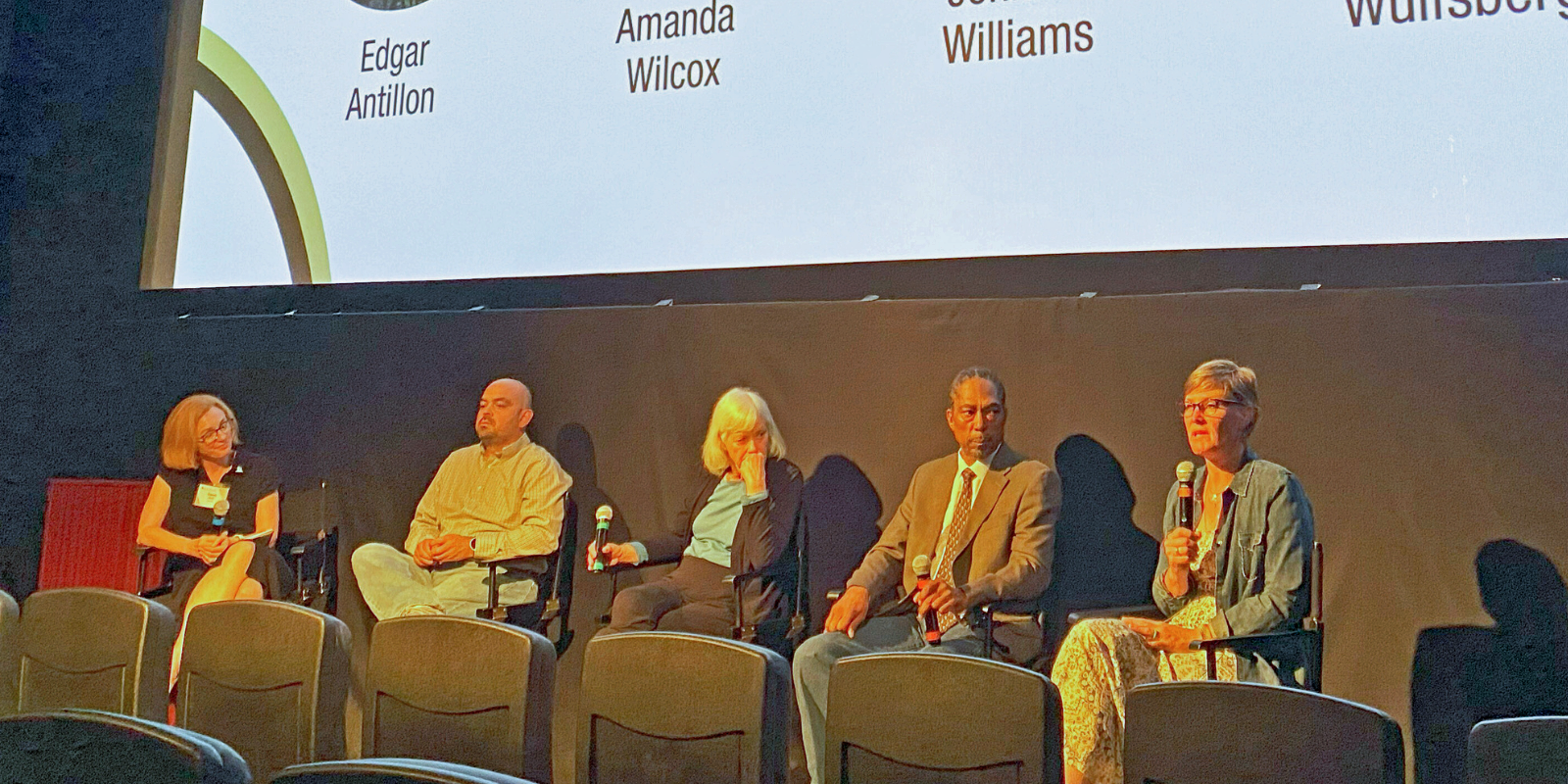
Photo at top: Emmy Betz, MD, MPH (left) with panelists Edgar Antillon, Amanda Wilcox, Johnnie Williams, and Kirsten Wulfsberg at a FIPI forum on June 22, 2025, at the Sie FilmCenter in Denver. Photo by Mark Harden | CU Department of Emergency Medicine.
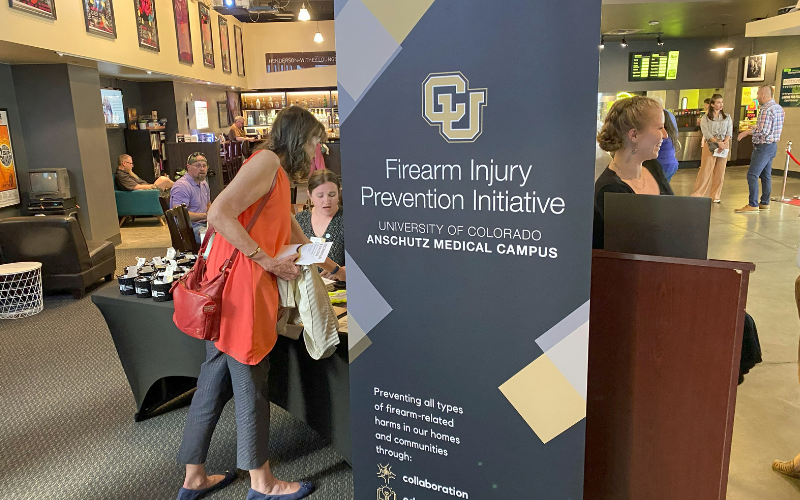
Attendees visit a FIPI informational station in the lobby of the Sie FilmCenter in Denver before a FIPI forum on June 22, 2025. Photo by Mark Harden | CU Department of Emergency Medicine.
Being part of the solution
Following the screening, Betz introduced four members of FIPI’s external advisory committee to discuss issues raised by the film and to highlight how a similar approach is happening in Colorado:
- Edgar Antillon, co-founder of Guns for Everyone National, a nonprofit firearms training organization that seeks to normalize responsible firearm ownership.
- Amanda Wilcox, a longtime California policy advocate who lost her 19-year-old daughter due to firearm violence.
- Johnnie Williams, executive director of Denver Youth Program, whose sister was killed by firearm violence.
- Kirsten Wulfsberg, a behavioral health specialist for the mountain region with Colorado State University Extension who also works with the Colorado AgrAbility Project. She is a licensed professional counselor who spent 20 years working in psychiatric crisis management in a hospital/emergency department setting.
Betz moderated a discussion of topics and issues raised by the film. While the panelists expressed several divergent views, there was general concurrence on the need for cultural change, responsible firearms ownership, and addressing root causes of firearm violence, including fear and community safety. And all agreed on the value of finding common ground when possible.
Antillon spoke of “the importance the gun-owning community has in playing the role in reducing negative outcomes with firearms,” and said it’s vital for firearms owners to learn how to use guns appropriately and responsibly.
He said people like him often feel ostracized by those with different views on firearm ownership, which makes it difficult to be “part of the solution,” as he put it. “I wish people would understand that many of us struggle with not feeling like we’re part of the solution, not because we don’t want to be, but because we get shunned because we own the tools they hate,” he said.
Seeking understanding
Wilcox, who worked for 15 years on passing more than 80 firearm safety laws in California, talked of living in a rural part of that state before retiring in Colorado. “Many of our friends and neighbors didn’t agree with our positions and what we were advocating for, and it was important to me to have a dialogue with those people, to see where they were coming from and to seek to understand them.”
She said there’s a misconception that major firearm violence prevention groups are advocating for a ban on all firearms. “Poll after poll for over 50 years have shown that Americans do not support a gun ban, so I believe that would never happen, but they do support measures to reduce gun violence.”
Williams spoke of Denver Youth Program’s efforts to “work with youth to reduce violence in the community and provide opportunities” for clients. He spoke of “the mental health situations that our clients face, and [that] they’re using firearms as a tool,” adding, “Until we are able to fix the issues that they struggle with, then we may want to remove the tools they’re using to do these crimes.”
Williams added that he’s “a trained marksman who refuses to carry a weapon.” He spoke of the importance of not using firearms as a first resort for self-defense, and said people should be trained to employ less lethal ways to deal with threatening situations.
Respecting hot buttons
Wulfsberg told of her work at hospitals doing “more than my share of evaluations on people with suicidal ideations where their plan was involving a gun, and I did quite a few evaluations on people who actually did try to kill themselves with a gun.”
She also talked of growing up in a home with firearms for hunting. She said that in her current counseling work in rural Colorado farmers and ranchers, “I have the background of seeing the way they experience the need or the choice to have guns. So I see both sides. I have seen the devastation guns can cause, and I've also seen how people think of this as their livelihood.”
Conversations about firearms can become arguments and debates unless people respect each other’s “hot buttons” that can trigger defensiveness, Wulfsberg said. She noted that in the documentary, every participant took time to share their personal stories and explain why they were taking part. “They could all see the humanness in the other person, and then they were able to move forward in their conversation,” she said.
Betz closed the evening by encouraging the audience to get involved in FIPI, through visiting the website, subscribing to the FIPI email newsletter and considering a donation to support FIPI’s work.
“Tell somebody else about our program,” Betz urged the audience. “Go back, tell your friends, tell your mom, tell your kids, and share the website with someone who you think might be ready to start having some of these tough conversations. We’ve seen firsthand that it’s possible to bring people together across differences to make progress.”
Betz added: “At FIPI, we’re ready to keep growing these efforts – not just here in Colorado, but wherever communities are looking for common ground and real solutions to prevent firearm injuries.”