What are the peak months for lightning strike injuries?
In the United States, June, July, and August are the peak months for lightning strikes. That’s partly because of thunderstorms in the afternoon, when the atmosphere starts to heat up and creates the conditions for electrical discharge from the clouds to the ground. And it’s also because of an increase in outdoor recreation activities during the summer. It’s the combination of increased frequency of ground discharge and more people outside that leads to more injuries.
How common are lightning injuries and deaths?
Lightning is very common. In Colorado, we see lightning almost every afternoon during the summer storm season. But lightning injuries and deaths are not very common. In the U.S., we have fewer than 30 lightning deaths per year, which is very minuscule in comparison with other causes of death, like cardiovascular disease or motor vehicle accidents. And the injury and death rates have been declining over the last few decades because of increased forecasting awareness. There are now advanced apps that can tell you exactly where lightning is occurring and how storms are moving across a certain territory.
Are lightning strike injuries usually fatal?
A common misperception is that if you are hit by lightning, you’re automatically dead, or have a very high risk of death. The sudden release of an enormous amount of electricity can affect vital functions, and people do die from it. But the fact is, the majority of people affected by lightning don’t die.
In a direct strike, you could go into cardiac arrest or respiratory arrest. We have the equivalent of small pacemakers in our brains and our hearts that tell us when and how to breathe and pump blood, and those can get shut down temporarily in a lightning strike, so patients can have arrhythmias and stop breathing. A good portion of these patients can survive with good-quality CPR and if we support ventilation as well.
What injuries are most common from a lightning strike?
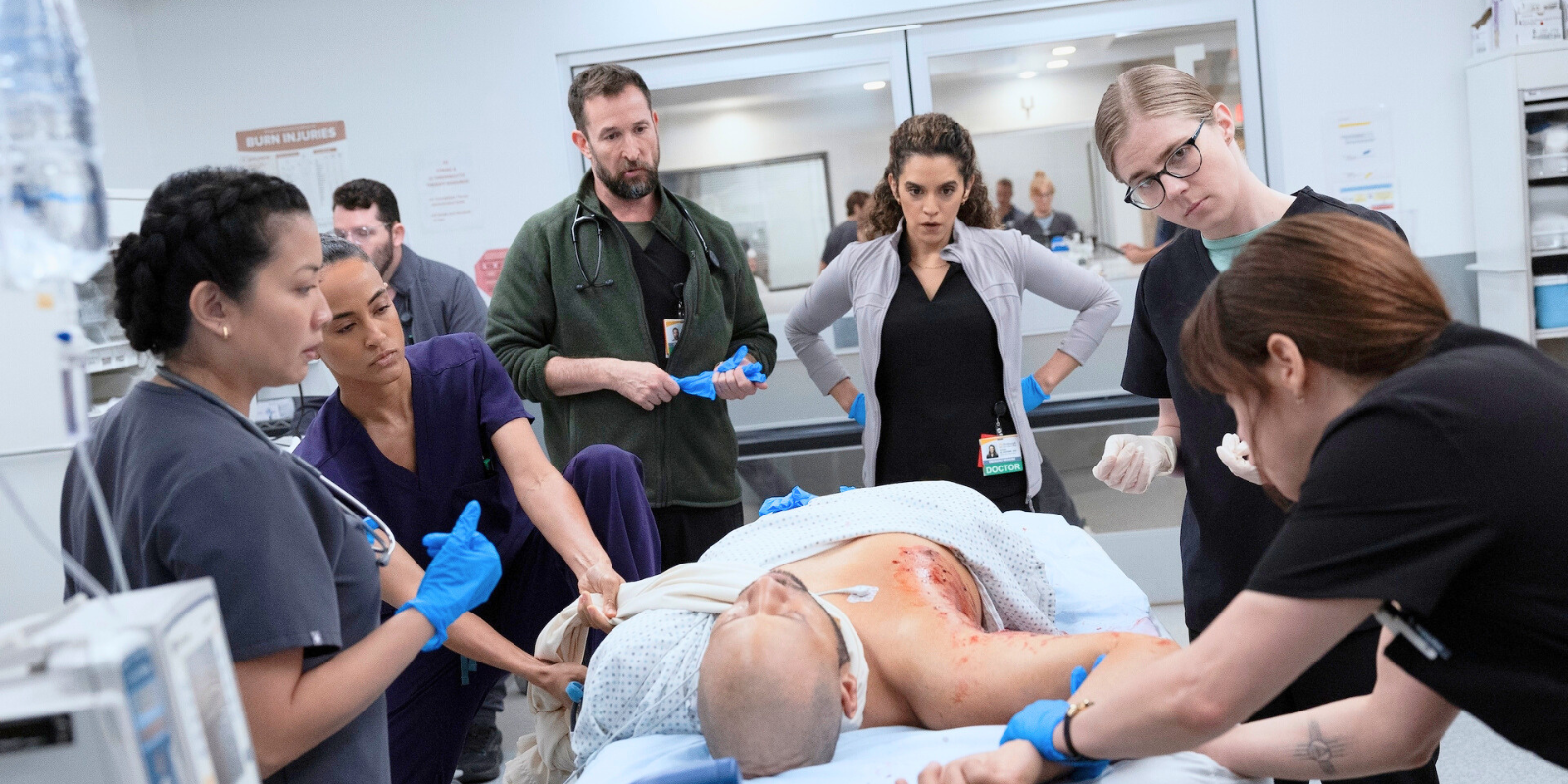
There’s a lot of heat produced by a lightning strike, so burns are common. If you have a metal belt buckle, you might get a metal tattoo. If you’re sweating, you might see burns along the path of your sweat, where your skin is moist. Sometimes we see unusual skin rashes, called Lichtenberg figures, in a dendritic pattern. It’s not a burn; basically it’s your small blood vessels getting stunned by the electric discharge, and it fades away soon. Your nerves can conduct electricity, so you can have paralysis of one or more limbs, which can be temporary.
A lightning strike causes a blast, so there can be traumatic injuries from getting hit by an object or being thrown into a rock or the ground. Eardrum ruptures are pretty common, since the sound from the blast can be extreme.
What are some ways to avoid being injured by lightning?
The best strategy is avoidance. Check the weather forecast before you head out. If you see big, tall clouds building up, the question is not if lightning will happen; it’s when.
Thunderstorms usually develop in the afternoon, so plan your outside activities for the morning as much as possible. If you’re going up a mountain, you need to wake up at 4 a.m., get started by 5 a.m., and be off the ridge by 11 a.m. or noon at the latest, so that by 1 p.m., whenever the lightning comes, you’re having lunch.
If I’m outdoors and I see lightning or hear thunder, what should I do?
We usually tell people, “When the thunder roars, go indoors.” There’s also the 30-30 rule. If you see lightning and then hear thunder within 30 seconds, go indoors. And when you see the storm pass, don’t go outside until 30 minutes after the last thunder you hear.
You don’t have to be directly under the storm clouds to be at risk. Lightning can travel a significant distance from the front or back of a storm, even when there are blue skies – a bolt from the blue.
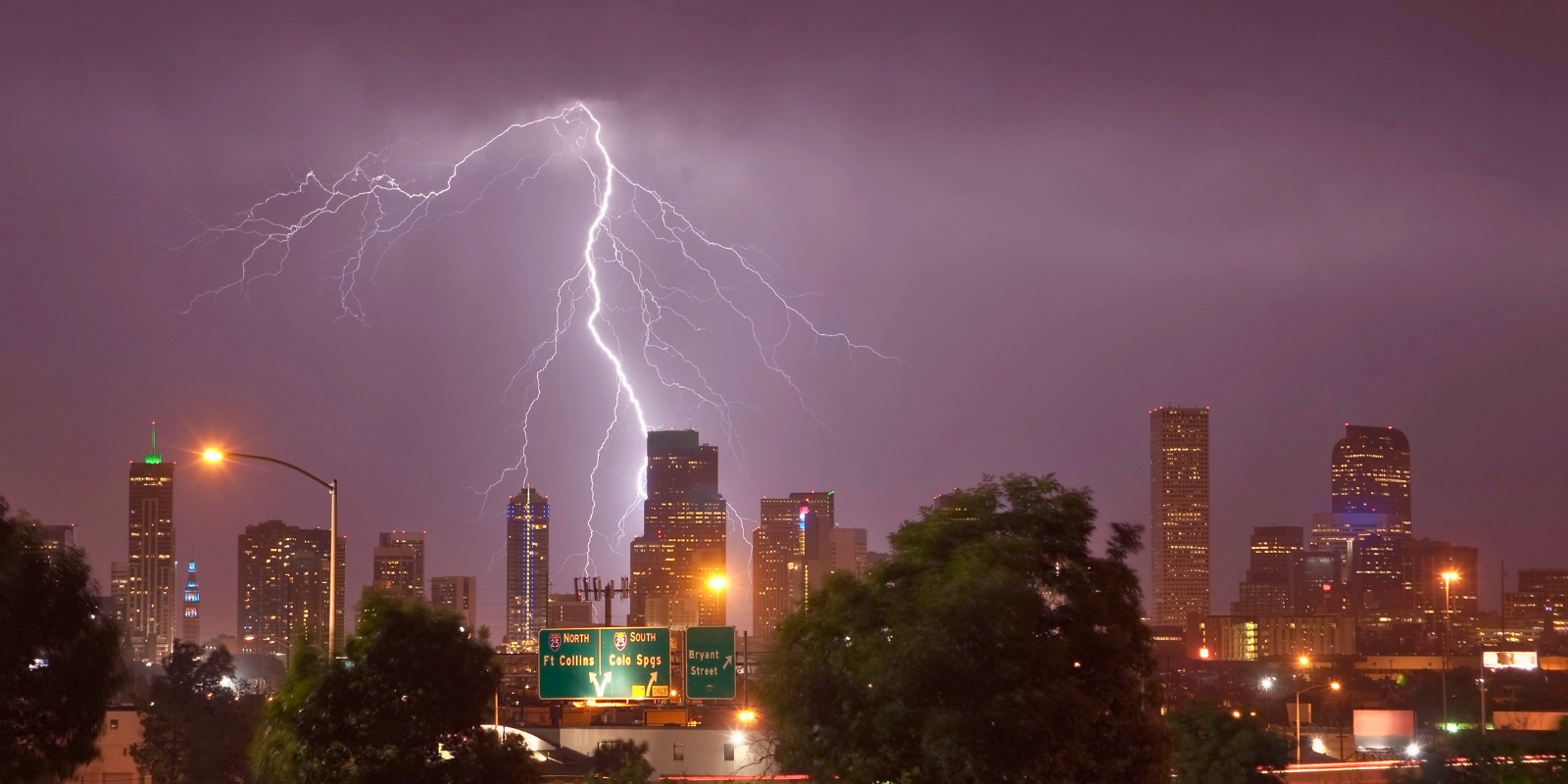
Photo at top: A late June thunderstorm over downtown Denver. Photo: iStock.
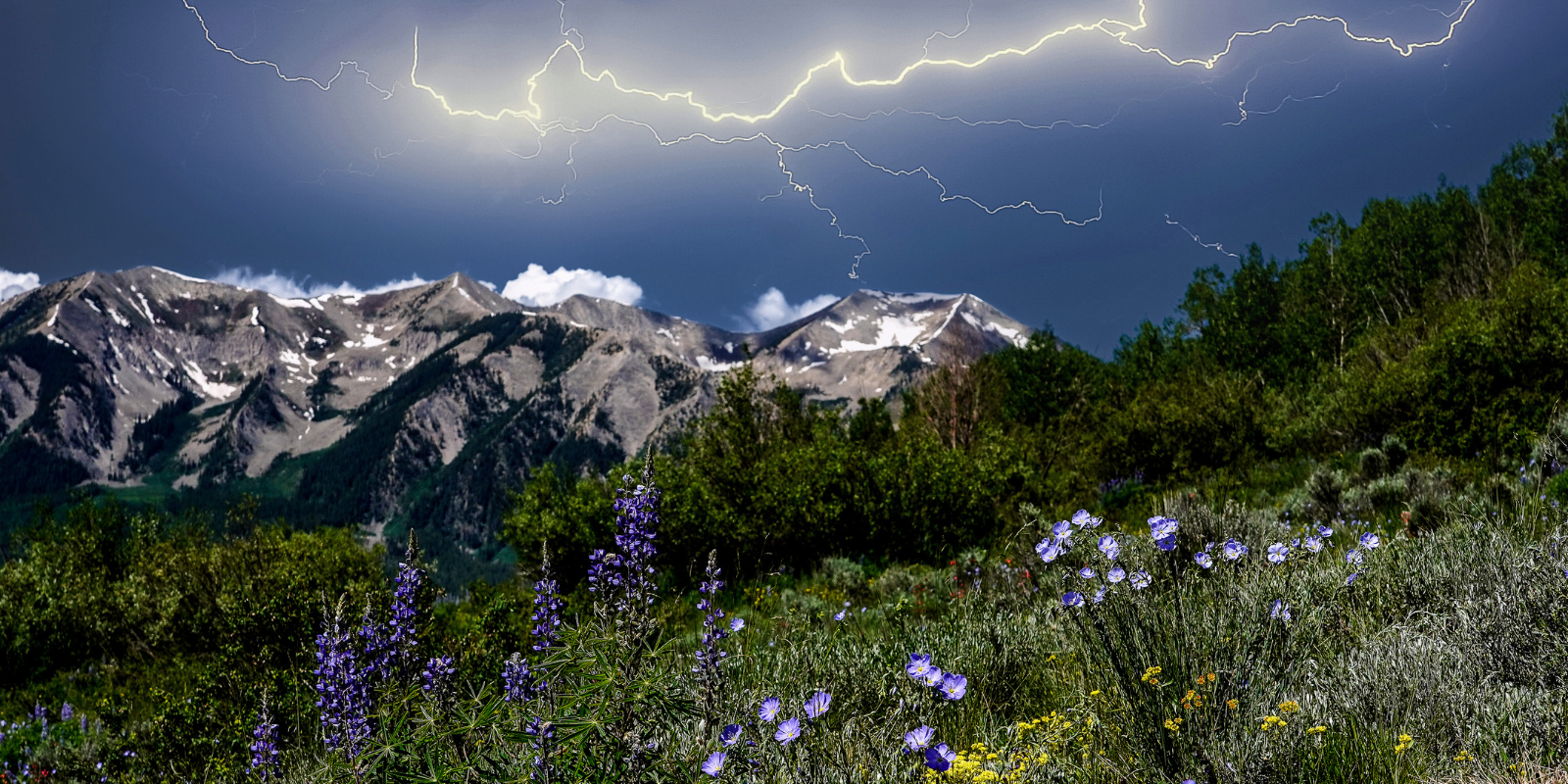 Lightning over the Elk Mountains near Crested Butte. Photo: Dennis Welker | iStock
Where should I take shelter during a lightning storm?
The best protection is inside a proper shelter – a house or other building that’s closed and has wiring and pipes. When these structures get hit by lightning, they’re connected to the ground, so the energy dissipates.
Being inside a hard-topped vehicle is better than being outside, but not because of the rubber tires. It’s because of the metal exterior, which conducts the current around you and into the ground.
Lightning tends to strike the tallest structure in an open field, so standing under a single tree is probably one of the worst places to be. And an open, metal shelter or playground lean-to is also a dangerous place. A shallow cave is not a proper shelter.
What if I’m in the mountains and there’s no shelter available?
Get off of summit ridges and get below tree line, where you’re still at risk but it’s safer. Avoid isolated trees and try not to be around water, since those can conduct electricity. If you’re in a group, the best strategy is to put some distance between people, so that if someone gets hit by lightning, there’s less chance of the entire group being hit, and someone can render aid or get help.
Should I get into a crouch to reduce the risk of getting hit?
The idea of the “lightning position” – getting into a crouch – has been widely circulated, but it has not been proven as effective by science. It could be useful, but I wouldn't waste time putting myself in a lightning position and waiting for the storm to pass. It’s more useful to get away from a high-probability area for lightning, like ridges.
If you’re already in a lightning storm and there’s lightning coming down all around you, you can try getting yourself low to the ground in a crouch position so you’re not the tallest object around. Stay away from anything that can conduct electricity, like metal. You can try to make less contact with the ground by insulating it with your pack or a camping pad and standing on it on your tippy-toes. Cover your ears, because there’s a big blast when there’s a lightning strike, and that can perforate your eardrums.
But that’s not the safest thing to do in a storm. The safest thing is to seek proper shelter.
What about lying flat on the ground?
Don’t lie flat on the ground. When lightning strikes the ground, electricity spreads out as a ground current. You want to minimize your contact with the ground.
Is training for the public available through your Wilderness and Environmental Medicine program to help people cope with lightning and other outdoor hazards?
Yes, our courses for the general public include wilderness first aid, which will teach you how to prevent these situations. Or, if you’re dealing with someone with a lightning injury or other problem, we teach how to perform “scene safety” – how to assess the scene for hazards before providing help – and also how to assess a patient, how to offer care, how to organize an evacuation, and other skills.
You need to get out and experience all that the Colorado outdoors has to offer. But it’s best to do that knowing what’s at risk and how to avoid it.