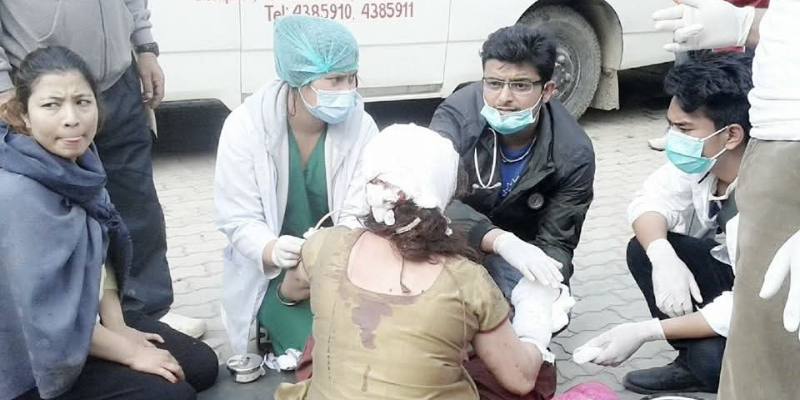
On the quiet & beautiful morning of Saturday, April 25, 2015, in Kathmandu, Nepal, I had just taken handover from my night-shift colleague and began 24-hour weekend duty. Moments later, a 7.9-magnitude earthquake struck. The epicenter was within 50 miles of my location. Within minutes, the world around us changed drastically. Not just the hospital building but the entire nation was shaken in a tremor. After the ground shook violently, the hospital started flooding with waves of patients- some walking in, some carried by family, neighbors, or strangers, all needing urgent care. Aftershocks followed relentlessly every 15 to 20 minutes. One measured 6.7 the next day. Another major quake of magnitude 7.3 struck on May 12. In those two weeks, more than 500 aftershocks of magnitude 4 or higher rattled the country—almost one tremor every hour.
We were not prepared for what we faced and what followed: crushed skulls, jaws, extremities, blunt abdominal trauma, and whatnot. Supplies ran out within hours. Beds filled instantly. We were not equipped for this level of crisis, but the staff were stretched far beyond human limits. Frequent tremors damaged the hospital infrastructure, forcing us move our patients under the open sky at the parking lot. That earthquake killed 8,962 people, more than 22K were severely injured, and hundreds of thousands were left with permanent disabilities.
What I had only rehearsed in disaster drills became my reality: chaos, confusion,
anguish, anxiety, frustration, loud noise, tears, grief, and nonstop emergency
response. I watched many patients die right after they reach hospital gates. Many died pleading for help because we could not start immediate blood transfusions. Many children died in my arms whom I could have saved if the oxygen supply had not been interrupted. Pregnant women died holding our hands, begging us to save their unborn children—children who might have survived if emergency C-sections were possible. Some died simply from unbearable pain, who we could have saved if there were an adequate supply of morphine or options to sedate them. There was no food, water, no electricity, no mobile connectivity, no internet, no fuel or supplies, nothing. I was trapped between caring for patients and worrying about my elderly parents. As I was the only child, I had no way to reach them and no idea if they were alive. What I had only watched in movies had become my reality.
One newborn died in my arms because we had no power to keep the incubator running. I was stitching one elderly man’s tongue without local anesthesia, because supplies were gone and bleeding could not wait. Being a healthcare provider, I desire to serve, and I feel a responsibility to help, but being unable to help left me with profound guilt. I showed up on duty physically, but emotionally, I was numb. Our team was exhausted with the crisis, and we were trying to treat as many patients as possible with limited resources, and patients overflowed. Appropriate triage was just an imagination. There was no time for us to pause, no endurance with us to process and reflect, and no structure for us to rest. We just kept moving forward.
Initially, I survived on adrenaline, but gradually I began to feel drained—emotionally, physically, and spiritually. I could not sleep for 5 consecutive nights. Scenes replayed relentlessly in my mind—faces of those we lost, voices asking for help. I cried alone, talked to myself, withdrew, and became absent-minded. It wasn’t just one death that pushed me to the edge—it was the accumulation of suffering, visuals, sounds, pain, and helplessness.
An 8-year-old boy was brought by his mother, a nurse from our own hospital. She herself had multiple injuries to her forehead, legs, and crushed right UE fingers. Her husband and younger daughter died when their home collapsed just a couple of hours earlier. The boy was sitting quietly, grabbing his mother’s saree, his only source of strength. He looked pale, dehydrated, with a distended abdomen and bruise- a clear sign of internal bleeding. He was silent, but his grip on the saree said everything. His mother stood in shock, eyes praying to God, a faint voice with shallow breath requesting help. Her complete loneliness shook me and had an intense impact. The child needed an immediate CT scan to locate the bleeding source, a blood transfusion & emergency surgery to control damage. On any normal day, we could have saved him, but that day god was watching us being helpless. I wanted to run to the blood bank, to help his mother, to do something more, but leaving meant abandoning other patients who were also dying. The boy’s mother was constantly communicating with me through her eyes, and I knew she understood the truth: her child had little time.
The boy’s hand gripping the saree, his mother’s silence, the chaos surrounding us. This often replays in my mind. I often wonder what palliative care could have meant that day—not only for those who were dying, but for those of us who survived while breaking inside.
In that open-air hospital, there was no morphine & oxygen, no surgeries &
blood transfusions, no Normal saline or RL, no ventilators & incubators, but there were stories. Stories of courage, sorrow, compassion, and humanity.
I started sharing my emotions and feelings with my colleagues who had been through
the same experience, and it made a big difference. Every patient in the beds on parking space had their stories of the death of a loved one. The patients were trying to share their burden and consoled each other. Patients were helping doctors treat another
patient. We all learned that the purpose of life is to serve and to show compassion and
the will to help others. We were silent, but our eyes were communicating. sometimes, even in complete helplessness, bearing witness was the most meaningful care we could offer.
Want to know more about our Palliative Care Education programs? Click below: