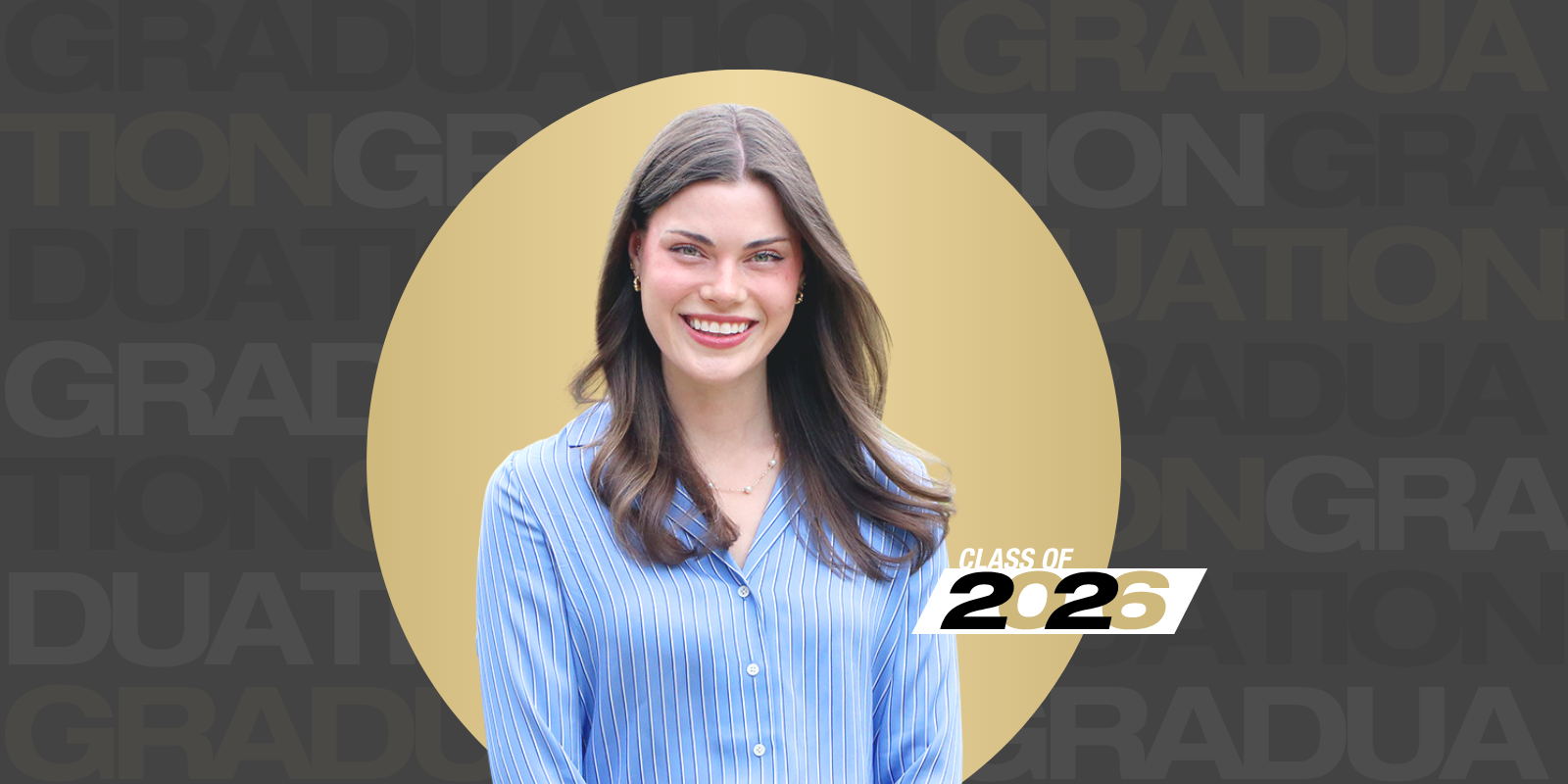
Kelsey Kines has called Colorado home for eight years. Each day has been full of studying, training, and preparing for the next step in her pursuit to becoming a physician scientist.
All eight of those years has been with the University of Colorado Anschutz School of Medicine’s Medical Scientist Training Program. This May, when Kines graduates, she’ll bid farewell to the Mile High State with two advanced degrees and a solid foundation for what’s next: an internship and residency program in dermatology at the University of North Carolina at Chapel Hill.
“I want the lab to inform the clinic, and my patients to inform my lab work,” she says. “That’s what I wanted when I began this journey.”
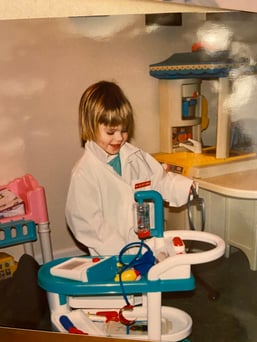
MD-PhD student Kelsey Kines playing with her a toy doctor set as a child. Photos courtesy of Kelsey Kines.
During her time at CU Anschutz, Kines made that goal her mission. She completed two years of medical school, then dived into the PhD program where she learned from and worked alongside researchers at the CU Anschutz Cancer Center working toward cutting-edge breast cancer treatments.
Finally, she finished up the last half of her traditional medical school curriculum.
“Amid all of that work I fell in love with the clinical work of dermatology,” says Kines, who precepted with a School of Medicine faculty member at the Rocky Mountain Regional VA Medical Center. “I already had some background and interest in the biology of the skin, but it was that VA experience that allowed me to explore the specialty through doing procedures, looking at different diagnosis, and helping with differentials and treatment plans.”
From cancer research to the dermatology clinic
Kines says she always left the dermatology clinic feeling happy and fulfilled by the work.
“That solidified that I was on the right path,” she says.
Kines’s PhD program work focused heavily on the molecular drivers of breast cancer in young women and postpartum breast cancer. She largely focused on a protein called Semaphorin 7a, which breast cancer can use to metastasize and evade drug treatments.
“In my thesis, I looked at the breast microenvironment, and we were able to develop a monoclonal antibody that targeted that protein,” she says.
The hope is that antibody will move toward clinical trials in the next few years.
All that hard work translates into her next phase of training, too.
“I use the skills that my PhD taught me every day,” she says. “It taught me how to think very big picture and to ask ‘why.’ Why is that the answer? Why are we doing what we are doing? I think that’s a useful skill in any specialty of medicine, and it bolstered my love of research.”
Kines also spent time during her medical school training as a mentor to middle and high school students interested in medicine and science. She hopes encouraging young scientists will offer the same kind of benefit she’s received throughout her journey.
Forging a path mentors, supporters, and passion
While Kines has spent the better part of a decade laser focused on medicine, it wasn’t always clear that would be her path, she says. Originally from Pennsylvania, Kines completed her undergraduate degree at the University of Richmond.
“I was thinking I would do a PhD in chemistry, but I had the opportunity to shadow some physicians and realized I really did like the medical side of science,” says Kines, who didn’t grow up with family working in the medical field, but often felt close to it because of her mom’s chronic illness.
“When you're in that world, you can be too close to it all. Once I was in college and I started to see medicine from different points of view, it brought me back to when I was home taking care of my mom. She didn't always have the best experience with health care professionals, so I knew I wanted to make it different for others and be a better health care professional,” she says.
Research remained a passion for Kines, and after talking to a mentor about possibly wanting to pursue a medical degree and a PhD, she decided a combined program was likely the right move for her.
Eight years later, she confidently says she was right.
“When I interviewed with CU, I was impressed with the collaborative culture I felt from researchers, mentors, clinicians, and students,” she says. “Everyone felt supportive and said, ‘We will be there for you with whatever decisions you make.’ When I’ve talked about my interests, people here immediately offer up new connections and say, ‘I know who you could talk to.’”
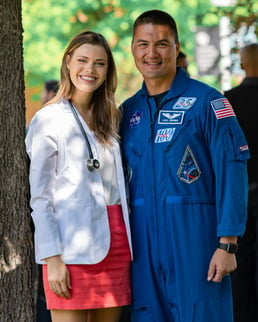
Kines at her white coat ceremony, typically the beginning of a student's medical school journey, in 2018, with keynote speaker American astronaut Kjell Lindgren.
Her time at CU also come with valuable lessons and experience in making the most of a combined program.
"Do a lot of self-reflection," Kines says. “It’s a really long time. It’s a really big commitment.” That also lends to another big piece of advice: “Don’t forget to have fun. Take the trips, see your friends, your family. Get a dog if you want. If you work hard and develop a strong support system, you’ll get through it to see the next chapter.”
Kines’s mom, who passed away the summer she applied to medical school, was among her biggest supporters. “She was passionate about education, and I hope that I’ll continue to foster that passion just as well,” she says.
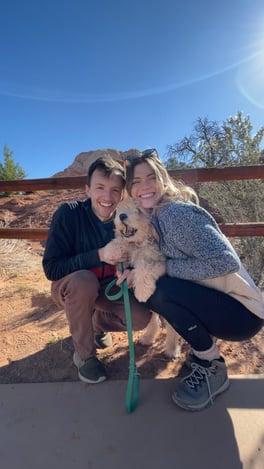
Kines with her husband and dog Wallace on vacation in Utah.
CU Anschutz commencement for medical students takes place May 18. From there, Kines will begin the next leg of her training — and settling into her new home — in North Carolina.
“I feel immense gratitude for everyone who's supported me to get here, particularly my husband and my sister," Kines says. "I'm so excited to start this next journey, especially since it's been so long with my medical school training. Colorado is the longest place that I've lived as an adult, so it will be hard to move on to the next place."
.png)