.png)
Twelve seconds — that’s how long it typically takes for hundreds of ultrasound beams to burn a lesion deep in a patient’s brain as they lie awake. While it may seem counterintuitive, neurologists and neurosurgeons at the University of Colorado Anschutz School of Medicine collaborate to perform this procedure, called a high-intensity focused ultrasound (HIFU), to reduce involuntary tremors in patients with essential tremor by disrupting the brain’s pathways.
Millions of Americans have essential tremor, a neurological condition that causes trembling, often in the hands, when moving. This progressive condition can limit a person’s mobility and reduce their quality of life. For some, medications are ineffective at calming these tremors, which can worsen over time. HIFU is a surgical option that aims to immediately reduce a patient’s tremors, no incisions needed.
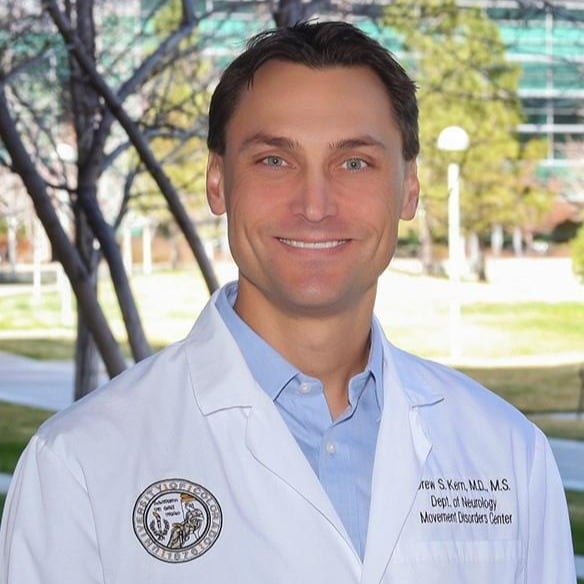
Neurosurgeons Steven Ojemann, MD, and Daniel Kramer, MD, as well as neurologist Drew Kern, MD, MS, of the multidisciplinary CU Anschutz Movement Disorders Center, recently performed the 100th HIFU case at the UCHealth University of Colorado Hospital, a significant milestone in their ongoing mission to help patients through a team-based approach.
“The number is a testament to the fact that we’ve been able to build a strong collaboration with the institution, with each other and other members of the treatment team, and with patients who are willing to put their trust in us,” says Ojemann, director of stereotactic and functional neurosurgery and a professor in the CU Anschutz Department of Neurosurgery.
Kramer, an assistant professor of neurosurgery and co-founder of the Neural Engineering Research and Design of Colorado laboratory at CU Anschutz, adds, “Through a dedicated team, we are able to offer cutting-edge treatments with the expertise of a well-oiled machine.”
Delivering the best care possible is what matters most to the treatment team, explains Kern, an associate professor of neurology who specializes in advanced stages of movement disorders, such as essential tremor and Parkinson’s disease, that require surgical interventions.
“Neurologists and neurosurgeons plan and perform this procedure together. We’re the only center in the world that I’m aware of that does it this way,” Kern says. “We’ve had patients travel from other states to our center because of our team approach. They feel they get a holistic, total evaluation and treatment.”
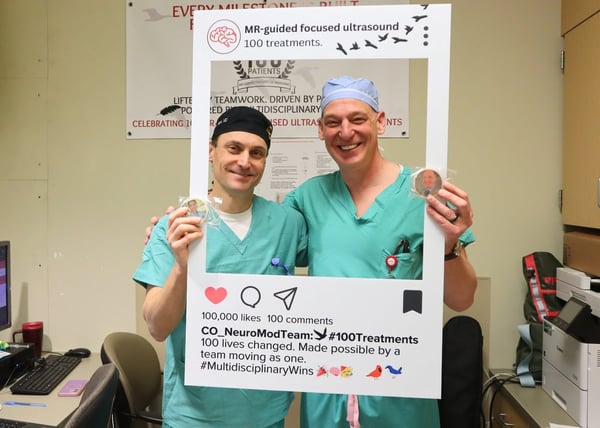 From left to right: Drew Kern, MD, MS, smiles alongside Steven Ojemann, MD, as they celebrate the 100th HIFU case at the UCHealth University of Colorado Hospital. Images courtesy of Makenzie Hardy.
A unique approach to treating a common tremor
Many of the everyday movements that people perform — such as drinking a cup of coffee, using utensils to eat food, applying cosmetics, and writing on a piece of paper — can be difficult or nearly impossible for people with essential tremor. Unlike with Parkinson’s disease where tremors occur when remaining still, an essential tremor typically occurs when a person is performing a reaching movement.
“Unless you’re afflicted by something like this, there are a lot of movements that we take for granted, and there can be social stigma associated with this tremor,” Ojemann says.
It is a common condition, affecting an estimated 1% of the overall population and around 5% of people over the age of 65, Ojemann, Kramer, and Kern explain. Older adults are not the only ones at risk, as the condition appears to primarily peak among two age groups — people in their 20s and people in their 60s.
The exact cause of essential tremor is unknown, but it often runs in families. It’s most likely a heterogenous disease, meaning there are multiple causes for it, Kern explains. Though further research is needed, many believe the tremor may stem from abnormal signaling happening in a pathway of the brain called the dentato-rubro-thalamic tract, which goes from the cerebellum (considered the organ of balance) to the ventral intermediate nucleus of the thalamus (the brain’s information relay center that processes movement and sensory information).
“We unfortunately cannot treat the underlying disease of essential tremor, partly because it is so poorly understood, but we can treat the symptoms effectively,” Kramer says. “Here at CU Anschutz, research in my lab is specifically focused on understanding the functional role of the circuit that results in essential tremor, and we hope to soon have more effective treatments.”
Ojemann adds, “Since essential tremor likely has a number of different causes, it’s really important for neurologists and neurosurgeons to work together so we can combine our expertise to best understand and treat these nuanced cases.”
Choosing a surgical option
There is no cure for essential tremor, but there are two medications to reduce tremors. It’s estimated that these medications can improve tremor severity by about 50%, Kern says.
However, Ojemann estimates that roughly half of patients who use these medications will still have “disabling symptoms,” which is why patients may consider surgical treatments instead. Surgical treatment options can improve tremor severity by roughly 70-90%, Kern explains.
The two surgical options are HIFU, characterized by using ultrasound beams to create a brain lesion, and deep brain stimulation (DBS), where an electrode is implanted into a specific region of the brain to disrupt the pathways causing tremors. The electrode is connected to a battery placed under the skin near the collarbone, similar to a cardiac pacemaker. This generator can be programmed and adjusted to help control tremors.
Unlike DBS, doctors don’t make any incisions, and they don’t implant any devices into the body for a HIFU procedure. Instead, a patient’s head is shaved before Ojemann and Kramer apply local anesthesia above the eyebrows and ears. Then, they pin a head frame to the patient’s skull so that an apparatus can be securely placed on their head.
The apparatus is like a hood dryer at a hair salon, Kern explains. It surrounds the patient’s head so that ultrasound waves can converge to create heat that will burn brain tissue without causing permanent damage to the skin or skull. Patients lie awake in an MRI machine with the apparatus on their head as Ojemann, Kramer, and Kern slowly dial up the amount of energy the ultrasound beams deliver.
“It’s like a magnifying glass. Heat is generated by focusing hundreds of ultrasound waves at a single site in the brain,” Ojemann says. “We essentially destroy a small piece of tissue that is propagating an abnormal rhythm in the brain to interrupt the tremor circuit.”
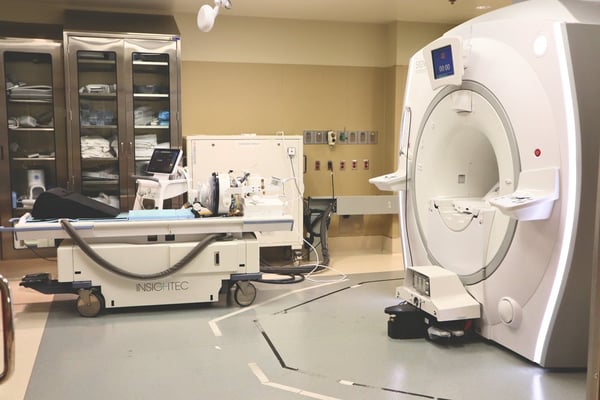 To perform a HIFU procedure, patients will lie awake in an MRI machine, shown to the right.
‘Still get awestruck by it’
It takes only seconds to create the brain lesion, but countless hours of preparation and collaboration precede the operation to safely and precisely locate the part of the patient’s brain that receives the ultrasound beams.
Ojemann, Kramer, Kern, and other members of the treatment team — such as neuroradiologists, neurophysiologists, nurse practitioners, and occupational therapists — carefully review, assess, and consult with patients to determine whether HIFU is an appropriate procedure. Then, neurosurgeons and neurologists work in tandem to create a plan. While this procedure has occasionally been performed to treat tremors in patients with Parkinson’s disease, HIFU is primarily used to help patients with essential tremor.
During the procedure, Ojemann, Kramer, and Kern use a gradual approach to ensure they are focused on the correct brain tissue. The MRI machine monitors temperature changes, allowing the doctors to first apply a minimal amount of heat to ensure the ultrasound waves target the right place.
Then, they apply a slightly higher amount of energy that stuns the tissue, causing a temporary effect on the brain. This allows clinicians to see whether there are any negative side effects and evaluate the effectiveness of the treatment in real time. They remove the patient from the MRI machine and have them draw spirals on a piece of paper. These spirals are compared to spirals made pre-procedure to assess if the tremors have lessened.
“We are one of only a few centers that have a movement disorder neurologist like me evaluate the patient during the procedure,” Kern says.
If there are no adverse effects and the patient’s spiral drawings demonstrate improvement, for 12 seconds at a time, the doctors will increase the temperature of the beams so that they deliver enough energy to permanently destroy the brain tissue. Within a few hours after the procedure, the patient will be able to go home, and they will return to the clinic the next day for a follow-up appointment. Six months later, the doctors will meet with the patient again to make sure the tremor severity is still reduced.
Due to essential tremor being a progressive condition with no cure, the procedure cannot fully prevent tremors from occurring or progressing in the future. However, research has found that there was an average 73% improvement in tremor severity five years after the procedure. On rare occasions, patients may re-develop severe tremors after the procedure. Doctors may consider doing the procedure again to target new brain tissue that is perpetuating the issue.
“When you see a patient’s tremors stop, it’s almost like a light switch. I’m always impressed with the before and after pictures of the spirals,” Ojemann says. “I still get awestruck by it. It’s a remarkable thing to have a patient talking to you as you perform this significant intervention to change their brain circuits.”
 The patient for the 100th HIFU procedure drew spirals before and after the treatment, demonstrating a reduction in tremors.
‘What matters to us is the patient’
Similar to many patients beforehand, the patient who received the 100th HIFU procedure at the University of Colorado Hospital experienced “exceptional” improvement in reducing tremors, Kern says, adding that the patient “was ecstatic because they could drink a cup of coffee again.”
While this procedure has helped many patients, it may not be the right choice for everyone, Kern notes. Although HIFU is commonly presented as a minimally invasive procedure, Kern tells patients that it is invasive given that it involves making a permanent lesion in the brain. There is roughly a 10-20% risk of experiencing side effects such as balance impairment, speech changes, coordination impairment, and sensory changes, though when these risks occur, patients usually describe them as mild.
Doctors performing HIFU are also only permitted to treat one side of the brain at a time. This means that if a person has essential tremor on both sides of their brain, they will need two separate HIFU procedures, and they will have to wait at least nine months in between the operations.
“This is one treatment option of many. We pride ourselves on being equally effective with any treatment options we offer. You should discuss all options with your doctor because each option has pros and cons depending on your specific situation,” Kramer says. “At CU Anschutz, what really matters to us is the patient.”
Ojemann agrees, adding, “We have a lot of pride in the quality of the HIFU treatment we provide, and in the fact that patients are willing to put their trust in us to make a lesion in their brain. At our comprehensive center, our objective is to provide the whole spectrum of treatment options to patients and personalize our approach to their needs.”
Interested in learning more? Visit the CU Anschutz Movement Disorders Center webpage for next steps and additional information on focused ultrasound treatment.