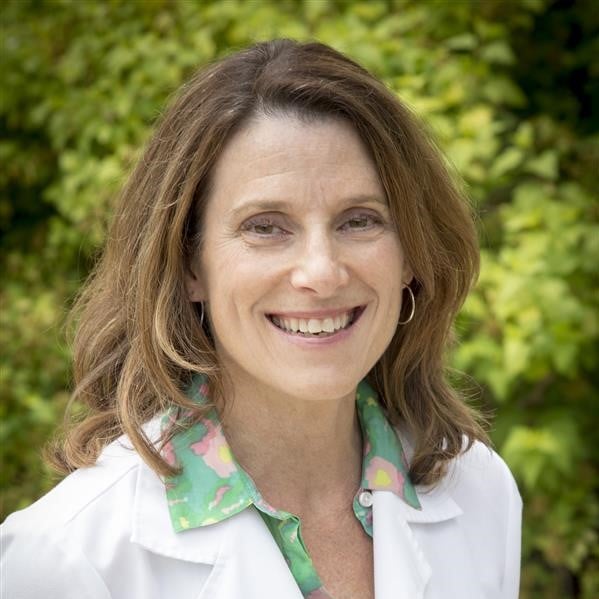
Suzanne Brandenburg, MD, adopted Blue, a pedigree Kerry blue terrier, from an elderly patient when it was no longer feasible for her to take care of the energetic dog.
“That dog was her whole world,” recalls Brandenburg, a general internist and associate dean for medical education at the University of Colorado School of Medicine at Colorado State University, also know as the Fort Collins branch.
“My patient knew after their partner passed away and their own health was declining; she just couldn’t do it anymore. Every time she came to see me, she’d say, ‘It’s getting harder.’ ‘I’m a wreck.’ ‘I can’t do it.’ She just wanted the dog to be loved, so I agreed to take Blue,” she says.
Through her years working as an internal medicine physician, Brandenburg came to find that her experience of taking on the care of Blue wasn’t uncommon. She learned of other health care workers who had done the same thing for their patients.
It’s also one of the reasons she enthusiastically jumped aboard the formation of P.A.C.T., an organization created to help bonded human and animal families in northern Colorado stay together by providing direct services to individuals living with an illness, disability, or housing instability, and older adults in need of care for their pets. P.A.C.T.’s mission is aligned with the partnership between the CU School of Medicine and CSU.
P.A.C.T. officially launched its services — house calls and temporary foster care — in June. Already, leaders and volunteers of the organization say it’s filling an important gap in health care for patients and providers alike.
Patients delaying care for pets
Rebecca Niemiec, PhD, co-founder of P.A.C.T. and director of the Animal-Human Policy Center at CSU, studies the intersection of human and animal health.
“When a person has to give their pet away, that can be a negative outcome for both the person and the animal because of that human-animal bond,” Niemiec says. “That’s what motivated me to engage with this work.”
In her former position as manager of the Bureau of Animal Protection for the state of Colorado, Niemiec says there were many times where P.A.C.T. could have been a valuable resource.
“Sometimes there were situations where the owners cared deeply about their animals and were giving all the resources they had to the animals and just needed some additional help and support,” she says. “For those situations, I was trying to find places to refer people, but not many existed.”
Now, as a social scientist and associate professor at CSU, she’s diving into research that shines a light on the importance of the human-animal connection — especially in health care. The research also helped inform the mission of P.A.C.T.
In a survey Niemiec and colleagues including a CU medical student administered, more than 70% of emergency medical services workers, assisted living and nursing facility workers, medical students, and social work students surveyed agreed that patients who own pets are more likely to delay or refuse social services or admission to long-term care or a hospital, or transport to a hospital due to concerns over pet care.
Over the course of a month, 25% of social workers and 62% of health providers said they had experienced at least one instance where pet ownership resulted in delays in obtaining services.
Additionally, half of health provider respondents and 18% of social workers said at least once per month they encountered pet ownership as a reason why clients or patients refused services.
“This goes to show that in health care, sometimes the job is more than medicine,” Niemiec says.
From that research, P.A.C.T. was created. Brandenburg says its mission is a natural fit for the One Health approach that has come to define the Fort Collins medical school branch.
“The idea is that humans, animals, the planet, and climate are all interconnected. It's crazy if we don't think about the big picture when we're trying to care for or nurture one segment of that equation, so we include the One health framework as a thread that runs through our medical school program,” she says. “We’re always thinking about how we can help everybody see that connection and make a difference on a broader level, beyond one patient, one doctor.”
Research meets reality
The interconnection of human health and animals is a lesson CU medical students in Fort Collins are learning early.
Katie Culver, who begins her third year of medical school in August, spent many of her early days in her first internal medicine rotation trying to acquire care for a patient who was worried about the care of their cats during their hospital stay.
“The first day I met this patient, they had a significantly altered mental status, but when we finally got them stabilized and I could ask how they were feeling, they immediately told me their cats were at a local shelter and could only stay there for three days,” she recalls.
Coincidently for Culver, her patient experience was happening parallel to her work collecting data for the research on how pets impact medical care.
“This is exactly what we were doing this research for,” she remembers thinking as she continuously called the shelter asking for extensions to keep the cats.
“After I told the patient that I was going to find the resources to care for their animals, their energy changed. They were so much calmer. We would talk about the cats every day, and I would relay updates I got from the shelter,” Culver says. “That was my first experience being incredibly hands-on in the hospital, and it blew all of what I thought was going to happen out of the water because it was such a real and raw experience that helped me see how important this type of care can be.”
Culver is now a student associate for P.A.C.T. and helps share information about the organization with hospitals and health care facilities in northern Colorado. She also wants to get the program added as a community service option for medical students.
“It’s been really great to see the creation of P.A.C.T. and know that the backbone of this work is the research that we’ve done and filling a gap the community has identified,” she says. “It’s an incredible feeling to know the work you’re doing is making a difference.”