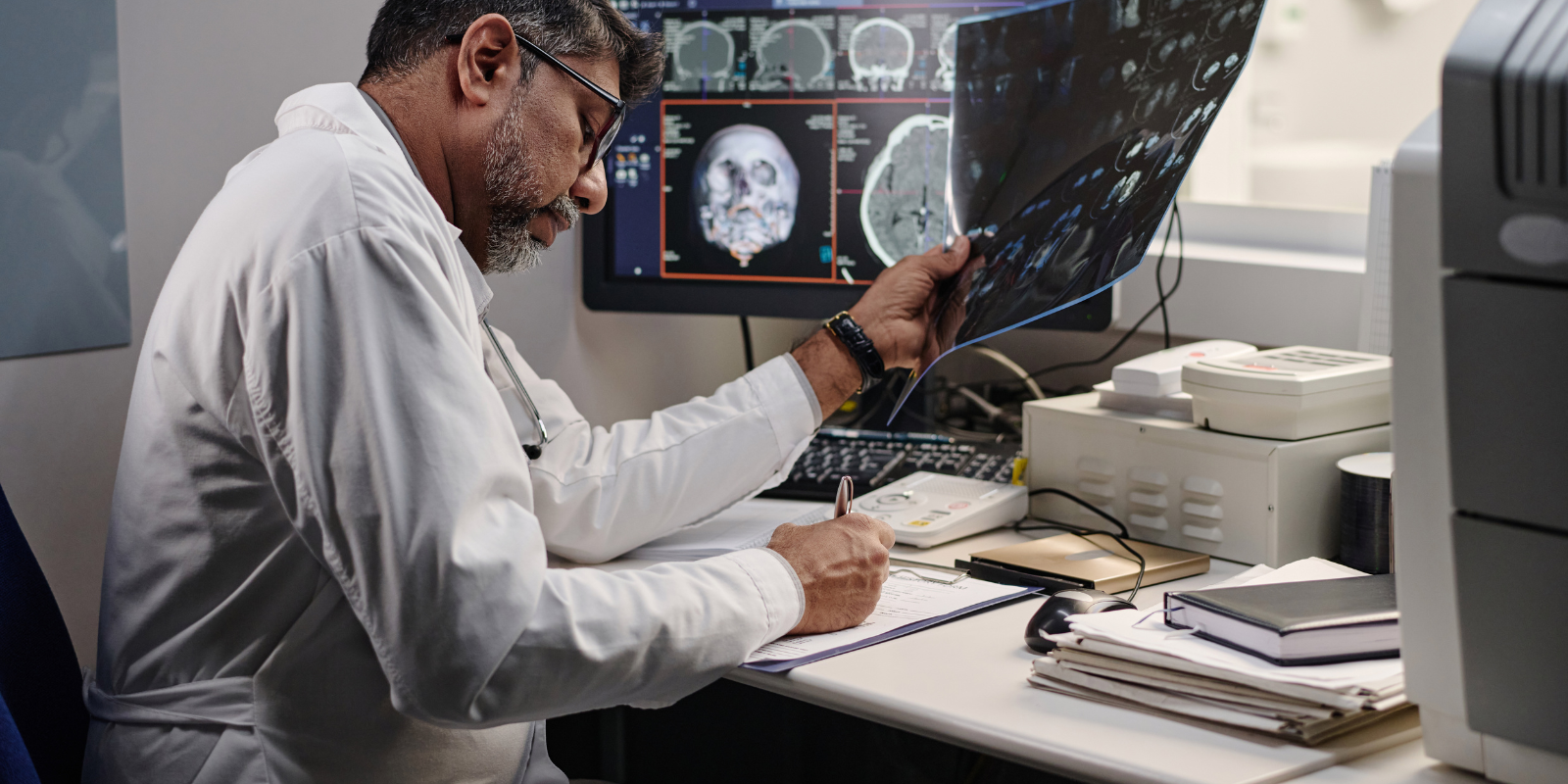
A significant part of a radiologist’s job is understanding their patient’s health journey, even if they never meet with them face-to-face.
“How you interpret medical imaging depends heavily on the patient’s story,” says Nikhil Madhuripan, MD, assistant professor of radiology at the University of Colorado Anschutz School of Medicine and interim section chief of abdominal imaging.
This often requires sorting through a patient’s electronic health record (EHR) to understand why the patient underwent imaging and what might be relevant from the patient’s past that could impact the radiologist’s reading of a scan and the diagnosis. To do this kind of investigatory work takes time – but Madhuripan and colleagues believe artificial intelligence (AI) could offer some support.
Madhuripan and Aakriti Pandita, MD, assistant professor of medicine, have spent the past two years building an AI assistant that works with Epic, a popular hospital charting software, that performs contextual EHR data extraction for radiologists. The first-of-its-kind tool, called AIDA, can summarize an EHR for the radiologist, saving them time and maximizing efficiency.
“Our goal is to improve reporting quality at scale by helping radiologists access information faster,” says Pandita, who is also an investigator at the Adult and Child Center for Outcomes Research and Delivery Science (ACCORDS).
The power of AI
When Pandita and Madhuripan first teamed up to work on an AI tool, they began asking clinicians what they wanted to see. Overwhelmingly, the duo found, specialists wanted help in summarization and no such tool existed for radiologists, who heavily rely on a patient’s medical history and EHR data.
The project moved forward with support from experts including Justin Honce, MD, associate professor and vice chair of informatics for the Department of Radiology; Justin Moore, artificial intelligence and research computing division manager for Information Strategy and Services at CU Anschutz; and IT leaders across UCHealth.
“We don’t need AI to help diagnosing patients, we need AI to help the tasks that are repetitive and redundant and administrative in nature,” Pandita says.
Madhuripan has first-hand experience on that front. When he opens a scan, he might not have crucial information, like a cancer diagnosis for example, ready to inform his reading. That often takes opening the patient’s chart and several clicks to find.
“Then, I have to parse through a bunch of different chunks of notes to get to the information I need,” he says.
That can be burdensome given the work load many radiologists experience.
→ Read more: Synthetic Data Powers Breakthrough in Radiology AI at CU Anschutz
Another challenge, Madhuripan and Pandita say, is that an EHR itself can be a massive repository of data.
“The challenge isn’t getting the data, it’s making it accessible,” Pandita says. “How do we sort, filter, and dig through an EHR in an efficient manner so that the radiologist can spend more time focusing on the patient’s scan instead of all this searching?”
This is where AI can make a significant contribution to the work.
Leveraging tools that make a difference
So far, 18 radiologists have piloted AIDA. Their feedback has been overwhelmingly positive.
William Colantoni, DO, MBA, section chief of emergency radiology, works at two clinical sites – one that has access to AIDA and another that does not.
“The difference is striking. On the days I do not have AIDA, I genuinely miss it,” he says. “It smooths out my workflow in a way that is hard to overstate and helps me deliver higher quality, more impactful reports, especially for complex patients.”
Likewise, Garvit Khatri, MBBS, DNB, assistant professor of radiology and director of quality and peer learning in the abdominal imaging section, explains that “while many AI tools are emerging in this space, the real challenge is identifying, synthesizing, and evolving with those that truly add value to clinical care.”
“AIDA stands out in this regard. Its seamless integration with Epic and its ability to intelligently summarize clinical notes and prior imaging provide relevant, high-yield information directly at the time of report dictation, eliminating the need to dig through extensive patient charts,” he says.
That can save a radiologist time and help them enhance quality – two perks that go hand-in-hand.
“As for the potential of this kind of technology, I think tools like AIDA represent a major shift in how radiologists can interact with the EHR. They reduce cognitive overhead, improve consistency, and enable faster, more informed decisions in settings where time matters. For emergency radiology in particular, the impact is meaningful,” Colantoni says.
A frontier and the future
Radiology may be the starting point for AIDA. Madhuripan and Pandita can see how the tool could help transform other specialties, too.
“I’ve tested AIDA as I’m admitting patients and for me, it acts as a second set of eyes, just to make sure I’m not missing anything,” Pandita says.
For now, the researchers will continue fine-tuning AIDA and the interface with hopes of it making its way into the hands of radiologists across the country following a clinical trial. As early users, Colantoni and Khatri says they are eager to see how Madhuripan and Pandita will continue to evolve the technology to continue meeting the needs of radiologists.
“Something we found along the way is that the tool has to be useful most of the time, or it's not useful,” Madhuripan says. “If it's only useful some of the time means people just stop using it. They just stick with their existing workflow. To be useful most of the time, you need to know what the user is trying to find out.”
The team has received five awards so far, including Colorado SPARK, the Faculty Well-being Innovation award from CU Thrive, and CU Anschutz Healthcare Innovation and Entrepreneurship Initiative.
Another perk of the tool is that early use has also revealed examples where AIDA helped catch tumor nodules early in a patient that can be challenging to diagnose without the proper context. Those instances make the tool beneficial for everybody, from the radiologist to the patient.
“Radiology workflows don’t exist in silos,” Pandita says. “Their work is closely tied to our workflow on the bedside site.”
Ultimately, AIDA could be a win-win for health care systems.
“In the clinical study, we’ll be looking at multiple outcomes, including clinician burnout, the tool’s effect on reducing cognitive load for radiologists, how it impacts time savings and quality of documentation,” Pandita says. “This is one of the first homegrown projects integrating AI to be deployed in the EHR and with so many firsts come a lot of questions and we’re excited to see where this promising technology takes us.”