When Meghan Perea had to stop and catch her breath after walking two blocks, her family knew something was terribly wrong.
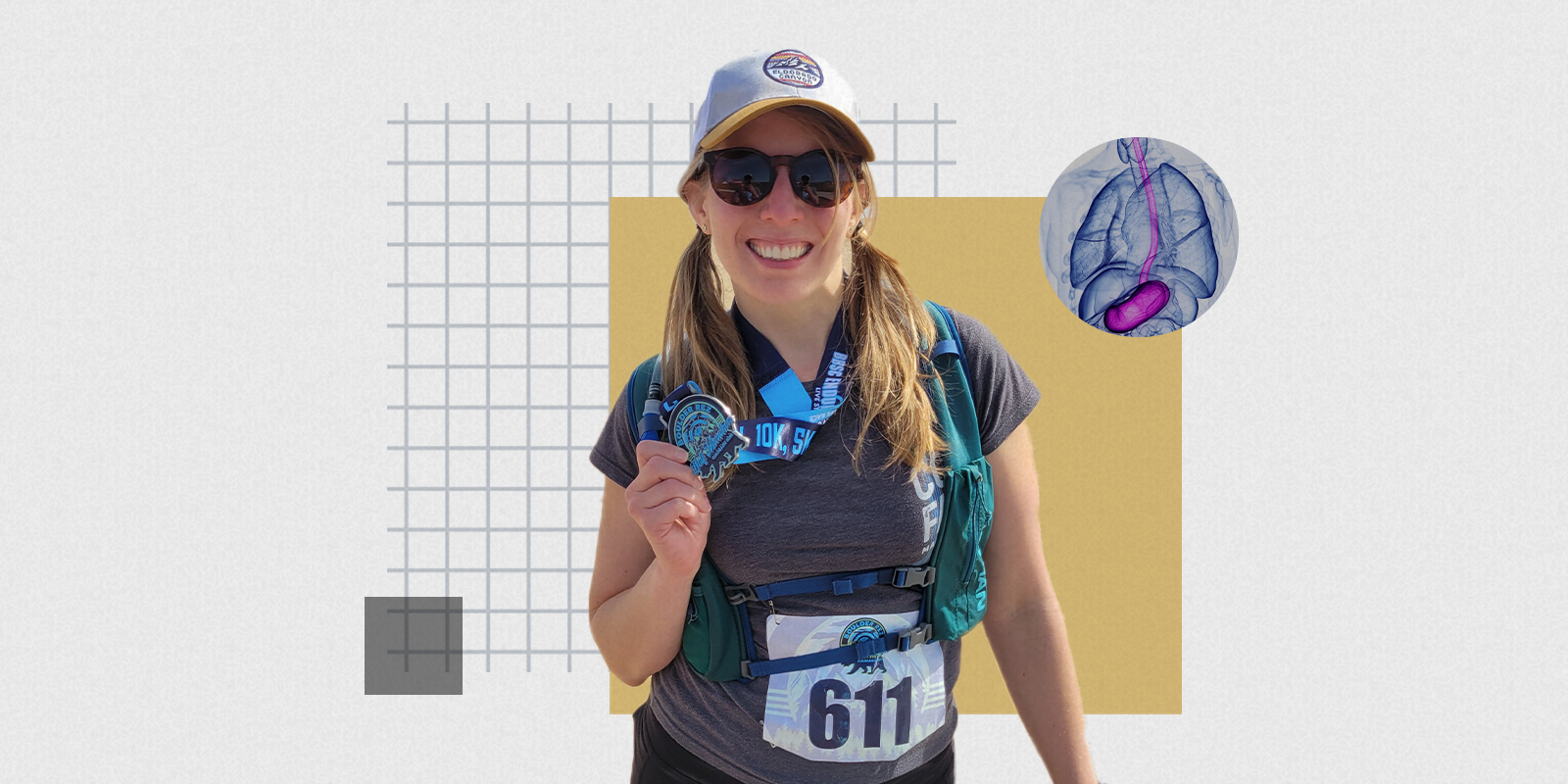
Perea, age 36, loves to be active. She hikes, bikes, participates in interval training and runs half marathons.
But in January 2025, Perea said her runs started to feel a little harder. She assumed she hadn’t trained enough. Then, on a “little” five-mile run that September, her sister asked, “Do you always breathe like that when you run?” At that point, Perea said the answer was yes. She’d accepted that her breathing just sounded “snorty.”
Fast forward to January 2026, when Perea got a cold. She’d heard others complaining about a virus known for giving people a “three-week cough.” Hers lasted longer, so she saw a provider online and was prescribed nasal spray and an inhaler.
A few weeks later, Perea went back to the gym. She was shocked to find she couldn’t run a lap around the small track without losing her breath. That’s when she also noticed how winded she got climbing stairs in her house and talking on the phone. The cold was gone. But her breathing had gotten worse.
After that two-block walk in late February – and at the urging of her family – she took a day off work to go to urgent care. An X-ray of her lungs revealed nothing unusual, and she was sent home with an inhaler. But later that day, the provider called and asked her to go to the nearest emergency department, saying he’d feel better if blood clots were ruled out. So she went to her local hospital and received a full workup.
Everything came back normal. But the doctor had concerns.
“He said, ‘We’re sitting three feet apart, and I can hear you breathing, and that’s weird,’” Perea said. He could hear some congestion in her throat, so he ordered a CT scan of her neck. That’s when they saw the scar tissue that had narrowed her airway to the size of a pencil.
Perea was immediately referred to UCHealth University of Colorado Hospital.
“I'm so lucky,” she said. “Dr. Lina happened to be the doctor on call that night.”
What is idiopathic subglottic stenosis?
Ioan "John" Lina, MD, assistant professor of otolaryngology and head and neck surgery at the CU Anschutz School of Medicine, took one look at Perea’s scans and told her she didn’t need to make the drive to Aurora to be seen immediately. He did, however, schedule her to come into his clinic for evaluation to confirm what her scans already told him: Perea is one of the estimated 400,000 women in the United States who has idiopathic subglottic stenosis. There’s no known cause, but it happens almost exclusively to Caucasian women of Northern European descent on average between the ages of 20 and 50.
“We suspect it occurs more frequently than this,” Lina said. He explained that patients tend to see their doctors because they are feeling out of breath and can’t be as active as they’d like to be. The condition is easily misdiagnosed, with women seeing multiple doctors and specialists and receiving diagnoses such as asthma, acid reflux and even anxiety.
Lina is one of the few specialists in the Rocky Mountain region who treats this condition. In Colorado, Lina said there are only about 10 doctors who treat the condition – four of whom are in his department at CU Anschutz.
“The drive to breathe is strong,” Lina said. “It’s super scary for these patients who, like Meghan, are otherwise healthy and find themselves gasping for air.”
How is idiopathic subglottic stenosis treated?
Procedures that reopen the narrowed airway are a mainstay of treatment for idiopathic subglottic stenosis. While endoscopic dilation can reopen the narrowed airway and improve breathing, it’s not a cure. The scarring eventually returns.
Longer-lasting treatment is possible, Lina said, but the procedures are more extensive. In severe cases, the scarred section of airway can be removed and reconnected via the “healthy” ends. Or the entire airway can be reconstructed with a skin graft and stent.
Perea’s initial appointment with Lina confirmed the narrowing of her airway was due to scarring related to idiopathic subglottic stenosis. Within a week, she was scheduled for endoscopic surgery.
“It’s really intense to hear a doctor tell you, ‘Right now, your airway is the size of a straw,’ and you need corrective surgery right away,” Perea said.
Lina sat with Perea and her family and answered all their questions. No question was too small or silly for any of the providers she saw. Perea describes the experience as amazing, from scheduling to pharmacy.
She describes the 20-minute surgery itself as “life-changing.”
Perea took a week off to recover, but within two days, she was breathing normally again. She had forgotten what it felt like to breathe fully.
“It's profoundly incredible to be free from that kind of intense struggle,” she said.
National clinical trial to investigate this rare, understudied disease
Although surgery reopens the airway and restores breathing, idiopathic subglottic stenosis typically returns. Recurrence varies widely by patient, but Lina said on average another intervention is needed within 14 to 18 months.
It’s why Lina is excited to be a site investigator for the ASTRO trial: the first placebo-controlled, double-blind clinical trial to test whether steroid injections delivered in the clinic can help patients go longer between surgical procedures. The trial grew out of research collaborations at the Johns Hopkins University and Vanderbilt University. CU Anschutz is one of 10 locations nationwide to participate, largely due to the work and expertise of Lina and his team.
If successful, the steroid approach could reduce patients’ need for repeated trips to the operating room. Lina is hopeful it can also help establish a more standardized treatment for this rare disease.
Although Perea is not participating in the trial, she is receiving steroid injections to prolong the time between surgeries. It’s an uncomfortable procedure, but it’s worth it, she said.
“If it means I don’t have to have surgery as frequently, then it’s a yes for me.”
What researchers are learning about idiopathic subglottic stenosis
It’s not known why this condition primarily occurs in women of Northern European descent. In addition to the clinical trial investigating steroid therapy for treatment, Lina recently received approval to study patient samples in his lab to learn more about the condition.
Lina’s hopeful that the research at CU Anschutz will also help to raise awareness. He sees patients who travel from around the region because most areas lack access to a specialist. One patient from South Dakota was referred to him for breathing issues associated with an enlarged thyroid. Lina found that she was actually suffering from scarring in her airway, but the condition had been missed due in part to a lack of awareness of the condition and the patient’s high body mass index (BMI).
A “life-changing” surgery supports a healthy lifestyle
Perea was able to return to running within two weeks of her surgery. She no longer struggles to breathe.
"I told Dr. Lina that the muscles in my feet have to catch up to how much air I can move now," she said.
The experience made Perea deeply aware of how fortunate she was to have health insurance, financial resources and access to specialists who recognized and knew how to treat her condition. It also gave her greater empathy for people living with chronic illnesses, particularly those who need frequent procedures or struggle to access appropriate care. She credits early diagnosis and expert treatment with helping her avoid more invasive interventions and a potential medical emergency.
“I'm grateful I received the care I needed. It also made me recognize all the circumstances that made that possible – circumstances that aren't true for everyone,” Perea said.
For Lina, the goal is ultimately to raise awareness of idiopathic subglottic stenosis while giving patients more ways to manage the disease and change its course.
“We have more options today than when I first trained, and that’s great. My hope is that we can get to a point where we can do one surgery and a patient is able to breathe better for life. If we can get there, I think it’ll be amazing to help our patients who are suffering from this disease,” Lina said.
Key points:
Idiopathic subglottic stenosis is a rare disease that causes scar tissue to narrow the airway.
The condition can be difficult to diagnose and is sometimes mistaken for asthma or other conditions.
Surgery can restore breathing, but the airway narrowing often returns.
CU Anschutz is one of 10 sites in a national trial testing whether steroid injections can extend the time between surgeries.
Researchers hope to reduce repeated surgeries and improve treatment for this understudied disease.
CU Anschutz is also studying patient samples to better understand what causes the disease and how to change its course.