One of the most common things Amy Wallace McDevitt, DPT, PhD, sees in her patients with low back pain is fear.
The physical therapist at a busy UCHealth University of Colorado Hospital rehabilitation center said about a quarter of her patients come to her with low back pain, many of them having had episodes before. “And often, they're afraid to move.”
Whether it’s from lost workdays, muscle spasms or shooting nerve pain, memories of their past experiences cause them to freeze up, afraid that moving will make the pain worse. But in reality, movement is most often the best medicine.
“We know from a lot of studies that sedentary behaviors or bed rest following injury is actually not helpful at all,” said McDevitt, an associate professor of physical therapy at the CU Anschutz School of Medicine. “If anything, it's the antithesis of that.”
Easing their minds and coaching them through the importance of walking and other gentle mobility exercises – such as the five examples demonstrated in the videos below – becomes the primary therapy.
Did you know? Low back pain is a top cause of doctor visits in the United States. Certain lifestyle factors can raise risk, including poor sleep, high stress, smoking, being overweight, heavy lifting, lack of exercise and sitting for long periods of time.
“One of the safest activities that we can do, even when we're having an episode of low back pain, is to walk. Walking can decrease pain,” McDevitt said, advising people to work through immediate discomfort, which is common and should begin subsiding in less than five minutes as the body warms up.
Lack of movement is not only bad for recovery; it’s often the culprit of mechanical low back pain. Sedentary lifestyles are a chief reason that eight out of 10 people will experience low back pain at some point in their lives, studies show. And about 80% of those will have recurring back pain, often within a year.
Once her patients’ pain becomes more tolerable, McDevitt generally begins layering in strength exercises (not included below) to build the musculature that helps support the low back, such as hip and deep abdominal muscles.
The following exercises can help relieve and prevent low-back pain by maintaining or improving spinal mobility. They should be performed in the early part of the day, before commuting and sitting begins, and should be paired with a walking routine.
Note: Consult with a doctor before beginning any exercise program.
Supine Lower Trunk Rotation
What this exercise does: improves spinal mobility and lumbar rotation.
Common mistakes to avoid: over rotation of the legs and lifting of the shoulders.
Repetitions: 10-12 per side.
→ Lie on your back with your knees bent, feet flat on the floor or table.
→ Engage your core muscles by pulling your navel toward your spine.
→ Slowly lower both knees together to one side; hold for 1-2 seconds, keeping shoulders and back flat on the floor at all times.
→ Slowly bring your knees back to the starting position and then lower to the other side.
→ Hold for 1-2 seconds and repeat alternatively.
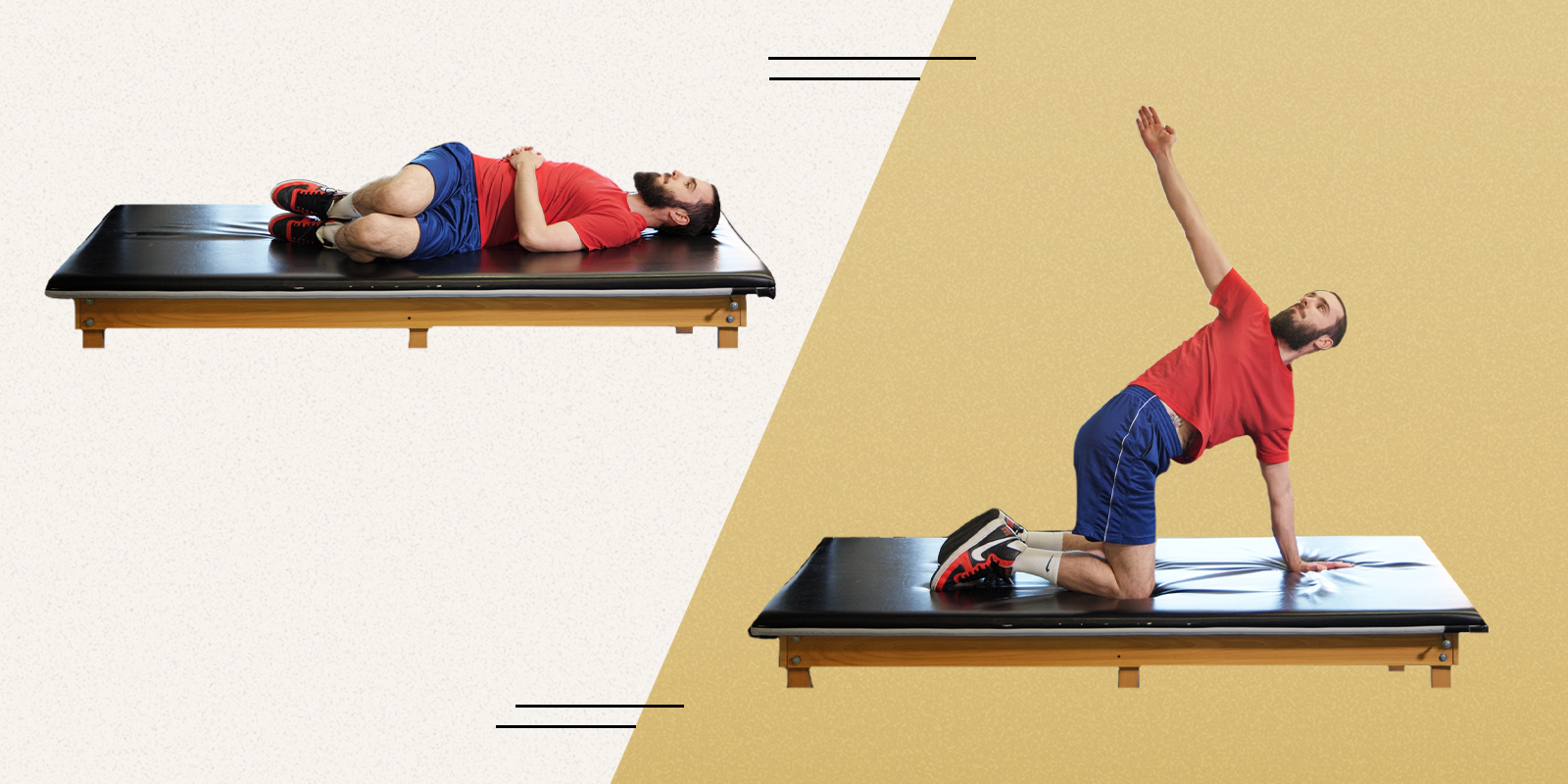
Side Lying Thoracic Rotation
What this exercise does: improves spinal mobility and thoracic rotation.
Common mistakes to avoid: over rotation in the shoulder versus the trunk.
Repetitions: 4-6 per side.
→ Lie on your side with your knees bent at a 90-degree angle and stacked one on top of the other.
→ Place your top arm straight out in front of you and rest your head on your bottom arm/hand. Keeping your bottom knee and hips stationary, slowly open your top arm up and over your body, reaching toward the floor behind you.
→ Follow your top hand with your eyes as your chest and back slowly rotate.
→ Slowly bring your arm back to the starting position.
→ Repeat set on the other side.
Quadruped Thread the Needle
What this exercise does: improves spinal mobility and thoracic rotation.
Common mistakes to avoid: looking straight ahead (may place strain on the neck).
Repetitions: 4-6 per side.
→ Get on your hands and knees. Position your wrists directly under your shoulders and your knees directly under your hips. Keep your back flat and core engaged.
→ Slide one arm under your chest and through to the other side, letting your shoulder and upper back rotate toward the floor, following your hand with your eyes.
→ Reverse the movement by rotating your torso upward, reaching that same arm toward the ceiling, following your hand with your eyes.
→ Slowly return to the starting position.
→ Repeat set on the other side.
Prone Press Up
What this exercise does: improves spinal mobility and thoracic and lumbar extension.
Common mistakes to avoid: raising too high on elbows, excessive neck extension, lifting pelvis off the floor.
Repetitions: 10-12.
→ Lie on your stomach with your arms bent under your shoulders and hands in front of you, as if preparing for a pushup but with your hands held flat on the floor or table.
→ Slowly press your upper body up while keeping your hips and lower back on the floor. Your upper arms should straighten, but your pelvis and hips should stay down.
→ Hold this position for 1-2 seconds, then slowly lower yourself back down.
Seated Lumbar Flexion
What this exercise does: improves spinal mobility and thoracic and lumbar flexion.
Common mistakes to avoid: hinging at the hip and keeping low back straight.
Repetitions: 10-12.
→ Sit toward the front of a stable chair, with your feet flat on the floor.
→ Position your feet shoulder-width apart for stability.
→ Engage your core muscles before you begin to move.
→ Bring your arms forward with hands together, mimicking a diving move.
→ Slowly lower your torso segmentally towards the floor starting at the neck and moving down to the low back. Slowly increase spinal bending (flexion) throughout the movement.
→ Return to the starting position by reversing the movement, starting with your low back.
View the full video below: