<img height="1" width="1" style="display:none" src="https://www.facebook.com/tr?id=799546403794687&amp;ev=PageView&amp;noscript=1">

Touted as Non-Contact, Flag Football Is Still a Game of Hard Knocks

As the sport skyrockets in popularity, a study analyzes injury patterns in female players over a 10-year span, recommending helmets for improved safety

minute read

by Chris Casey | January 9, 2026
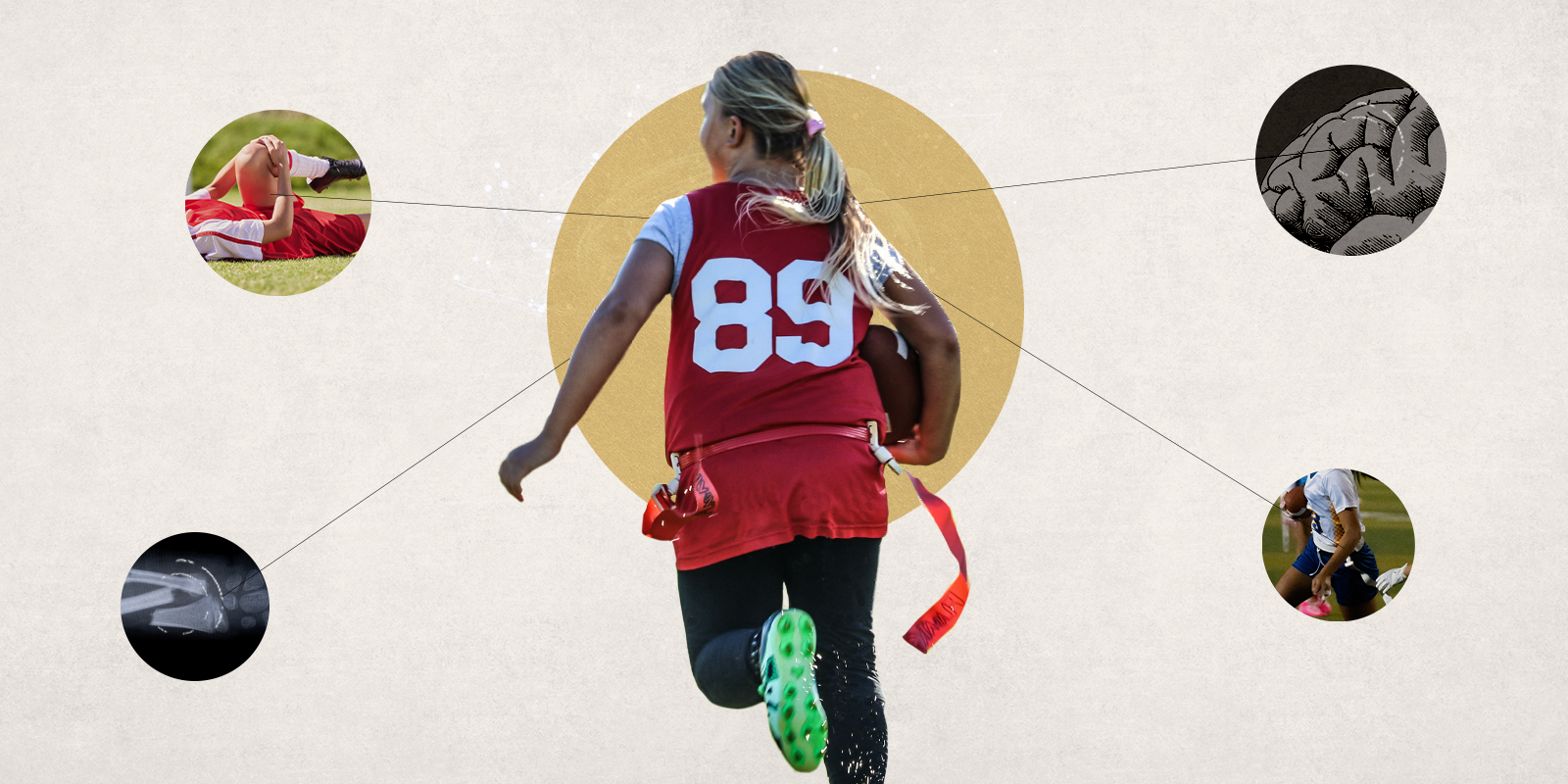
Image showing a female flag football player running with the ball.

Pigskin passers are invading athletic fields once dominated by soccer and lacrosse teams. But these blitzers aren’t suited up like gladiators.

Flag football is exploding in popularity and will make its Olympic debut at the 2028 Games in Los Angeles. The National Football League is launching two pro leagues – one for women and one for men. The sport’s perceived safety, compared to rough-and-tumble tackle football, is a big part of the appeal.

But it’s still a game of relatively hard knocks, as researchers found in a study of injuries sustained by female players from 2014 to 2023. The researchers, including Rachel Frank, MD, an orthopedist at the CU Anschutz School of Medicine, analyzed flag football-specific injuries captured in the National Electronic Injury Surveillance System (NEISS), a database of emergency department injuries.

Key points:

  • Flag football is exploding in popularity, especially among female players.
  • A national study examined injuries sustained by female players, ages 6 to 47, over a 10-year span (2014 to 2023).
  • Muscle strains and sprains were the most common injuries. While concussion frequency paled in comparison to tackle football, the researchers, including an orthopedist at CU Anschutz, recommended helmets and other protective equipment for players. 

The research team extrapolated the injuries of 605 female players – ages 6 to 47 – to a national estimate of 22,666 injuries over the 10-year span. Muscle strains and sprains were the most common injuries among the female players, a 30% rate, with adolescent players sustaining the greatest number of injuries.

While concussion frequency paled in comparison to tackle football, the 8% rate prompted researchers to recommend helmets and other protective equipment for players.

“You can’t prevent all types of injuries, including concussions, but it’s a little curious that the concussion rate is as high as it is,” Frank said. “Other flag football studies have shown a higher rate than what we found, but our rate was not insignificant.”

The research team:


The “Current State of American Flag Football Injuries Among Female Athletes” was published in the Orthopaedic Journal of Sports Medicine in August. Joining Rachel Frank, MD, of the CU Anschutz School of Medicine in the study were Uma Balachandran, Niklas Koehne, Auston Locke, Charu Jain, Katrina Nietsch and Robert Parisien of the Icahn School of Medicine at Mount Sinai; Mary Mulcahey of Loyola University Medical Center; and Lisa Cannada of the University of North Carolina Charlotte School of Medicine. 

Frank has close ties to women’s sports. She played collegiate soccer and is currently the head orthopaedic surgeon for the Colorado Rapids and a team physician for the U.S. Women’s National Soccer Team. She is excited to see flag football’s rapid growth; an estimated half million girls ages 6 to 17 played the sport in the United States last year, a 63% increase since 2019.

In the following Q&A, Frank breaks down the study and talks about flag football’s surging popularity and possible measures to make the game safer and more enjoyable for players.

The interview has been edited and condensed. 

Q&A Header

Flag football is growing rapidly, especially among female players. Can you talk about what’s driving the sport’s growth?

Flag football for girls and boys – athletes in general – is thought to be the fastest-growing sport in the U.S. There are a lot of reasons, but No. 1 is safety and No. 2 is access. It’s a lot safer than tackle football, which is attractive to parents and gets kids involved at a young age. It doesn’t require as much equipment, so it’s more accessible from a socioeconomic perspective. And because females didn’t really have an easy avenue to play (tackle) football in the past, their participation has grown exponentially and that trend is expected to continue.

A previous study on flag football injuries, one looking at male players, listed lacerations followed by concussions as the most common injuries. Your group’s findings showed strains and sprains as most common. Was this surprising, and could you expound on this finding?

Yes, it is interesting. Like in any area of research, the data in drives the data out. With this particular database, the NEISS, what you see in the emergency room might be different than what gets reported in other medical databases. So, that’s one variable.

Ours is an updated study looking at trends from 2014 to 2023. The older data sets with concussions and lacerations were presumably more reflective of how the sport was played. Now, as the sport is becoming more popular, technique is becoming more important and better understood. Players probably aren’t running into each other as much, and so perhaps there’s less overall contact, and instead we’re seeing more of the cutting and pivoting injuries, leading to the strains and sprains. I think probably the way the game is being coached, practiced and played is contributing to the trend of injury patterns. It makes sense that we’d see less concussions in a sport that’s supposed to be non-contact, but it’s still going to be possible to have concussions. 

How do body composition and biomechanics make females more susceptible to strains and sprains?

When it comes to anterior cruciate ligament (ACL) injuries, we know that female athletes are up to seven times more likely to sustain a tear compared to male athletes at the same age, playing the same sport. The only difference is biologic sex. There are many factors involved, one of which is dynamic muscular control. Specifically, how female athletes jump and land, especially single-leg, tends to be a little different than how males land after jumping.

Anatomically, females have wider hips and narrower knees, which creates a wider quadriceps angle, or Q angle, and that can lead to increased strain across the knee. Hormonal factors are also extremely relevant. And so, there are a lot of factors at play for female athletes to have a higher risk of ACL tears.

But what we haven’t seen in all of the data is an increased risk in overall sprains and strains as well as muscular, tendon and ligament injuries, specifically in females. And in this particular study, it’s unclear. It would be really great if we had equivalent data for a male cohort to see what the injury patterns would be, because I don’t know that there’s any more strains, sprains, fractures in the female cohort compared to males who are playing flag football in the same age group. More research is needed. 

Fractures were found to be the second most common injury among female flag football players. Are there ways to improve bone health to reduce these injuries?

As sports medicine specialists and orthopedic surgeons, we’re focused on bone health. Fractures are going to happen in every sport. We want athletes to optimize their metabolic states with respect to nutritional considerations: Are they getting sufficient protein, vitamin D, magnesium, potassium, calcium, etc.? Should an athlete experience a tackle or fall or have a twisting injury, ideally, they don’t sustain a fracture because their bones are healthy. And then if they do get a fracture, ideally, they have good potential for healing and healing in an appropriate setting. 

Are there certain training regimens that can help flag football players reduce injuries?

In flag football, players are running, sprinting, jumping, stopping, cutting, pivoting. It’s similar to soccer, traditional tackle football, basketball, etc. We need an overall approach to training and fitness that incorporates cardiovascular fitness, strength, stretching, etc. For female flag football players in particular, we encourage a dynamic warmup – runs and sprints and then incorporating stretching.

You want your body to get into that fatigued level quickly, so that your muscles are activated in the right way to get you ready for the game or the training session. It’s more dynamic now. 

What’s next for the research into reducing injuries in flag football?

Honest data – through athletic trainers at the youth, high school, collegiate and professional levels – in real time is critical. And then being willing to make potentially tough decisions about how to change the sport if we need to protect the safety and health of the athletes. I think we’re going to continue to see this explosion of participation, which is a good thing. I love the fact that young women now have a welcoming environment to get involved. 

Topics: Research,

Featured Experts
Staff Mention

Rachel Frank, MD