The stories were always there, waiting to be put down on paper.
During her 16-year nursing career—from the bright chaos of Las Vegas NICUs to the careful vigilance of infection prevention—Amanda Skenandore found herself scribbling fragments of story ideas and narrative whenever she could steal a moment. What started as stress relief during 12-hour shifts transformed into a second career as a historical fiction author, one that allowed her to step away from nursing entirely this past March.
"Whenever I had a quiet moment at work, which wasn't very often, I would write a story as an outlet to express my thoughts, and I think it helped me de-stress and relax," says Skenandore, whose latest novel explores medicine through the lens of the devastating 1900 Galveston Hurricane.
But the transition from bedside to bookshelf wasn't swift. It took seven years of balancing syringes and storylines before Skenandore saw her first novel in print—a testament to the persistence that nursing demands and writing rewards in equal measure.
The Road from Pine (Colorado) to Publication
Skenandore's journey began in the Colorado mountains, where she grew up in Pine with an imagination that refused to stay quiet.
"I was always daydreaming or enacting these elaborate scenarios with my toys," she recalls. "Creative writing was my favorite subject in school."
After earning a linguistics degree, however, practical considerations led her toward nursing school at the University of Colorado.
"Nursing is an intellectually demanding job," she explains. "It's not the kind of job where you can do it on autopilot; you have to be thoughtful about what you're doing. I wanted to make a difference in people's lives, and I liked that no shift is the same."
That first nursing position in Las Vegas proved challenging in ways textbooks never prepare you for.
"It was really difficult being a nurse…and sometimes it's true what they say—nurses eat their own young," Skenandore admits, referencing the harsh reality many new graduates face.
The demanding nature of healthcare, rather than extinguishing her creative spark, seemed to fuel it. A creative writing class taken "for fun" reignited the passion that had been simmering beneath stethoscopes and patient charts.
Where Medicine Meets Narrative
Skenandore's novels inhabit the intersection of her two worlds, crafting historical fiction that centers on medical themes. Her latest work, The Medicine Woman of Galveston, follows a female physician who joins a traveling medicine show to support her disabled son during one of America's deadliest natural disasters (the Galveston Hurricane of 1900 is estimated to have caused approximately 8,000 deaths).
"I think any good historical fiction, no matter the era or topic, has some relevance in our lives today," she says. "I think it makes us more appreciative of the healthcare we have today, but we can also learn from the past and see what areas of healthcare we may be struggling in and hopefully find a better path forward."
 |
In The Nurse's Secret, set in 1800s New York at the country's first nursing school, Skenandore explores the rigid expectations placed on women entering the profession. Her protagonist, Una, is a pickpocket fleeing a murder charge who lies her way into the prestigious program.
"The acceptance criteria were so strict. You had to be a certain age, and you couldn't be married or divorced. You had to embody this prim and proper Victorian idea, so I thought, what if Una is a pickpocket and she lies her way into school because she's running from police for a murder she didn't commit? I wanted to tell a story about this nursing school but make it more fun and accessible to people who aren't nurse historians."
Despite her extensive medical background, Skenandore remains "very meticulous" with her research, often sending manuscripts to physician relatives for accuracy checks.
"Even though I have a lot of nursing knowledge and expertise, there are some areas I'm not as knowledgeable in, so I want to make sure I'm not writing about things that are incorrect," she says.
The Creative Prescription
Research increasingly supports what Skenandore discovered instinctively: creative expression serves as a vital outlet for healthcare workers processing the emotional demands of their profession.
"As nurses, we see a lot and it's a stressful profession, but we have a lot to share beyond the bedside," she says. "We can share our creativity through writing, painting, drawing, sculpting, or other artistic outlets."
The synergy between her two careers runs deeper than stress relief. "Being a nurse has made me a better writer and being a writer has helped me become a better nurse," Skenandore reflects. "Both things can enrich your life and make you better at what you do."
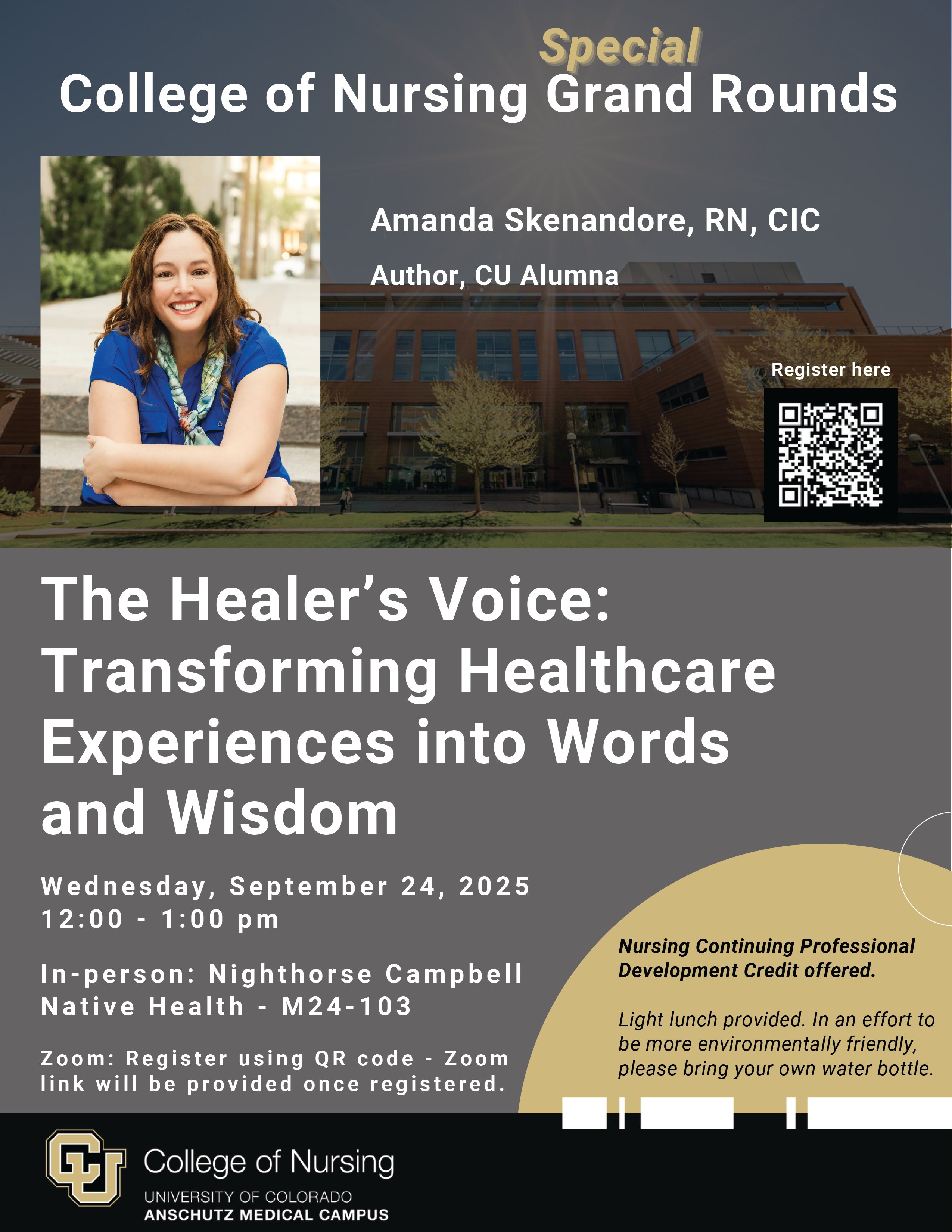
She'll share insights from her unique dual perspective during a special Grand Rounds presentation at CU Nursing on Wednesday, September 24, discussing both her career journey and the research supporting creative expression for healthcare professionals.
"I'm so excited to come back to CU Nursing," says Skenandore, who earned her nursing degree from the university in 2007. "It's a real honor and I'm excited to share my experiences and what I've learned with fellow nurses, especially since I've taken a non-traditional route in my nursing career."
For more information about Amanda Skenandore's work, visit amandaskenandore.com.