.png)
A newer version of a laser eye procedure used to treat glaucoma appears to perform as well as, or even better than, the standard procedures, according to recently published research that four faculty members at the University of Colorado Anschutz Department of Ophthalmology contributed to. The lead author, Saif Aldeen Alryalat, MD, is a 2025 graduate of CU Anschutz’s glaucoma fellowship program, who now works as an assistant professor at the University of Illinois College of Medicine Chicago.
Glaucoma is a progressive, age-related eye disease that primarily affects older adults and is one of the leading causes of irreversible blindness. It is characterized by damage to the optic nerve, which transmits vision from the eye to the brain. The main risk factor for glaucoma is elevated eye pressure, which is different from blood pressure, because elevated eye pressure can cause damage to the optic nerve.
There is currently no cure for this chronic disease, but one treatment method is conducting laser surgery to reduce eye pressure. Two laser procedures — endoscopic cyclophotocoagulation (ECP) and transscleral cyclophotocoagulation (TCP) — have been used for decades to accomplish this, but a novel ECP device was recently created to make the procedure faster and more efficient.
“Before we start offering this to patients, as with any new device, we wanted to test it in a pre-clinical setting to see how this newer laser treatment compares to our existing technology,” says Leo Seibold, MD, a professor of ophthalmology and chief of the glaucoma service at the Sue Anschutz-Rodgers Eye Center.
TCP vs ECP
Alryalat, Seibold, and their co-investigators compared the three laser treatments — the standard ECP, the novel ECP, and TCP — by assessing how they affected the tissues of human cadaveric eyes (eyes that are from a deceased human donor).
Each of these three laser procedures aim to target a part of the eye called the ciliary processes, which Seibold describes as lumpy tissue behind the iris (or the colored part) of the eye.
“That tissue is responsible for producing the fluid that helps determine what the eye pressure is,” he says. “By lasering the ciliary processes, we can decrease the amount of fluid the eye is producing and thereby lower the eye pressure.”
With TCP, which dates to the 1960s, a probe is applied from outside the eye. Energy from the laser is transmitted through the sclera, the white part of the eye, and gets absorbed in the ciliary processes. A downside of the procedure is that it is not as precise as the ECP procedure.
“We can’t directly see what we’re treating, so we have to approximate the right position, but anatomy can vary. One of the shortcomings with it is that you can end up treating parts of the eye that you didn’t intend to,” Seibold says. “There could be some collateral damage, and that can lead to things like inflammation, swelling in the back of the eye, and blurred vision.”
The standard ECP device, on the other hand, involves an endoscopic probe that goes into the eye. This probe has a camera that allows surgeons to directly see the tissues of the eye, allowing them to be more precise in targeting the ciliary processes. However, because this procedure involves creating an incision in the eye for the probe, there are risks of infection.
“ECP has been around since the 1990s, and it really hasn’t changed much in instrumentation or methods since it was invented. But recently, a newer version of it was developed and is coming onto the market,” Seibold says of the novel ECP device. “It has a lot of thoughtful innovations that make the procedure go a lot smoother and more efficiently.”
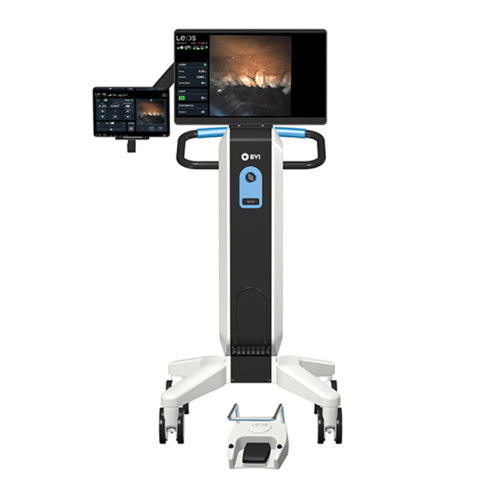 Image of the new Leos™ Laser Endoscopy Ophthalmic System, created by the company BVI Medical, that was designed to enhance the ECP procedure. Image courtesy of BVI Medical.
Using lasers on cadaver eyes
Testing the novel ECP device on donated cadaver eyes offers the best possible representation of how the laser will perform and how the eye tissue will respond to laser treatment in living patients, Seibold explains.
“It’s not a perfect representation but is a very close approximation,” he says. “This is a necessary first step before implementing this procedure among patients.”
To compare these devices, Seibold and his co-investigators used three donated cadaver eyes. Two of the eyes were split into thirds, and the third eye was split in half to test the three laser procedures. After the laser treatment, the eyes were further dissected to analyze how the lasers affected the tissues of the eyes.
“After preparing the tissue, we examined it using light microscopy, which enables us to see the ciliary processes, the underlying smooth muscle tissue, and the surrounding structures in the eye,” he says. “We can compare the effects that the lasers had on all of those tissues.”
Ultimately, the investigators found that both versions of ECP, the standard and novel devices, successfully targeted just the ciliary processes, whereas TCP had more collateral damage to the tissues beneath the ciliary processes.
“Now, we know the tissue effects of the new ECP are similar to the standard ECP, which is beneficial because the standard ECP is not as easy to use,” he says. “This research confirms that we have new technology that offers a lot of useful improvements in terms of how we use it in the operating room.”
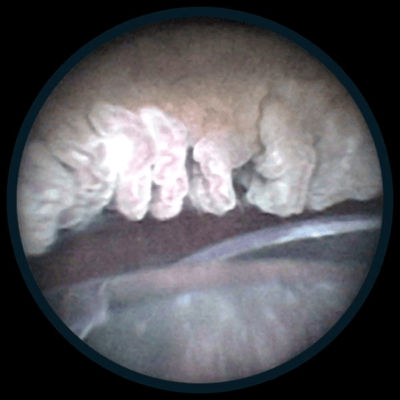 An endoscopic view of the ciliary processes during treatment with the novel ECP. Treatment results in whitening and shrinkage of the tissue, as seen on the left side of the image. Image courtesy of Seibold.
‘Innovation is happening’
Given the positive results, Seibold says his main takeaway is that glaucoma specialists like him can proceed with starting to use this novel device in patients.
“This device should help us more accurately visualize the eye tissue we are treating while operating and offer a more streamlined, efficient procedure. It’s easier on the surgeon, easier on the operating staff, and it requires less manipulation to ensure we’re getting a good view during the operation,” he says.
The next steps for research will be following patient outcomes to verify that the new procedure is successful.
“Innovation is happening in glaucoma surgery, and we're constantly trying to find ways to deliver treatments that are effective, safe, and efficient,” Seibold says. “This is one step forward in advancing the field of glaucoma surgery to deliver those improved treatment options for our patients.”