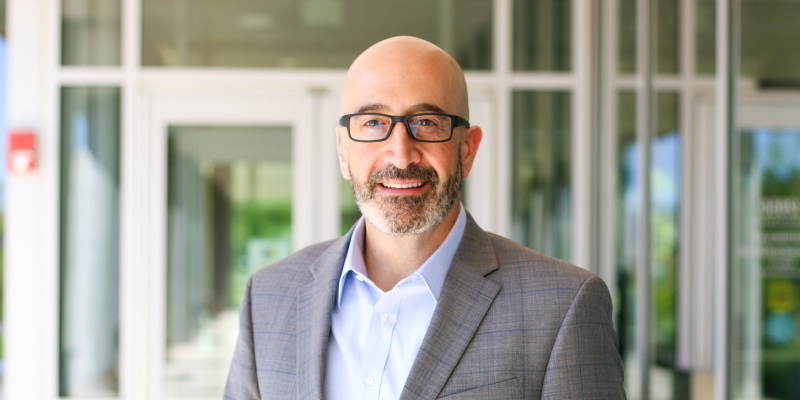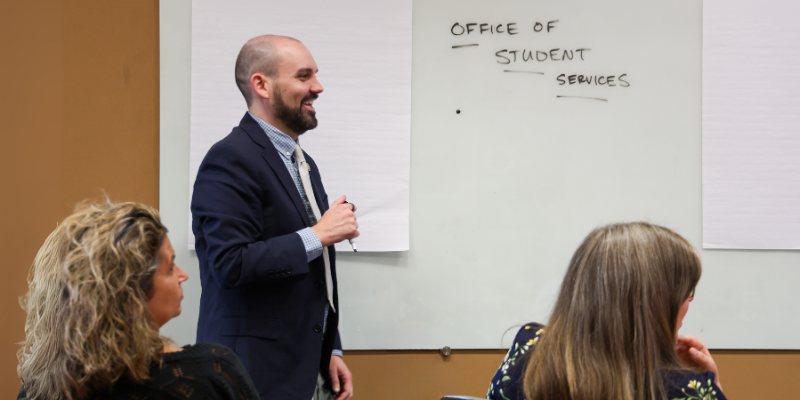
New Assistant Dean for Student Affairs and Associate Professor at CU Skaggs School of Pharmacy and Pharmaceutical Sciences Michael Wolcott, PharmD, PhD, arrived in Colorado three weeks ago, and he cannot get over the view.
“I've lived in North Carolina for fifteen years and so we have the Blue Ridge Mountains and then you come here and you're like ‘these are real mountains!’” he said. Dr. Wolcott’s time in North Carolina was extensive. He earned both PharmD and his PhD from the University of North Carolina (UNC) at Chapel Hill as well as served in various capacities as a member of faculty. Many of CU Pharmacy’s faculty, researchers, and leadership have PhDs. Wolcott is unique in that his area of PhD study is not related to pharmaceutical sciences, but the science of learning.
“What’s funny,” he said, “is that I feel like a lot of things in my life have happened by accident.”
Let’s call it fate.


Learner-Centered Approach
“I think it's an exciting time to be here and to see the change and impact that's going to happen because I know it's inevitable,” he said. “And I think that's refreshing in a higher ed space. There's an interest, there's an investment, there are resources that are being put forward into the spaces that matter. One of the things that I value a lot about the CU Pharmacy student affairs space is that the amount of personnel and the amount of dedication and the passion that these people have for it is just astronomical. And I've never seen it anywhere else.”
“I want a person to be able to emerge from a program feeling like they learned skills that are applicable, that prepared them for the real world, that they're practice-ready, that they feel a sense of belonging, that they feel part of a community, and that's something that they want to give back to,” he said.
“That's one of the things that I think is beautiful about students. The work that we do with learners crosses all of those domains of experiential education, career development, leadership and personal development, emotional support and well-being. It’s such a foundation for any person's success. And so that's where I want to make the difference is being able to elevate and advocate for that perspective and that voice. So that way we are thinking about their experience. And in my opinion, by being more mindful for that.”
The Path to a PhD
Wolcott decided to get a PharmD because he liked science and chemistry—he was enrolled in chemical engineering before the switch to pharmacy—but knew he wanted to be integrated in teams that cared for others. A friend he met in a randomly assigned organic chemistry lab was the person who gave him the insight to follow an untapped passion and he switched his coursework two weeks before the start of the fall semester.
After PharmD graduation, he completed a general post-graduate year one residency at Duke University Hospital. When it came to his year two, he did not get the placement he wanted.
“I think a lot of times we talk about failure and, these things that we don't discuss, such as opportunities where we're not selected for things. And I think about these moments where they can be pivotal in our lives,” he said. “And while they may not feel great in the moment, we can often look back at it and see that there was a lot of utility and value in it. And it's okay to feel both.”
Instead, Wolcott was encouraged to apply to a PhD program in learning sciences and psychological studies as part of a collaboration between UNC’s Schools of Education and Pharmacy. He explained that that specific dean wanted pharmacists who were also trained in conducting educational as well as social and behavioral research, something entirely new to Wolcott.
.png?width=1200&length=1200&name=Michael%20Wolcott%20slider%20(4).png)

“UNC has a very intense focus on K-12 education,” he said, “because of the population that they serve it is very much about how to improve access and how we think about different populations in different spaces.”
“Having my training be in a space that was K-12 oriented opened me to a lot more from a policy perspective and from a creativity perspective, thinking about things differently from access and the implications of that. And I don't think I would have gotten that if I had gone to any other program. I carry a lot of that with me, and I am incredibly appreciative of it.”
Interprofessional Work
Wolcott’s advisor for his PhD dissertation worked in assessment with nursing and medical education, and he encouraged Wolcott to look for jobs outside of pharmacy.
“Which was not kind of the plan,” Wolcott laughed. “The plan was to go back into pharmacy education. When I was looking for jobs, I had another happy accident. I had a colleague in the School of Pharmacy who was asked to teach a pharmacology course in the dental hygiene program, and they did not have the bandwidth. Could I do it? I had TA’d before but that was my first teaching experience. Dental hygiene and dental assisting students. I loved it.”
Wolcott’s co-instructor of that course was also working on curriculum reform within the School of Dentistry, something all schools across UNC’s health campus eventually addressed. The co-instructor encouraged him to apply as a team member to support their curriculum work, a position he got.
“Then one of the former pharmacy deans went, ‘Wait, you’re a pharmacist. We need you here,’” Wolcott said. “So, I split my time between both schools. I was helping faculty with the curriculum change and creating content that they really wanted. It was just a novel opportunity.”
A Unique Offer
In time Wolcott was offered a position as Academic Dean at High Point University, who was developing its own, new, dental program.
“I couldn't pass up the opportunity to be a part of something new,” he said. “It was such a rush to be able to do everything, to build a program from scratch, to go through initial accreditation, to just say, we can do whatever we want.”
What Wolcott wanted was to design a program that was centered on the learning experience.
“And then being very intentional about how we created everything from our admissions model to our orientation to day-to-day activities in class,” he said. “We took all these pain points from surveys and from research that we did with other programs, and I said, ‘Let's build it intentionally.”
Wolcott knew he had learners with families, with kids. So, his team asked, what does it look like to design an educational experience that respects their full workload? It was a shift in thinking that went far beyond adjusting class times. They debated the core of what education should require, and what it shouldn’t. Attendance, for instance, became a conversation not about control, but about consequences.


“Let’s treat learners the way we expect them to function when they graduate,” he said. “As professionals... We had to rethink how we were delivering content. It had to be engaging, meaningful, and directly tied to patient care.”
Wolcott’s team rewired the curriculum to be intentionally focused on real-world application, cases that reflected actual patient scenarios, teamwork simulations, and interprofessional learning. Every piece of content was designed to matter beyond the classroom walls.
“We weren't just teaching subjects,” he said. “We were building clinicians, collaborators, and problem-solvers.”
In the end, his team didn’t just build a new program. They built trust. Trust in learners to own their education, and in faculty to create something worth showing up for. Something they kept in mind through the process is that creating a curriculum also means creating and developing learner support services. As Wolcott put it, all of the systems need to talk to each other.
Honoring the Learner Experience
His experience led him to seek a new position supporting learners through their journeys, and he landed at CU Pharmacy. Wolcott brings a visionary lens to learner support, one shaped by years of educational design, real-world empathy, and personal reflection. He’s not just helping learners meet academic benchmarks; he’s helping them shape lives of purpose. “By being more mindful of their experience,” he said, “we create not only better learners, but better humans.”