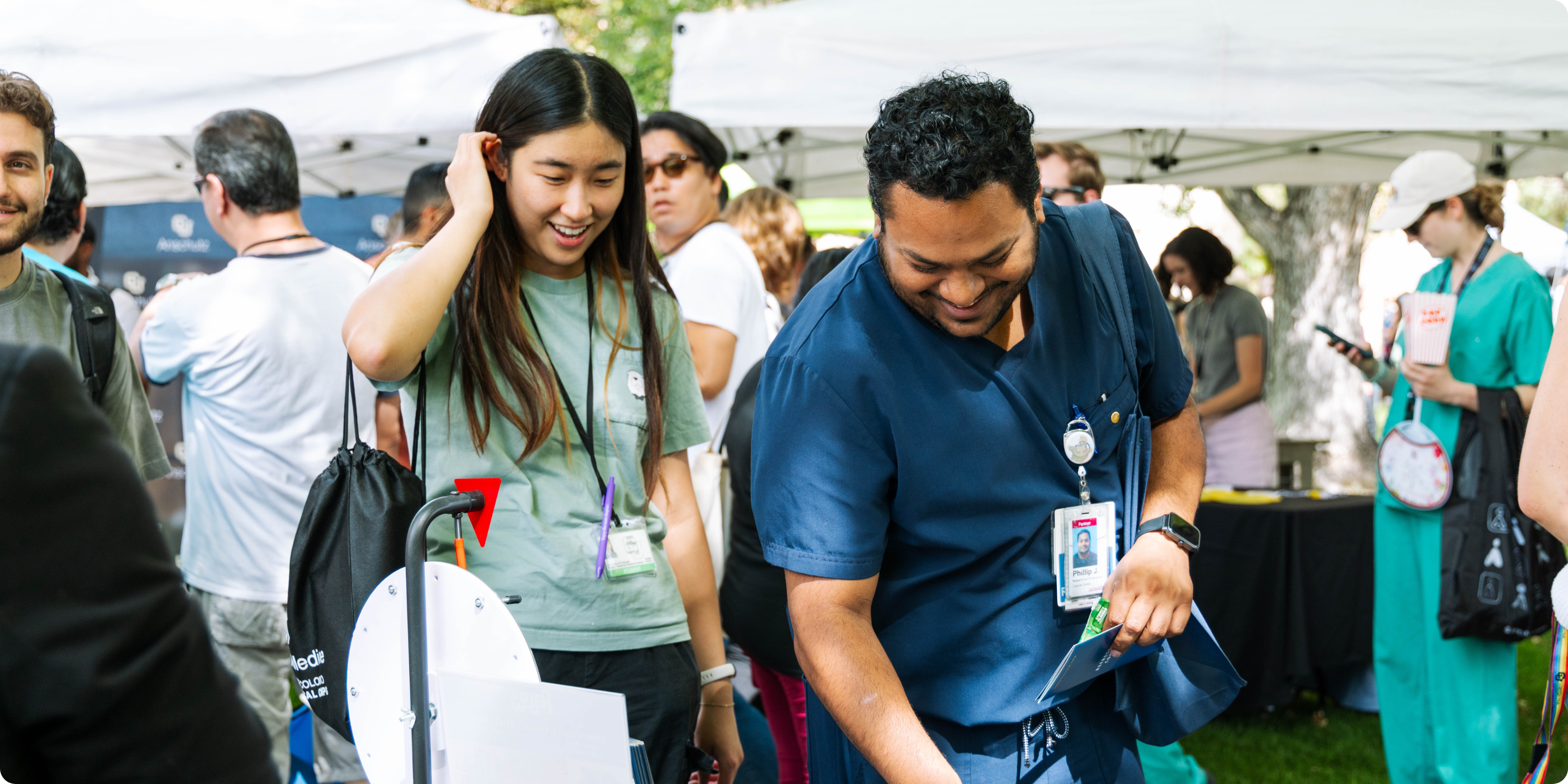

On Sunday, Oct. 4, during the Denver Broncos game, CU Anschutz will debut Dreamers Never Quit, the newest chapter of the Where Dreams Live advertising campaign. The campaign will run throughout the fall and into 2027 on streaming and broadcast television, social media and in a host of publications.
Built around the idea that meaningful progress requires persistence, Dreamers Never Quit exemplifies the tenacity and grit of the CU Anschutz community – the faculty, staff, students and the patients we serve whose persistence pushes us forward.
We push ourselves to see how far we can go. How high we can climb. What we can overcome. At CU Anschutz, we push further because what lies beyond the limits of today could change someone’s tomorrow.
The new ad brings that idea to life through a story of perseverance and possibility, drawing parallels between people who push their physical limits and the researchers and clinicians who refuse to stop searching for new answers to medicine’s toughest challenges.
“Dreamers Never Quit focuses on what it takes to turn ambitious dreams into meaningful progress,” said Chancellor Don Elliman. “Together, the stories reflect a quality found across CU Anschutz – the willingness to pursue difficult questions, challenge existing boundaries and keep working when answers don’t come easily.”
Pushing beyond today’s limits
At the center of Dreamers Never Quit is Daniel Kramer, MD, an associate professor of neurosurgery at the CU Anschutz School of Medicine, and his team as they use an approach among the first of its kind – a brain-computer interface implanted in higher-level areas of the brain – to help a patient regain movement.
This technology is an area of rapid discovery in neuroscience, where researchers are gaining an increasingly detailed understanding of the brain and exploring how the brain turns thought into action.
“The human brain is probably the single most complicated thing nature has ever produced,” said Kramer. “We have some patients that we are collaborating with on this research who are paralyzed and can’t feel anything from the neck down. Our larger goal is to give them feeling again.”
The work reflects the idea at the heart of Dreamers Never Quit: Today’s limits do not have to define tomorrow’s possibilities.
Persistence in cancer research
The determination featured in Dreamers Never Quit extends far beyond neuroscience. Across CU Anschutz, researchers and clinicians are taking on diseases and conditions that have long been difficult to understand and treat.
In cancer research, multidisciplinary teams are harnessing the immune system to pursue new treatments for rare, aggressive and hard-to-treat cancers. Experimental CAR T-cell therapies developed in CU Anschutz laboratories and manufactured on campus at the Gates Biomanufacturing Facility are opening new avenues of research, including a clinical trial that’s testing genetically engineered immune cells in adults with advanced colorectal cancer who have exhausted standard treatment options.
“Colorectal cancer is now the number one cause of cancer deaths in people under age 50,” said Christopher Lieu, MD, professor of medicine and medical oncology at the CU Anschutz School of Medicine. “This trial is so important because it uses engineered T-cells to recognize and fight colorectal cancer, giving these young people more options than the standard of care.”
Advancing OCD treatment
The same drive is helping CU Anschutz teams pursue new possibilities for people with severe, treatment-resistant obsessive-compulsive disorder (OCD).
CU Anschutz is among a select group of academic medical campuses in the United States performing deep brain stimulation (DBS) for patients with severe OCD who have not responded to standard therapies. The approach uses electrodes placed in specific areas of the brain to disrupt disordered networks, potentially providing long-lasting symptom relief.
“These are patients who have tried everything and not responded,” said Rachel Davis, MD, director of adult psychiatry and the OCD Program at CU Anschutz. “That’s what drives me to keep pushing the boundaries of what we can offer and to try things outside the box. Deep brain stimulation has a 70% response rate, which is remarkable in these patients who have suffered their entire lives. My dream is to make these therapies more accessible to patients.”
Chasing what’s possible
For paracyclist Jason Macom, pushing limits is a way of life. After a severe bicycle injury led to the amputation of his lower leg, Macom fought his way back to elite competition, winning a national sprint title and two world championship silver medals. Years later, debilitating pain forced him off his bike again and left him relying on a wheelchair and forearm crutches.
His search for a way forward brought him to the Limb Restoration Program in the Department of Orthopedics at CU Anschutz. Working with a multidisciplinary team, Macom regained his mobility and independence – and eventually returned to the sport he loves.
Macom’s determination embodies the spirit of Dreamers Never Quit: patients, clinicians and researchers pushing forward together, even when the path ahead is uncertain.
Dreamers never quit
Dreamers Never Quit builds on Where Dreams Live, which launched in February 2025, and Never Dream Alone in September 2025.
From restoring movement and sensation to finding new ways to harness the immune system to treat cancer and expanding options for people who have exhausted existing treatments, CU Anschutz teams are working toward possibilities that once seemed out of reach.
Dreamers Never Quit celebrates the people behind that progress and the patients who inspire it.
It’s a reflection of the relentless spirit of CU Anschutz: pushing beyond the boundaries of medicine to pursue new discoveries, transform lives and make untreatable a thing of the past.
Because when the stakes are this high, dreamers never quit.
Check out photos from the production!


-3.png "Behind the scenes at the Fulginiti Pavilion")