“I finally feel peace of mind,” says a Colorado woman diagnosed with cervical cancer who was able to get treatment, thanks to an expanding University of Colorado Cancer Center initiative called Connect to Care that helps navigate under-insured, low-income women to affordable cancer care.
The woman, who needed surgery, says she struggled to find affordable care and faced a language barrier. That’s when she met Samantha Garcia, a bilingual patient navigator with the CU Cancer Center’s Office of Community Outreach & Engagement (COE).
“Having a bilingual navigator made all the difference,” says the woman, who asked that her identity not be shared. “Samantha never gave up – she helped me start over, apply for financial assistance, and worked with multiple hospitals to make sure I got the treatment I needed.” The woman is now free of cancer.
Connect to Care is a partnership between COE and Women’s Wellness Connection (WWC), a program of the Colorado Department of Public Health & Environment. WWC offers free cervical cancer screening to eligible women at a statewide network of clinics, backed by funding from the U.S. Centers for Disease Control and Prevention.
At a growing number of those clinics, Connect to Care helps eligible women who’ve been diagnosed with cancer and do not qualify for treatment through Medicaid to find affordable treatment. The initiative also helps navigate women to breast cancer care.
Statewide coverage
The partnership’s goals are to detect cancer early and help women obtain treatment they might not be able to access otherwise, says Jan Lowery, PhD, MPH, assistant director for dissemination and implementation in the CU Cancer Center COE office.
Lowery says the WWC screening program operates in 34 clinical systems representing 100 clinics statewide, “so WWC has good coverage across the state.”
And now, Connect to Care offers patient-navigation services at about 20 WWC clinic systems serving 31 Colorado counties, up from a handful when it started in 2024, and more are on the way, Lowery says.
“We approach clinics across the state, with the help of the WWC leadership, and say, ‘We’re happy to partner to help you find treatment services for women who do not qualify for treatment through Medicaid.’ We have bilingual patient navigators who are well versed in how to find affordable care or to take advantage of hospital discounted care,” she says.
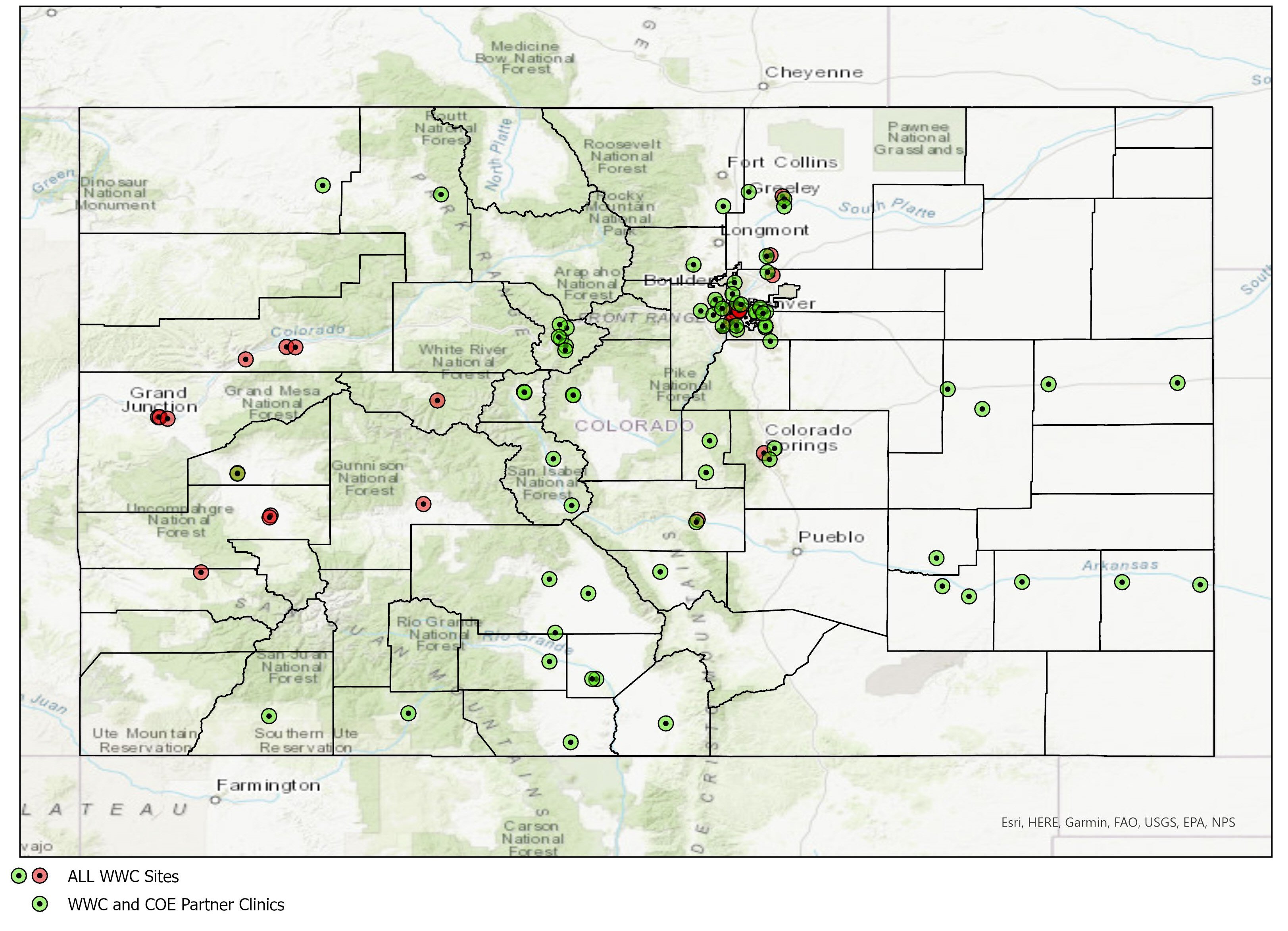
The map of Colorado above show location of clinics where eligible women can get free screenings for cervical and breast cancer through Women's Welfare Connection (red and green dots). The green dots are clinics operated by health care systems where the CU Cancer Center COE office partners with WWC to offer Connect to Care patient navigation to cancer care for eligible women. Click here for the names and locations of participating clinic systems.
Survival rates vary
Cervical cancer starts in the cells of the cervix, part of a woman’s reproductive system. Rates of the disease have decreased sharply in the U.S. since the mid-1970s, thanks largely to broader use of Pap smear tests to screen for precancerous conditions and through childhood vaccination against the human papillomavirus (HPV), the driver of most cervical cancers.
Still, many women don’t get screened or vaccinated, especially those with limited income and little or no insurance. And some women who need treatment may not get it.
There were about 13,360 new cervical cancer diagnoses among women in the United States in 2025, and 4,320 deaths, the American Cancer Society estimates. Death rates for Black women and Native American women are about 65% higher than for white women.
When cervical cancer is diagnosed and treated at an early stage, survival rates after five years are about 91%, but survival rates drop considerably if the cancer is diagnosed after it has spread to a distant part of the body.
→ Dramatic Drop in Cervical Cancer Rates is Attributable to Widespread Adoption of HPV Vaccine
Patient navigators step in
Through WWC, women are eligible for a free Pap or HPV test at a participating clinic if they are between 21 and 65 years old, have limited or no health insurance, and have an income no more than 2⅟₂ times the federal poverty level. For breast cancer screenings, WWC provides mammograms for eligible people over age 40.
For those women who are diagnosed with cervical or breast cancer through a WWC screening and who are eligible for Medicaid, the state’s Breast and Cervical Cancer Program (BCCP) covers treatment by providers affiliated with Health First Colorado, the state’s Medicaid program.
However, while WWC is able to provide screening for people whether they are eligible for Medicaid or not, those ineligible for Medicaid might not be able to access affordable care if they are diagnosed. That’s where Connect to Care can help.
Once contacted by a WWC clinic or a patient is referred to them, COE’s bilingual patient navigators – Samantha Garcia and Carlo Caballero, LPC, CCM – help guide people diagnosed with cancer to treatment by providers across Colorado, including at UCHealth University of Colorado Hospital, a CU Cancer Center clinical partner.
A lot of barriers
As of December 2025, says Caballero, Connect to Care has received 27 referrals from clinics of women diagnosed with cervical or breast cancer, of which 24 have been successfully navigated to treatment, and three are in progress toward treatment.
Women served by Connect to Care “are usually of Hispanic descent and have to deal with a lot of barriers to health care,” including a lack of income, immigration status, and language, Caballero says. “For those who get a cancer diagnosis, they often don’t have an avenue to connect to treatment. That’s where we saw a major gap in the system.”
One tool the navigators use to help women with cancer find affordable treatment is the state’s Hospital Discounted Care program, established by the Colorado legislature in 2021, Caballero says. It limits the amounts that qualifying low-income patients can be billed for health care services by hospitals and providers who work there. Hospitals also offer various levels of free or discounted charity care based on ability to pay and other factors.
In other cases, the navigators help steer women to financial assistance programs to help cover their treatment costs. “We want to make sure that they have an avenue to be able to afford treatment, not just to obtain treatment,” Caballero says.
Feeling more encouraged
He cites one case in which a women diagnosed with cancer was denied treatment by a local hospital system close to her home. With advice from CU Cancer Center leaders, Caballero says he was able to work with the hospital system to get the woman approved for treatment and financial assistance.
“In that case, not only are we supporting the patient, but we’re also supporting a hospital system to make sure they get the correct information that they need to help approve this patient,” he says. “That was one of our most challenging cases, but also one of the most successful.”
Lowery says that when she and her colleagues meet with medical staff at clinics, “what we’ve heard is that knowing this navigation program exists helps them feel more encouraged to offer screening to all of their patients. It’s difficult to promote cancer screening for women if they don’t think they can access treatment.”
Clinics that would like to learn more about the Connect to Care program can call COE at 720-441-2529 or e-mail coe@cuanschutz.edu.