
In 2021, when Jennifer Brown was diagnosed with stage IV small-cell lung cancer that had spread to her bones, liver, and brain, she thought her life would soon be over, especially given the history of cancer in her family.
“I didn’t think there was anything the doctors could do,” says Brown, now 53. “My grandfather and my father both passed away from lung cancer, and my grandmother had cancer that metastasized to her bone and was gone within two weeks. Then my Aunt Marianne, I don't know exactly what cancer she got, but she passed away too.”
Prior to the diagnosis, Brown thought she had a cold, or possibly bronchitis. But after a month and half of coughing and other symptoms, her doctor sent her for x-rays that revealed the tumor.
“It was Christmas weekend, so he said, ‘It would be a good idea if you go to the emergency room today,’” Brown remembers. “So I did, and they did a biopsy right away. The ER doctor was great — I was ready to go home and get my affairs in order, but he said, ‘There are a lot of things we can do now that help you live a little bit longer, so just bear with us. Let's do a biopsy and see exactly what you have.’”
Life-changing diagnosis
Then living in Florida and in the early stages of exploring RV life, Brown put everything on hold and moved to Colorado to live with her brother in Commerce City while considering her treatment options. When her symptoms got so bad that she was having trouble breathing (she later learned that a tumor had encased itself around her superior vena cava and pulmonary artery), she went to the emergency room at UCHealth University of Colorado Hospital, where she found new hope in a University of Colorado Cancer Center team led by Tejas Patil, MD, assistant professor of medical oncology in the CU Anschutz School of Medicine.
Patil started Brown on the standard of care, a combination of immune therapy and chemotherapy, but after a few months, it was clear that the treatment wasn’t helping.
“Small-cell lung cancer is extremely aggressive and usually presents with widespread disease,” Patil says. “Patients can have initial responses to chemotherapy, but they're often short-lived. Most patients will relapse within a year, and the overall survival rates are very poor.”
Enrolling in a clinical trial
To Brown’s benefit, the CU Cancer Center is one of several sites nationwide to be part of a clinical trial of a new type of immunotherapy to treat small-cell lung cancer — a medication that targets DLL3, a protein that appears on the surface of small-cell lung cancer cells.
“About 90% to 95% of all small-cell lung cancers will have this protein on the cell surface,” Patil says. “The drug is an antibody to the DLL3 protein, and it pulls in a CD3 T cell to engage with the small-cell lung cancer and create a strong immune response.”
Within two months of starting on the trial, Brown was having “an exceptional response,” Patil says. “Her liver metastases had shrunk by almost 50%.”
‘It works, and it works well’
Brown started on the trial more than two years ago, and though she dealt with some inconveniences along the way — the first few infusions required a hospital stay, in case of an immune reaction, and she had side effects including nausea, diarrhea, and dry, itchy skin — she reports that “I'm back to my old self, for the most part.” She goes to an infusion center every Thursday to receive the medication, and she gets scans every three months to watch for signs the cancer is returning.
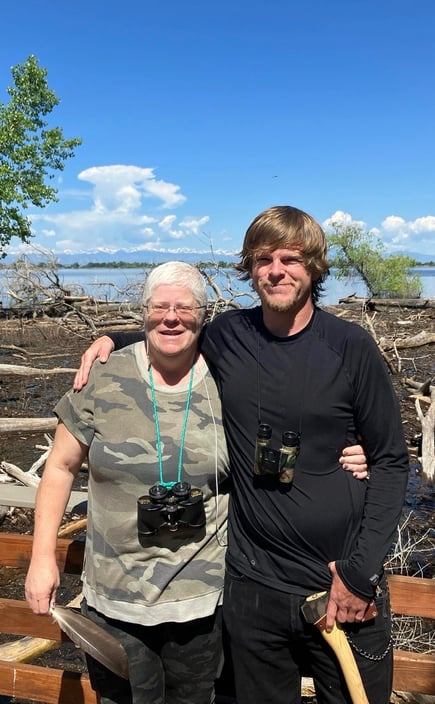 Brown with her son Tanner.
So far, the drug is keeping the disease under control, allowing Brown to enjoy hiking, one of her favorite activities, visit her boyfriend in Greeley, and make trips back to her home state of Montana, where her 34-year-old son still lives.
“I am looking for work currently, so I'm getting ready to go back to work full time,” she says. “I just live life, and I don't even think about the cancer. The drug works for me, and it works well.”
She thanks Patil, nurse practitioner Eliza Miller, xx Emma Filar, her brother and sister-in-law, her mother, her son, her two best friends, and, most of all, her boyfriend for supporting her throughout her cancer journey.
“I will be eternally grateful to all of them for the love and support they give to me,” she says.
‘Game changer’
Patil has seen similar results in patients treated on the clinical-trial drug, as well as an earlier-generation DLL3 T-cell engager that is already approved by the Food and Drug Administration.
“It's a game changer,” he says. “We are seeing remarkable responses. In my opinion, it's the biggest advance in small cell lung cancer in the last 20 years. This is the most important drug in this space.”
Brown says Patil is “the best doctor I have ever seen in my life” and is grateful that he was able to put her on the clinical trial that saved her life.
“At that stage, I felt like I trusted his opinion, and if he thought it was a good thing to try, I was going to go for it,” she says. “It was such a nightmare in the very beginning.”