Funded in part by a University of Colorado Cancer Center Innovation Award, recently published research by Meghan Kellett, MD, PhD, may point to a new therapeutic target for advanced thyroid cancer.
Kellett, now a resident at Children's Hospital of Philadelphia, conducted the research as an MD-PhD student in the Medical Scientist Training Program and Cancer Biology Graduate Program in the CU School of Medicine, working in the lab of CU Cancer Center member Rebecca Schweppe, PhD, director of the Cancer Biology Graduate Program.
“Meghan did her PhD studies in my lab, and for this paper that was just published, Meghan really drove her project forward and discovered a novel function of this kinase that has important implications for thyroid cancer treatment,” Schweppe says. Kellett has received many honors and awards for her thesis research, including an NCI-funded T32 fellowship and an individual NCI-funded NRSA F30 fellowship.
FAK locator
Kellett’s research looked at an enzyme called Focal Adhesion Kinase (FAK), which normally functions at the membrane of a cancer cell, signaling cancer cells to invade and metastasize. Previous studies had shown that FAK can go to the nucleus of a cell, where the regulation of gene expression occurs, but Kellett took those findings a step further, discovering FAK in the nucleolus of cells from thyroid cancer patients.
“Through her rigor, Meghan identified that FAK goes to the nucleolus, which is a subcompartment of the nucleus,” Schweppe explains. “Its main function is ribosomal RNA synthesis and ribosome biogenesis, which leads to protein synthesis that drives the ability of these cancer cells to grow, survive, and invade. There was one existing paper in breast cancer that had shown FAK localizes to the nucleolus, but that research didn't pin down its function. Meghan pinned down its function — that it regulates ribosome biogenesis — and she identified the specific ribosome that it regulates.”
New target
The finding points to a new therapeutic target for thyroid cancer, potentially using a drug that inhibits the phosphorylation, or activation, of FAK to dampen its ability to promote cells to metastasize.
“If we can inhibit the enzyme that regulates the modification,” Kellett says. “We could specifically target its activity as a therapeutic strategy, and we could also see where FAK is localized in the cell to have more clinical prognostic factors.”
Kellett says FAK could be used as a biomarker to analyze a patient’s tissue sample to see if the kinase is present in the nucleolus, basing treatment decisions on the likelihood of metastasis.
“It also gives us additional treatment options,” she says. “If patients fail first-line therapy, can we have more tools in our toolbox to be able to treat thyroid cancer, and other cancers as well, to give patients more options?”
Degrading proteins
Schweppe points to another medication option for targeting FAK — protein degraders that bind to proteins and use the body’s cellular machinery to destroy them. Now in clinical trials for other cancers, the drugs, she says, could be efficacious in treating multiple types of thyroid cancer.
“Many of the treatments for thyroid cancer are focused on oncogene mutations, such as BRAF mutations or RAS mutations, and this could be a more far-reaching treatment that isn’t dependent on any of these oncogenic mutations,” she says.
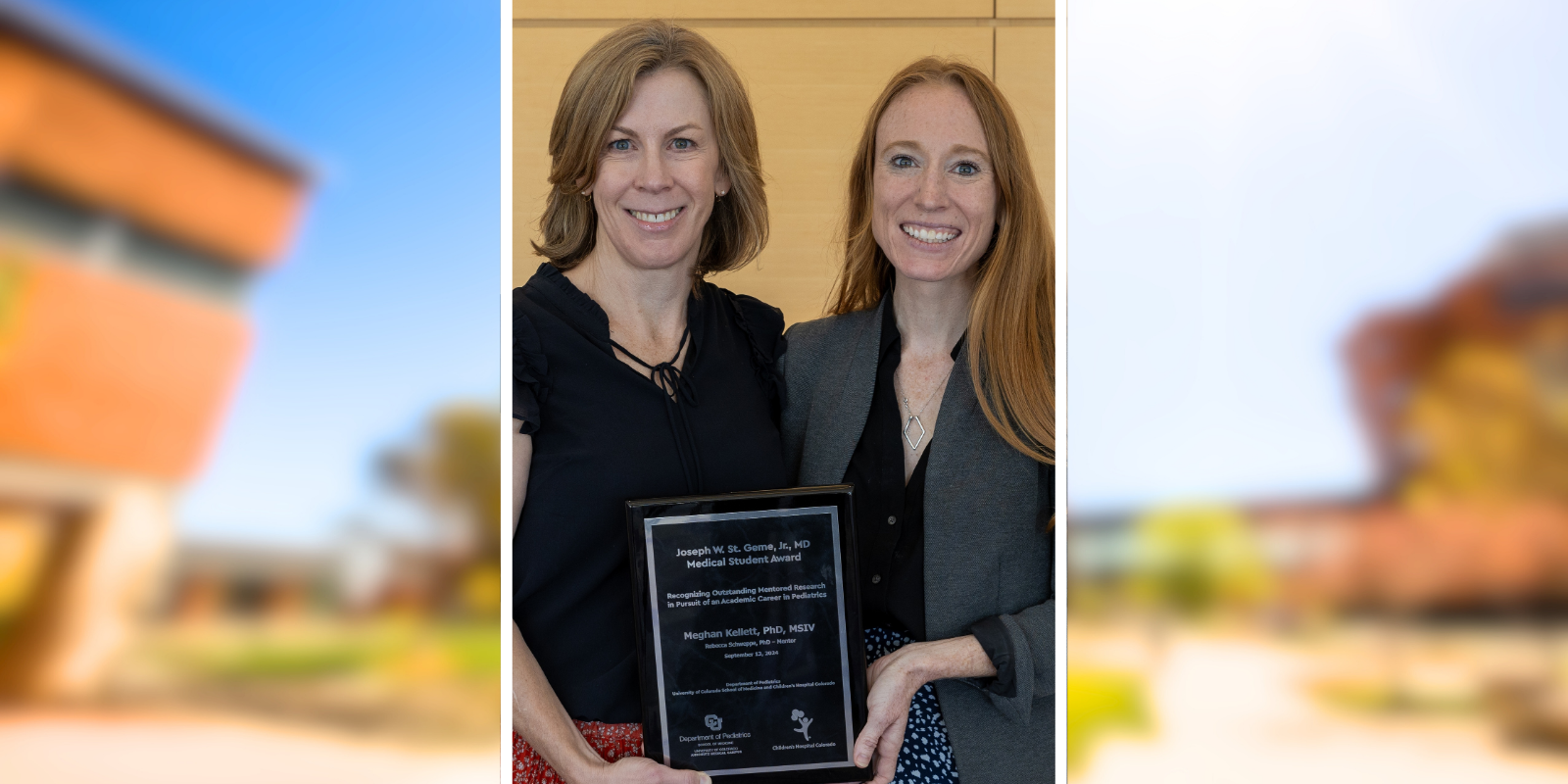
Featured image: Rebecca Schweppe, PhD, and then-medical student Meghan Kellett, MD, PhD, celebrate Kellett's Joseph W. St. Geme, MD, Medical Student Award for outstanding mentored research in pursuit of an academic career in pediatrics.