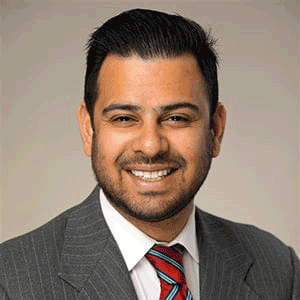
University of Colorado Cancer Center member Tejas Patil, MD, has been selected for the Paul Calabresi Clinical Scholars Award, part of a National Cancer Institute-funded career development program that aims to increase the number of cancer clinicians trained in research.
Patil, a thoracic oncologist, is an assistant professor in the CU Department of Medicine’s Division of Medical Oncology. He says the award funds will help him pursue answers to “a very important question in lung cancer” involving a subset of cancer cells that survive therapy and contribute to cancer relapse.
The award provides salary support to Patil for at least two years, plus additional research funding. It calls for Patil to commit 75% of his time to his research. Patil was selected for the award by a committee led by CU Cancer Center member Virginia Borges, MD, deputy head of medical oncology.
Patil, who completed his fellowship five years ago, says the award represents an important opportunity at this point in his career.
“The Calabresi award is designed to fund the researcher more than the project itself,” Patil says.
“One of the challenges in an academic physician’s life is balancing multiple competing responsibilities between clinic education, administrative time, and research time. This award allows me to protect my research time and take some of the ideas and concepts I have to a more advanced level, so I can be on track for a higher grant, like an R01.”
He adds: “The true value is that it gives me the time to think.”
→ ‘Worldwide Collaboration’ Helps Answer Questions About Lung Cancer Therapy
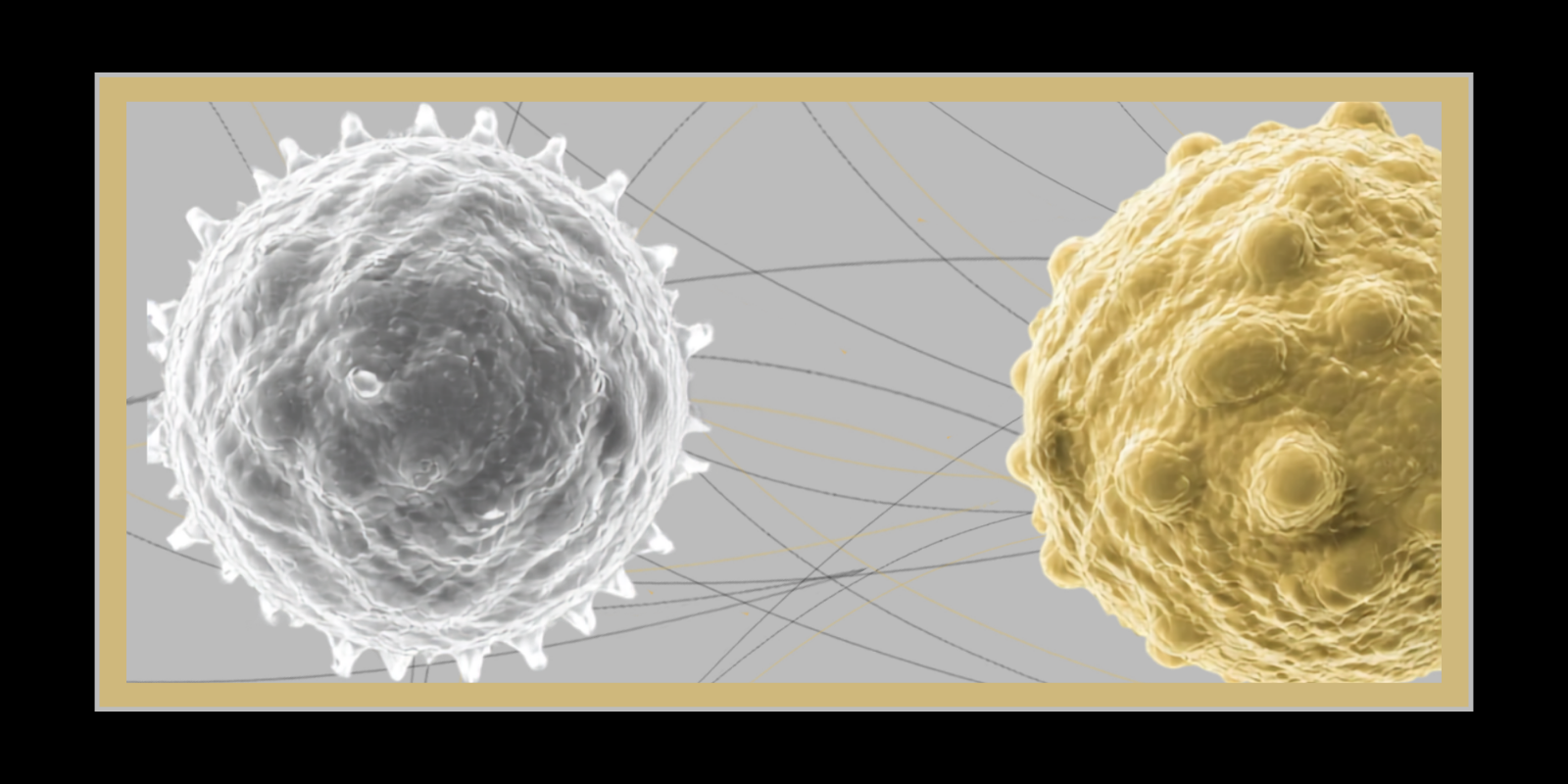
Drug-tolerant persister cells
As for the cancer question that Patil hopes to answer, he describes it this way:
“When you start targeted therapy, what exactly are the cancer cells doing after two months on treatment? Because one of the things we’ve noticed is that when you do a CT scan of a patient who’s got, let’s say, EGFR-mutation non-small cell lung cancer, and we treated them with osimertinib” – a targeted therapy medication – “it’s extremely rare for the patient to have what’s called a complete response, which would mean everything on their scan is gone. What you usually see is that 60% or 70% of the cancer has responded to treatment.”
That, Patil says, leaves “the open question as to why 20% to 30% of the cancer is still residual. What is happening in some of the cancer cells that is allowing them to adapt to and tolerate the osimertinib? We actually have very little understanding of what’s going on in those cells in the initial phases of treatment.”
These “drug-tolerant persister cells,” Patil says, “have adapted, through unclear mechanisms, to a very potent targeted therapy. My research in this space is asking, how is this happening?”
→ A Combination of Targeted Therapies Proves Effective Against Mutation-Driven Lung Cancer
A unique growth pathway
His study examines what’s happening at the cell cycling level – the series of events that a cell goes through as it grows, replicates its DNA, and divides into two new cells. He’s relying on data from research biopsies, gathered with the permission of patients two months after they start therapy.
Patil says he and his collaborator, CU Cancer Center member Sabrina Spencer, PhD, of CU Boulder, are “using an advanced imaging technique called single-cell spatial resolution to look at what’s going on in key cell cycling pathways within the first two to three months of treatment. I’m excited to see what kind of images we get.”
He hopes to find “a unique growth pathway” in the drug-tolerant persister cells that can be targeted. “Then you could develop a rationale for a trial of an intervention to kill these persister cells early, rather than wait for them to re-enter cell cycling and become resistant. That’s the long-term strategy.”
The Calabresi award comes on the heels of Patil being chosen in 2023 for the CU Department of Medicine Rising Star Award, recognizing outstanding early-career faculty members who exemplify excellence in patient care, research, education, and community service. He is immediate past president of the Rocky Mountain Oncology Society.
The Calabresi award is named for Paul Calabresi, MD, of Yale and Brown universities, a leading oncologist and a pioneer in developing cancer treatments who served on presidential and congressional cancer advisory committees. He died in 2003.
→ Tejas Patil, MD, on ‘Big Bang Theory’ Actress Kate Micucci’s Lung Cancer
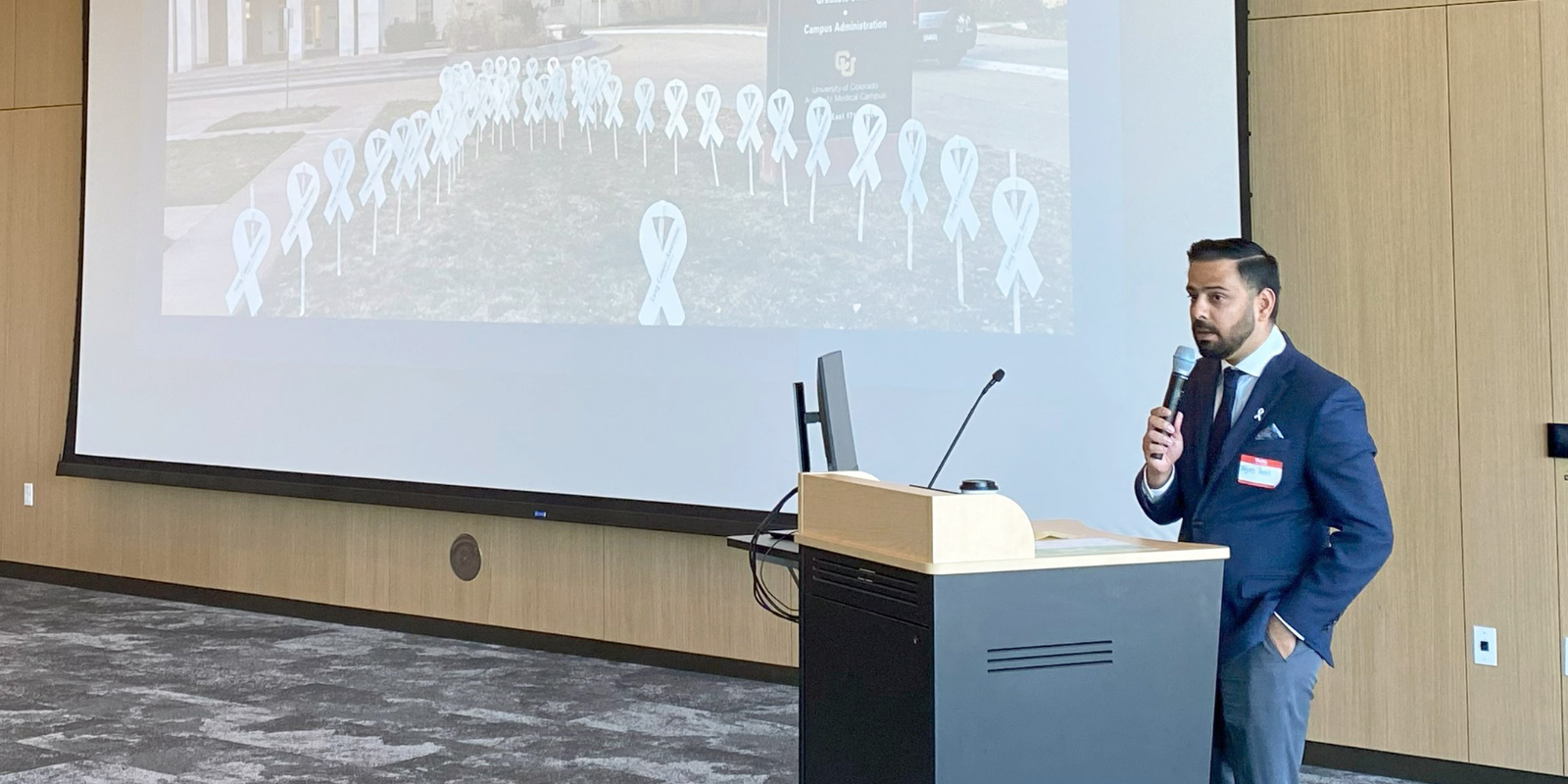
Photo at top: Tejas Patil, MD, speaks to lung cancer survivors at the 5+ Years Lung Cancer Survivorship Celebration on May 11, 2024, on the CU Anschutz Medical Campus. Patil also played piano for the guests. Photo by Mark Harden | CU Cancer Center.