
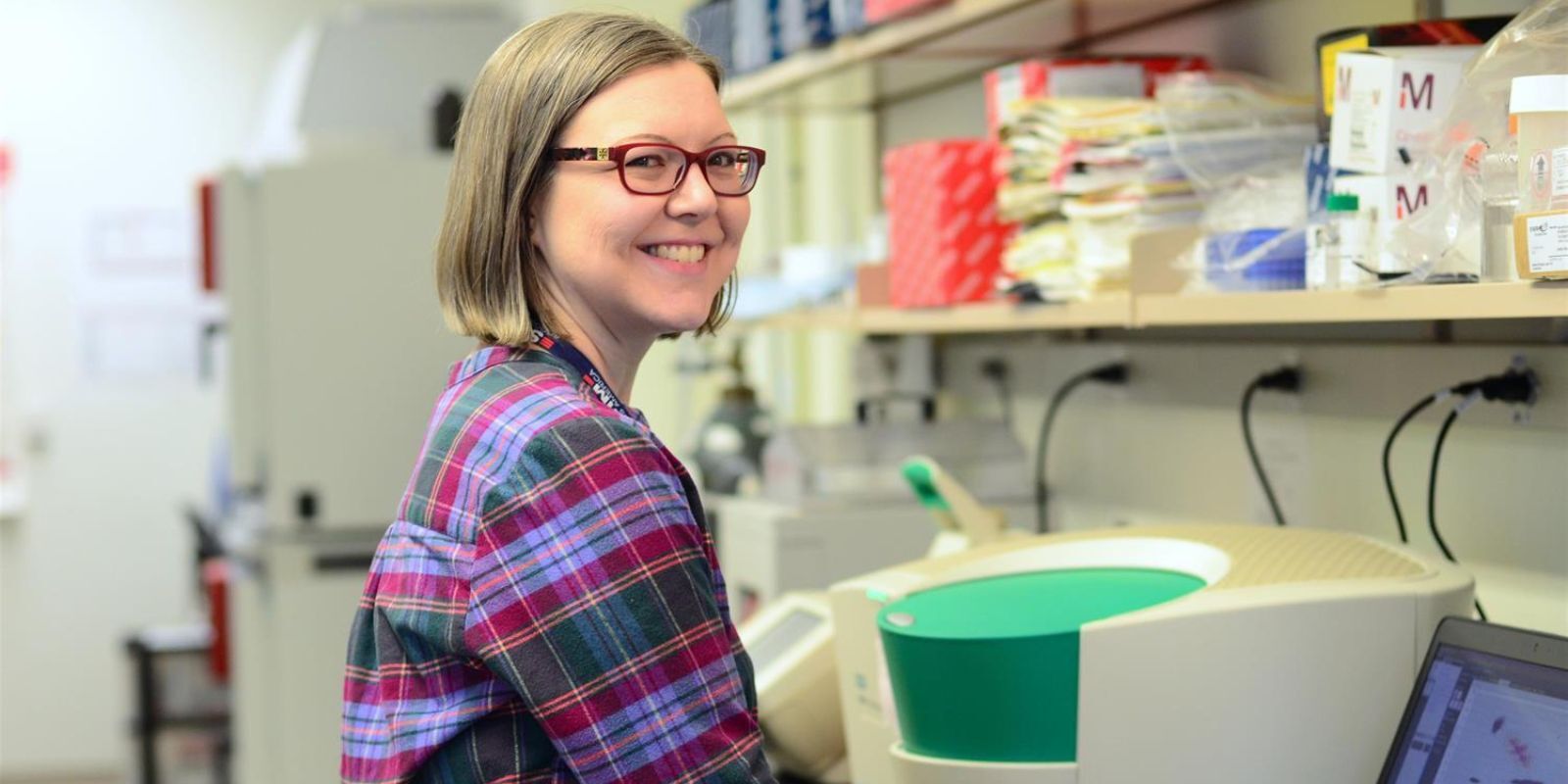
Supported by a $135,000 award from the American Cancer Society (ACS), University of Colorado Cancer Center researcher Amanda Winters, MD, PhD, is working on a better method to detect patients who are likely to relapse from pediatric acute myeloid leukemia (AML).
“One child in the U.S. will be diagnosed with AML every day, and half of these children will require bone marrow transplant, in addition to harsh chemotherapy,” says Winters, associate professor of pediatric hematology/oncology and bone marrow transplantation in the CU Anschutz School of Medicine. “A key component to therapy success is doctors’ ability to identify ultra-low levels of residual disease, or ‘MRD,’ after therapy, but current clinical tools are not sensitive enough. Up to 30% of patients relapse without warning.”
Looking for a better test
The relapse usually happens in the first two years after diagnosis, Winters says, and is much harder to treat than the original occurrence. The current method of predicting relapse involves a bone marrow sample that is tested for specific proteins that indicate the presence of cancer, but Winters is interested in a genetic test that is more accurate and can be conducted via a simple blood draw.
“A common type of leukemia in kids is lymphoblastic leukemia, and it’s been shown that genetic-based detection of disease in that type of leukemia dramatically improves the ability of physicians to identify patients who are going to relapse,” she says. “They have started to look at these types of tests in adults with AML, and they have shown that they are better than the protein-based MRD test we use clinically, but they haven't been rigorously evaluated in children yet.”
Going head to head
In the ACS-funded project, Winters will oversee an observational trial at eight sites around the country, including CU, that will test pediatric AML samples using both methods, to see which is more accurate. She is hopeful that the genetic test is better at detecting the potential for relapse, but even if it turns out to be equal to the protein-based test, it’s still an advantage to use a blood draw over a bone marrow test, she says.
“Bone marrow extraction is a painful, invasive procedure, and our children have to get sedated for them,” Winters says. “It would be great if we could get as good or better prediction of risk and not have to do those procedures.”
A new standard
Winters plans to enroll 100 patients across the eight sites, which she estimates will take two to three years to do. Patients will need to be followed for two years to check for relapse, after which time she hopes testing for genetic mutations will become the standard for pediatric AML patients.
“If it works, then it changes the clinical testing that we do for risk prediction,” she says. “Maybe we find there are more patients who end up needing a transplant up front, or we have a signal that they're going to relapse. In that case, there are post-transplant chemotherapies and other ways we can boost the transplant immunity preemptively before relapse actually happens. Hopefully we can prevent it from happening at all.”
Getting the results from a blood test, instead of a bone marrow sample, also means that the testing can be conducted more often, Winters says.
“We don't want to do a bone marrow test every two weeks — usually it's every few months,” she says. “But if we could do a very easy blood draw, and it's less painful and less invasive, we could be watching at more frequent intervals, so we could hopefully capture an early warning signal with better lead time.
“In the adult literature with AML, it shows that if you start treatment for relapse before relapse happens, your success rate is much higher than if they already have symptoms,” she continues. “It means more therapy, which is always hard to deal with, but it gives hope to families that the outcome could be much better.”