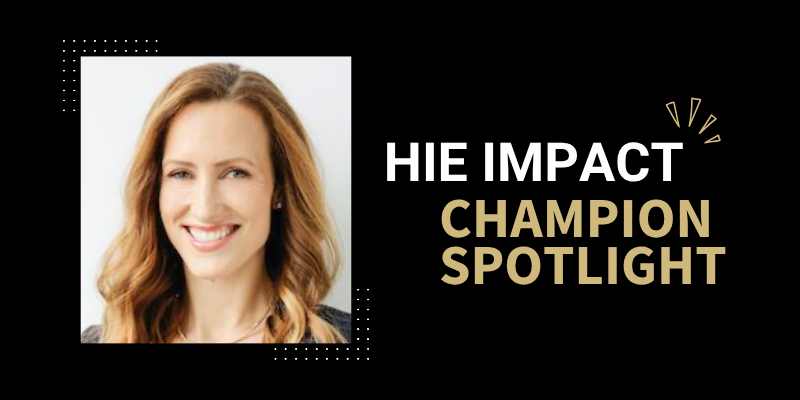
A Q&A with Dr. Elizabeth Goldberg, Professor, Department of Emergency Medicine, CU Anschutz School of Medicine
HIE Impact Innovation Champions are CU Anschutz faculty and staff embedded across campus who are helping shape a culture where ideas become impact. Through this spotlight series, we’ll introduce you to the Champions driving change from within, the connectors, catalysts, and collaborators who are making innovation more visible, accessible, and actionable for all. Get to know what motivates them, the discoveries they’re championing, and how they’re helping move bold ideas toward patient and societal benefit.

Why are you passionate about advancing healthcare innovation at CU Anschutz?
I’ve seen firsthand how innovation can improve both patient experience and patient outcomes. Our patients deserve technologies and systems that make it easier to manage their health, access to care, and stay healthy.
At the same time, not every technology is designed with patients, or the clinicians caring for them, as the end users. That’s where I think CU Anschutz can make an important contribution. We have clinicians, researchers, staff, engineers, and patients who understand the real-world problems we need to solve. By bringing those perspectives into the innovation process, we can create solutions that are not only technically impressive, but actually useful, equitable, and scalable.
How did you catch the innovation bug / what was your first exposure to innovation?
In 2017, I was preparing a career development award focused on falls in older adults when Apple introduced fall detection on the Apple Watch. It immediately solved a research problem for me: how could I better measure falls outside of the clinical setting? What really caught my attention was that the technology didn’t look medical. Unlike traditional fall-alert pendants, the watch was something people of all ages wanted to wear. It made me realize that the best healthcare technology doesn’t just work - it must fit naturally into people’s lives.
That experience led me to incorporate wearables, chatbots, and other technologies into my research. I’ve also watched the EHR evolve from something I primarily used for order entry during residency into a powerful platform for identifying research participants, randomizing patients, delivering interventions, and automating care. That evolution completely changed how I think about what is possible.
What innovation work are you currently involved in (or have supported), and what impact are you hoping it will create?
One of my current projects uses an EHR-embedded chatbot to notify patients about their fall risk and connect them with local, free or low-cost fall-prevention resources. What I like about this project is that the technology builds on work clinical staff are already doing. Nurses already screen patients for fall risk in our emergency department. Instead of allowing that information to sit in the medical record, we use it to automatically notify patients of their risk and personalize prevention resources for patients who need them. Clinicians don’t have to remember another referral or add another task to an already crowded workflow—the system does the work in the background.
That reflects a larger goal of my work: using innovation to make prevention easier and more scalable. Our healthcare system is still largely designed to respond after something bad happens health-wise. Technology gives us an opportunity to intervene earlier, connect hospitals with community resources, and deliver preventive care without continually adding work for clinicians. Ultimately, I want to help build systems that make the healthier choice and the evidence-based choice the easier choice - for patients, their care partners, and clinicians.
Is there anyone in your department doing particularly interesting innovation work?
There is an incredible breadth of innovation happening in Emergency Medicine because our specialty has always had to solve problems in complex, time-sensitive, and resource-constrained environments.
Our teams are developing EHR-based clinical pathways and just-in-time decision support to help clinicians deliver evidence-based trauma and medical care. Others are exploring AI to better understand patients’ whole-person health, including social needs that may determine whether someone can follow a treatment plan or access the resources we recommend. If technology can automate some of the work of identifying those needs, clinicians can spend more of their time actually addressing them.
What is especially exciting is that our innovation extends far beyond the walls of the emergency department. Faculty are developing approaches for people at risk for suicide, rural communities, prehospital care, high-altitude and austere environments, space flight, and the battlefield. Emergency medicine is fundamentally about figuring out how to deliver excellent care wherever the patient happens to be. Lessons learned in one extreme environment can often transform care in another.
If you could wave a magic wand, what is the most important thing you would be able to accomplish as an Innovation Champion?
I would make it easier for people with great ideas to move from identifying a problem to testing and scaling a solution. We have faculty and staff with tremendous entrepreneurial energy who see problems every day and think, “There has to be a better way.” Often what they lack isn’t the idea - it’s protected time, funding, project management, technical expertise, or mentorship.
As an Innovation Champion, I’d like to help connect those people with the right expertise and resources at the right time. If we can lower the barriers between having a great idea and implementing it, I think we’ll uncover a tremendous amount of innovation that already exists within our faculty and staff.
"I would make it easier for people with great ideas to move from identifying a problem to testing and scaling a solution. We have faculty and staff with tremendous entrepreneurial energy who see problems every day and think, 'There has to be a better way.' Often what's lacking isn’t the idea - it’s protected time, funding, project management, technical expertise, or mentorship."
What excites you most about the future of innovation on this campus?
From the time I first interviewed at CU Anschutz, I could see that this was a place willing to question how things have traditionally been done and highly focused on delivering the best care to patients. That culture matters enormously.
Innovation requires both bottom-up creativity and top-down investment. If I want to conduct a study using wearable technology, for example, enthusiasm for the idea isn’t enough. We need secure infrastructure for patient data, the capacity to store and process enormous amounts of information, regulatory expertise, and people who know how to analyze complex wearable data.
Building that ecosystem is harder than saying no to ambitious ideas - but once it exists, it lowers the activation energy for everyone who comes next. That’s what excites me about CU Anschutz: the opportunity to build an environment where clinicians, scientists, staff, and entrepreneurs can take smart risks because the infrastructure and expertise are already here to help them succeed.
Any particularly interesting or surprising learnings along the innovation journey?
One of my biggest lessons has been that you can build highly usable technology and still have low engagement. People have competing demands for their attention, and technology alone doesn’t create behavior change.
That has reinforced me how important the human side of innovation is. Engaging patients, communities, and clinicians early - and genuinely incorporating their feedback - often determines whether something ultimately succeeds.
I’ve also learned that innovation doesn’t necessarily start with someone who considers themselves an innovator. Researchers are well positioned to develop and test new ideas, but so is the bedside clinician who encounters the same frustrating problem for the hundredth time and thinks, again, “There has to be a better way.” Innovation often starts with simply noticing a problem, refusing to accept it as inevitable, and being curious enough to try something different.
What advice would you give a colleague who has an idea but isn’t sure where to begin?
Start by talking to people. Find an Innovation Champion, a mentor, or a colleague who has tried to solve a similar problem. You don’t need to know the entire pathway from idea to implementation before you begin. Most of my projects start as a problem I want to fix and are a labor of love until they get funded and achieve more momentum.
I’d also encourage people to spend time understanding the problem before becoming attached to a particular solution. Talk to the patients, clinicians, or staff who experience it. Find out what has already been tried. Then identify the expertise you’re missing.
Innovation is rarely a solo endeavor. The right collaborator or mentor can help you avoid months of unnecessary work—and can turn an interesting idea into something that actually reaches patients.