

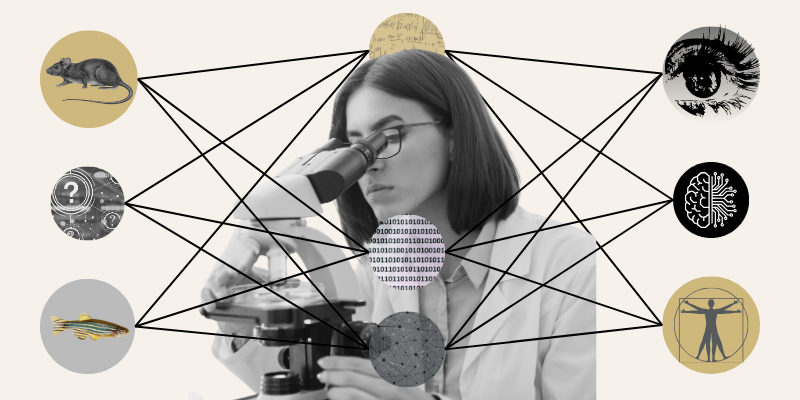
Before researchers can safely advance findings onto human subjects, they first need to see how it behaves in a complete living system—not just in isolated cells in a dish. That’s where model organisms come in. These are species like mice, fruit flies, or zebrafish that serve as stand-ins for humans, allowing researchers to observe how treatments or biological processes play out across an entire organism rather than in a single cell type; they lend a better understanding of human biology and diseases without complications that come with human subjects. For example, these model organisms enable researchers to perform in vivo studies—research where functional experiments, disease modeling and drug testing are conducted on living organisms.
While model organisms are essential for biomedical research, choosing the right model is complex, and finding equivalent molecular components across species poses challenges. Researchers at the University of Colorado Anschutz (CU Anschutz) and Michigan State University (MSU) have compiled a comprehensive and extensive survey of computational tools that are helping make these choices more accurately.
Why model organisms matter
Conducting this research on model organisms allows researchers to better understand impacts across an entire biological system without putting humans at risk. Additionally, model organisms also allow researchers to conduct research in a very controlled environment. Human testing traditionally has high levels of variability due to differences in population genetics and environmental factors. The model organisms let researchers control for these variabilities within a lab setting.
Current challenges with translating findings to humans
Although model organisms are a keystone component of biomedical research, their use comes with several challenges. For example, even though a model organism species might have genes that share an evolutionary past with humans, evolutionary divergence may give rise to biological processes that look similar but function differently. Processes like these cannot be interpreted as a 1:1 translation to humans; instead, their unique functionalities need to be interpreted.
Another challenge that arises with model organisms is choosing the best model. Certain species act as better models for different components of human biology, but researchers do not always have strong criteria to select the most appropriate model for the context without actually conducting experiments in multiple species. So, it is crucial to determine which components are equivalent between model organisms and humans.
New research proposes agnology, a novel approach to model organisms
A new perspective article addressing the field of model organisms was recently published in Nature Methods by: Arjun Krishnan, PhD and Kayla Johnson, PhD, biomedical researchers at the University of Colorado Anschutz School of Medicine (CU Anschutz School of Medicine); Christopher Mancuso, PhD, researcher at the Department of Biostatistics & Informatics at CU Anschutz; Hao Yuan, researcher in the Genetics and Genome Sciences Program at MSU and lead author; and Ingo Braasch, PhD, researcher in the Department of Integrative Biology at MSU and leader of the Braasch Lab. The article surveys challenges with model translation and evaluates the fast-growing computational tools designed to bridge these gaps.
In the article, the researchers explain that the traditional method of translating findings from model organisms is to focus on homologs, which are structures, genes, or molecules in different species that share a common ancestry. This idea of homology—evaluating different homologs—can be beneficial for modeling organisms towards humans. However, there is one important caveat when using homologs as functionally “equivalent” surrogates in studies of biological function or disease: shared evolutionary ancestry does not necessarily translate into shared function. Likewise, similar function of a structure does not necessarily mean that they evolved from a common ancestor; different species could have obtained these equivalent functions independently.
As an example, FOXP2 is a gene that helps shape how neural circuits develop and how complex movements are learned. In mice, foxp2 mainly influences motor coordination rather than language. In humans, however, changes in FOXP2 are also linked to speech and language disorders. In songbirds, FOXP2 is crucial for learning songs—a behavior that resembles human speech, but is not quite the same. This example illustrates how a common ancestral gene can have conserved functions across species, yet evolutionary divergence may also lend itself to functional complexities that need to be accounted for.
“As biologists generate increasingly large genomics datasets across many species, it becomes difficult to determine which genes, pathways and cell types are truly performing the same biological functions,” said Yuan, the first author on this article. “This distinction is crucial for understanding which disease-related discoveries made in research organisms can be reliably transferred to humans and other species.”
Yuan added that the rapid expansion of organism-level genomics resources, together with advances in computational methods, has created new opportunities for cross-species comparison. “Our review brings together state-of-the-art computational approaches that leverage large-scale omics data to identify functional equivalence beyond simple sequence homology,” he said. “We also introduce the concept of agnology to describe these data-driven functional equivalences.”
Agnology plays on the ideas of “homology” and “analogy” in biology. The prefix “homo-” in homology refers to a shared trait as a result of shared ancestry. In contrast, the prefix “ana-” in analogy refers to a similar trait with an independent ancestry. Agnology introduces a new prefix “agno-” which means“unknown” or “not known.” The shift towards agnology reflects a data-driven observation that emphasizes shared function across species, regardless of whether there is shared ancestry.
“In evolutionary biology, we aim to find those aspects of organisms that are shared across species because they are inherited from their last common ancestor,” explained Braasch. “These homologous structures—may they be genetic networks, cell types, tissues or organs—often have similar functions. Computational approaches now can identify entities that are functionally similar or equivalent across different species, without even knowing whether they are similar because they are homologous, or because nature has independently found similar solutions to similar problems. When we cannot (yet) tell whether, for example, genetic networks are homologous or convergently evolved without a common origin, we should call them agnologous, because we are agnostic to their evolutionary history. Sometimes, we just don’t know—and we need a term for this.”
The migration towards a computational, data-driven approach to identifying and selecting model organisms for biological research will enable researchers to find stronger, context-specific models. As more advanced computational methods are developed, researchers will discover more from non-traditional research model species and improve their ability to select appropriate models.
“The future of translational biomedicine lies in our ability to intelligently leverage the full diversity of research organisms,” added Krishnan. “Through advanced computational approaches that go beyond simple sequence comparison, we can now systematically identify which aspects of a disease are best modeled in zebrafish versus mice versus other organisms. This precision in model selection, guided by data-driven functional equivalence, will accelerate discovery and ultimately lead to more reliable translation of findings to human patients.”


.png)