.png)
With Russia’s full-scale invasion of Ukraine in its fifth year, hundreds of thousands of its troops have been wounded on the battlefield, and many of those casualties have needed blood products to survive. But getting those lifesaving supplies to the front lines and rapidly evacuating wounded troops to hospitals have been enormously difficult, with Russia targeting Ukraine’s transportation and supply lines with drones and missile attacks.
Now, the University of Colorado Anschutz Department of Emergency Medicine has partnered with global pharmaceutical company Octapharma in an international initiative to study the use of aerial drones to carry freeze-dried powdered plasma to frontline medics – and an early study of the program shows encouraging success.
The initiative is called PLASMA-RESCUE, standing for Plasma Resuscitation for Emergency Stabilization in Combat Ukraine Environment.
The research project is led by CU Anschutz Emergency Medicine’s ATLAS (Airway, Trauma, Lung Injury, and Sepsis) Research Program in partnership with the CU Anschutz Combat Medicine Research Center.
Corey Bills, MD, MPH, an associate professor of emergency medicine and an ATLAS co-principal investigator, leads the PLASMA-RESCUE study. Bills, who has extensive experience in global health, says the program is meant to address a critical need in Ukraine, where injured troops are dying given the inability to evacuate to places where they can receive further care.
In any conflict, delivering health care to wounded troops is difficult, but the war in Ukraine poses special challenges, Bills says.
“What’s unique is the inability to get people away from the front lines quickly to a hospital where they could get blood products,” he says. “In the previous U.S. conflicts in Iraq and Afghanistan, for example, our military had air superiority, so when someone was injured on the front lines, we could pick those people up and get them out safely without fear of having planes shot down from the sky. In this instance, there isn't that ability, because drones are everywhere and inescapable. So we’re trying to see if we can get blood products to individuals at their point of injury, as opposed to waiting the two, four, even seven days it takes to get someone from the front line to a hospital.”
“Resuscitating critically injured and bleeding patients is time-sensitive,” says Adit Ginde, MD, MPH, senior associate dean for clinical research, professor of emergency medicine at the CU Anschutz School of Medicine, ATLAS principal investigator, and co-principal investigator of the PLASMA-RESCUE study.
“Before the bleeding can be stopped surgically, rapidly providing blood products is the first line of defense and can be lifesaving,” Ginde says. “It gives patients enough support to buy time to reach definitive care and maintains blood flow to vital organs to prevent irreversible damage. The challenge we are addressing is delivering these blood products to the point of injury under the most difficult of circumstances.”
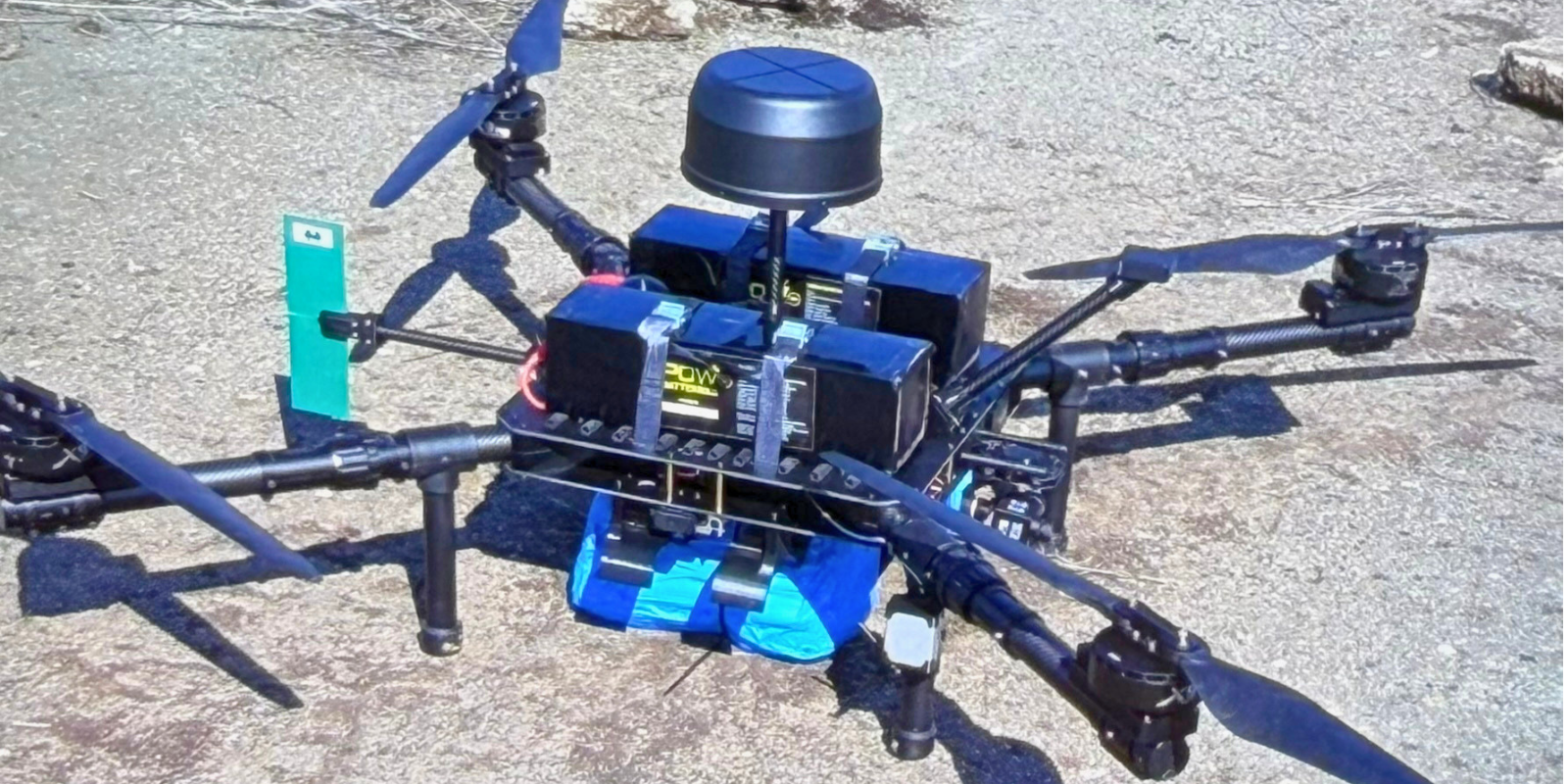
A drone in Ukraine with a package containing powdered blood plasma strapped underneath. All photos provided by Security Services of Ukraine.
Filling a critical gap
Plasma is a pale, yellow fluid that makes up about half of human blood. Plasma helps the body maintain healthy blood pressure and blood volume. It also carries many of the proteins necessary to support blood clotting and immune system responses, and it transports many of the electrolytes that muscles need to function properly.
Plasma transfusions are often administered in cases of massive trauma or severe burns when a patient has lost a significant amount of blood volume and when clotting is compromised. “Given the lack of other blood products, plasma in this setting fills a critical gap to at least temporize critically ill patients with hemorrhagic shock” caused by severe blood loss, Bills says.
Liquid plasma can be stored for a few weeks if refrigerated, or up to one year if frozen. But in a war zone, keeping plasma cold while transporting it long distances is a challenge.
For PLASMA-RESCUE, Octapharma, a CU Emergency Medicine research partner, donated supplies of a freeze-dried, powdered blood plasma product called octaplasLG to the Security Services of Ukraine. In powder form, the product lasts up to two years at room temperature and can be quickly reconstituted with sterile water when needed.
In 2024, the U.S. Food and Drug Administration granted emergency use authorization for octaplasLG as a lifesaving measure in treating uncontrolled bleeding or impaired clotting in military emergencies when the use of fresh or frozen plasma is not practical.
“We already had a working relationship with Octapharma on other studies, and we’d been doing ongoing work in Ukraine and knew people on the Ukraine side, so we thought it would be interesting to study whether or not it’s feasible to get this product to the front line, and once it gets delivered, if it provides clinical benefit for patients,” Bills says.
> A Major Clinical Trial Could Revolutionize Trauma Care for Life-Threatening Bleeding
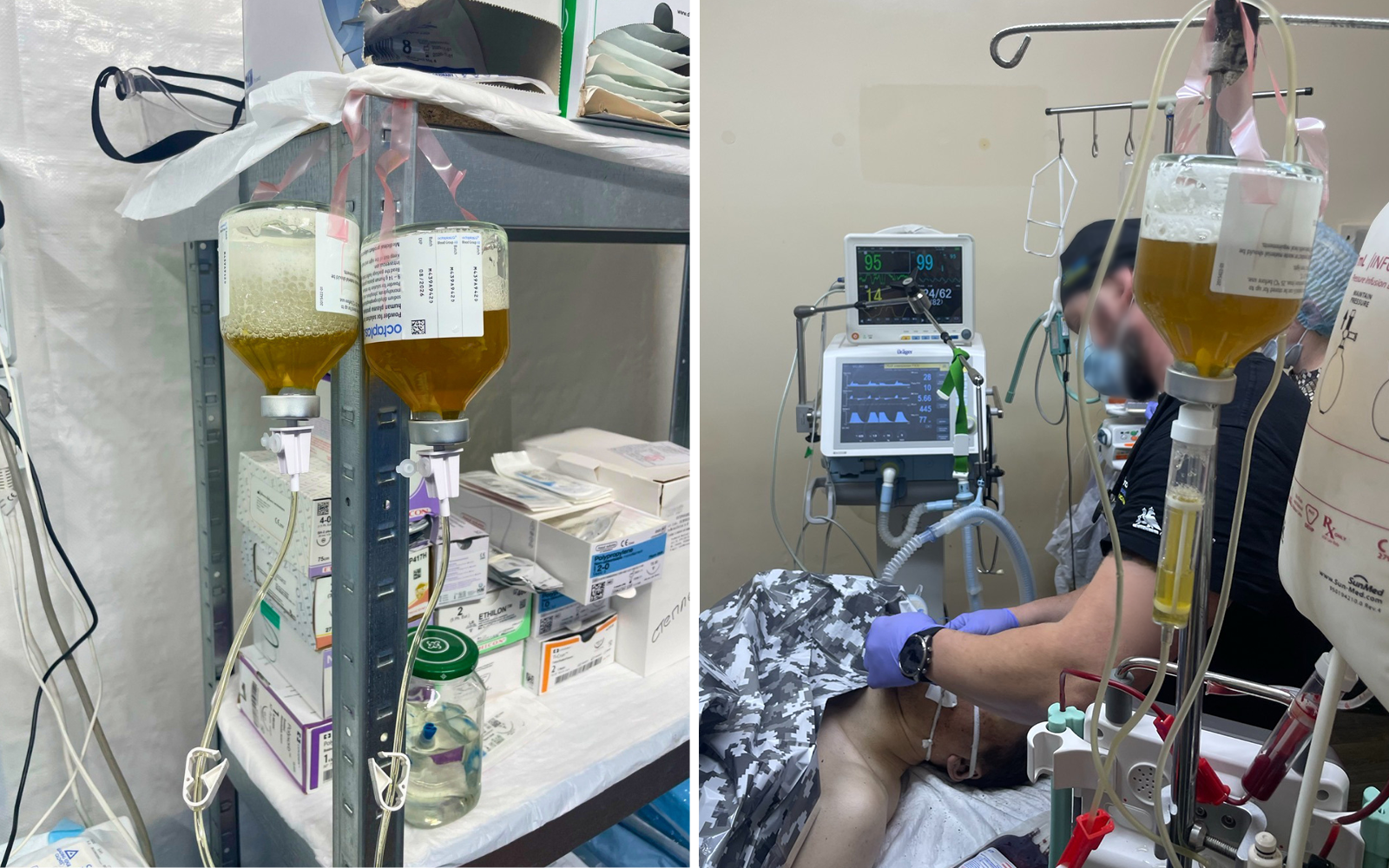
Reconstituted blood plasma being administered in Ukraine. The provider's face is obscured for security reasons in the photo on the left.
Dropped from the air
Octapharma and the Security Services of Ukraine worked out the logistics of transporting octaplasLG in some instances using aerial drones, which were already being used in Ukraine to deliver medicine, food, and other supplies to the front lines when necessary.
The plasma product is put in a plastic bottle container packed with foam, then wrapped in protective material and strapped to the underside of a drone, which then flies to where it’s needed several miles away.
When the drone reaches its destination near the front lines, if it cannot land safely, the package is sometimes dropped from a height of up to 65 feet to personnel waiting below.
What’s at the receiving end of the shipment may vary, Bills says. “In military parlance, they’re called Role 0 facilities. They include just a soldier or medics."
‘Significant improvement’
In their PLASMA-RESCUE study, Bills and his colleagues examined the results of delivering and transfusing freeze-dried plasma at the front lines over a three-month period.
“When we do a study like this in the United States, we don’t usually have to think about the logistics of the study treatment that we’re thinking about,” Bills says. “We just assume that it will get delivered, and we’ll study it, and it’ll get to patients. In this instance, that’s not necessarily true. There’s a whole bunch of logistics that have to be overcome to get this product to the patients who need it most.”
The study examined case reports on 26 wounded patients who were injured on the front lines between March 15 and June 13, 2026. Almost all were injured in blasts.
All the patients had sustained substantial hemorrhage as indicated by their shock index, a simple medical formula of heart rate divided by systolic blood pressure that’s used to identify severe blood loss, and as a rapid measure of overall clinical stability.
All 26 patients received drone-delivered octaplasLG as part of their treatment, and only a few were given additional blood products. All showed significant improvement in their vital signs after infusion.
“And when we looked at their shock index again after they received freeze-dried plasma, in some cases in combination with other blood products, we saw a significant improvement,” Bills says. All the drone-carried plasma used to treat the patients arrived intact and undamaged.
Leveraging success
In addition to providing outcomes data supporting PLASMA-RESCUE, Bills hopes his study helps answer questions about how similar medical drone-delivery programs might be organized in the future in rural or other remote settings.
“We’re looking at how we can do this better, and how we can improve getting not only freeze-dried plasma but also other products that might be beneficial to patients with acute hemorrhage from trauma in this kind of environment in the future,” he says.
Providing life-saving trauma care to areas with limited available resources and infrastructure – whether on the battlefield or following a devastating natural disaster – can mean the difference between life and death, says Flemming Nielsen, board member at Octapharma and president of Octapharma USA.
“The world is changing in ways that require a rethink of how emergency care is delivered when traditional methods are impossible,” Nielsen says. “Using drones to deliver emergency trauma and wound care in hard-to-reach places can reduce dependency on centralized supply and evacuation systems, and more importantly, help limit preventable deaths. We are proud to partner with CU Anschutz and the Ukrainian military on these efforts to build resilient critical care strategies for the future.”
As for PLASMA-RESCUE, Bills and his colleagues will continue to collect data on more wounded patients who receive freeze-dried plasma. “We want to add additional parameters to better understand what kinds of patients would benefit the most from these deliveries, and whether additional forms of trauma, such as traumatic brain injuries, would benefit from this as well.”
Meanwhile, Bills says, Octapharma will continue to provide freeze-dried plasma and other blood products to the Ukranian military medics, and they’ll work to refine how best to deliver the product.
Bills sees CU Emergency Medicine’s role in PLASMA-RESCUE as “leveraging our success in partnering with industry and our ongoing relationships and commitment to research in Ukraine. It also broadens our ability to take lessons learned, whether in war or other austere settings, to think about how we might apply this to patient care at home in Colorado.”
Vik Bebarta, MD, chair of CU Anschutz Emergency Medicine and founder of the Combat Medicine Research Center, sees that longer arc as well. “We’ve spent years learning how to keep wounded service members alive when the hospital is far away, and almost everything we’ve learned has ended up helping civilians,” he says. “This is the same pattern. If a drone can put plasma in a medic’s hands hundreds of miles from a blood bank, it can do the same for a paramedic on a mountain road.”