Moving to Minnesota in February was not easy for a child of 5⅟₂ from Nigeria.
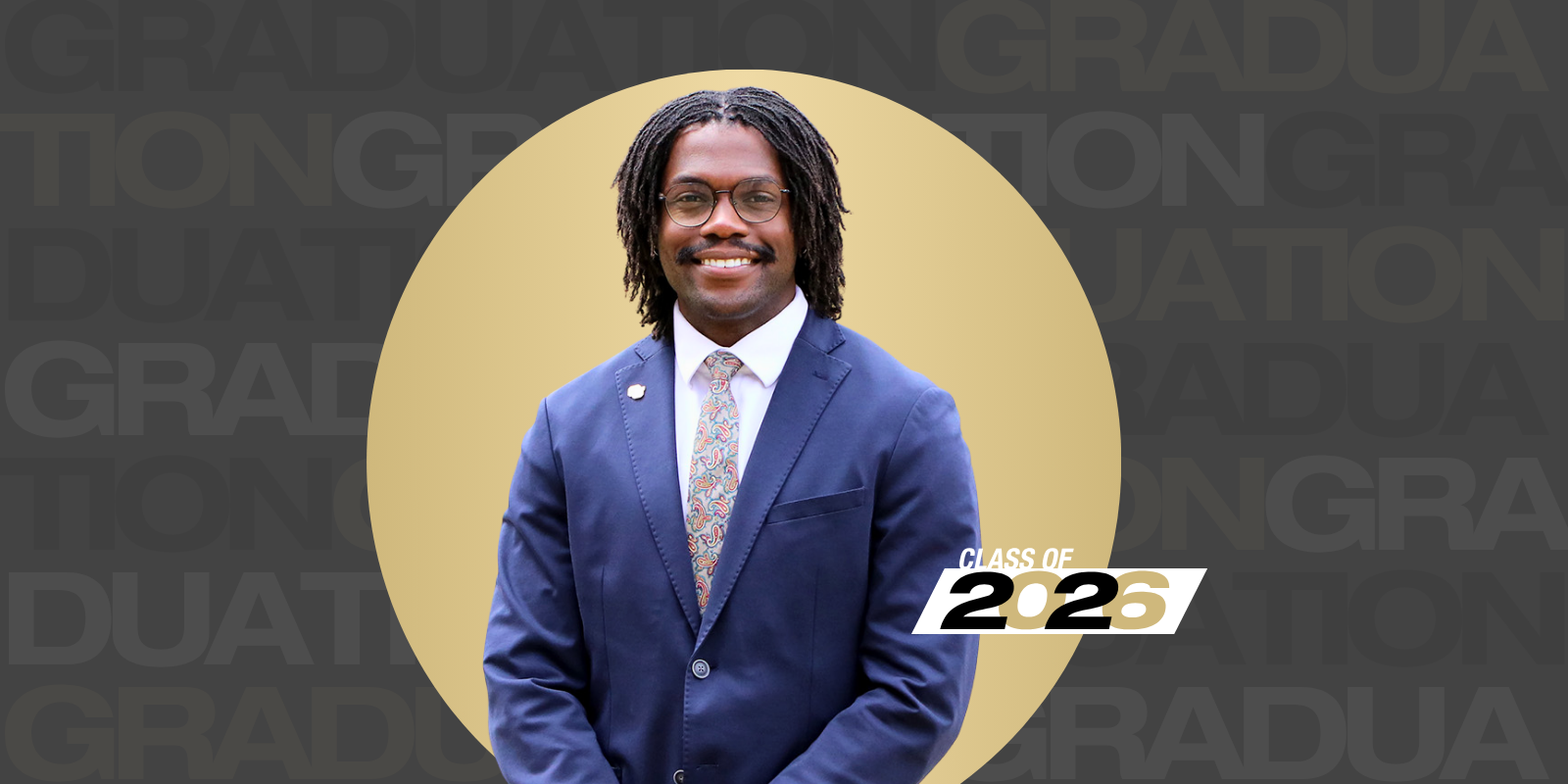
“As you can imagine, going from a sub-Saharan climate to Minnesota at the coldest time of the year was a shock,” Chiagoziem Anigbogu says with a grin.
But when Anigbogu, his parents, and his four siblings arrived in St. Paul, the welcome they received was anything but cold.
“There was a church in the area that took our family in,” he says. “They helped us adjust with getting jackets and toys, things like that. And they helped my parents get around and figure out what they needed to do. It was really helpful.”
The theme of caring crops up frequently as Anigbogu describes his journey through the University of Colorado Anschutz School of Medicine as a student now on the cusp of graduation. Along the way he encountered dedicated doctors providing care to patients, and he was guided by mentors and friends, helping him stay focused during challenging times.
A love of science is another recurring theme in Anigbogu’s story. “Growing up, science classes were my favorite – biology, chemistry,” he says. Over time, he grew to better understand how science plays a key part in caring for patients.
In medical school, Anigbogu combined his clinical and research passions and also found time for mentorship and tutoring at a local church. He sees teaching in his future, which could lead him into academic medicine.
During an interview for residency, Anigbogu says he was asked: “At the end of your career, how will you define a successful career?”
“My answer was, ‘If I know that the people that I've mentored and taught are now all over the world and are doing good by their patients, that to me will be a successful career,’” he says. “The titles don't matter. The accumulation of accolades doesn't matter. I want to leave an impact through people.”
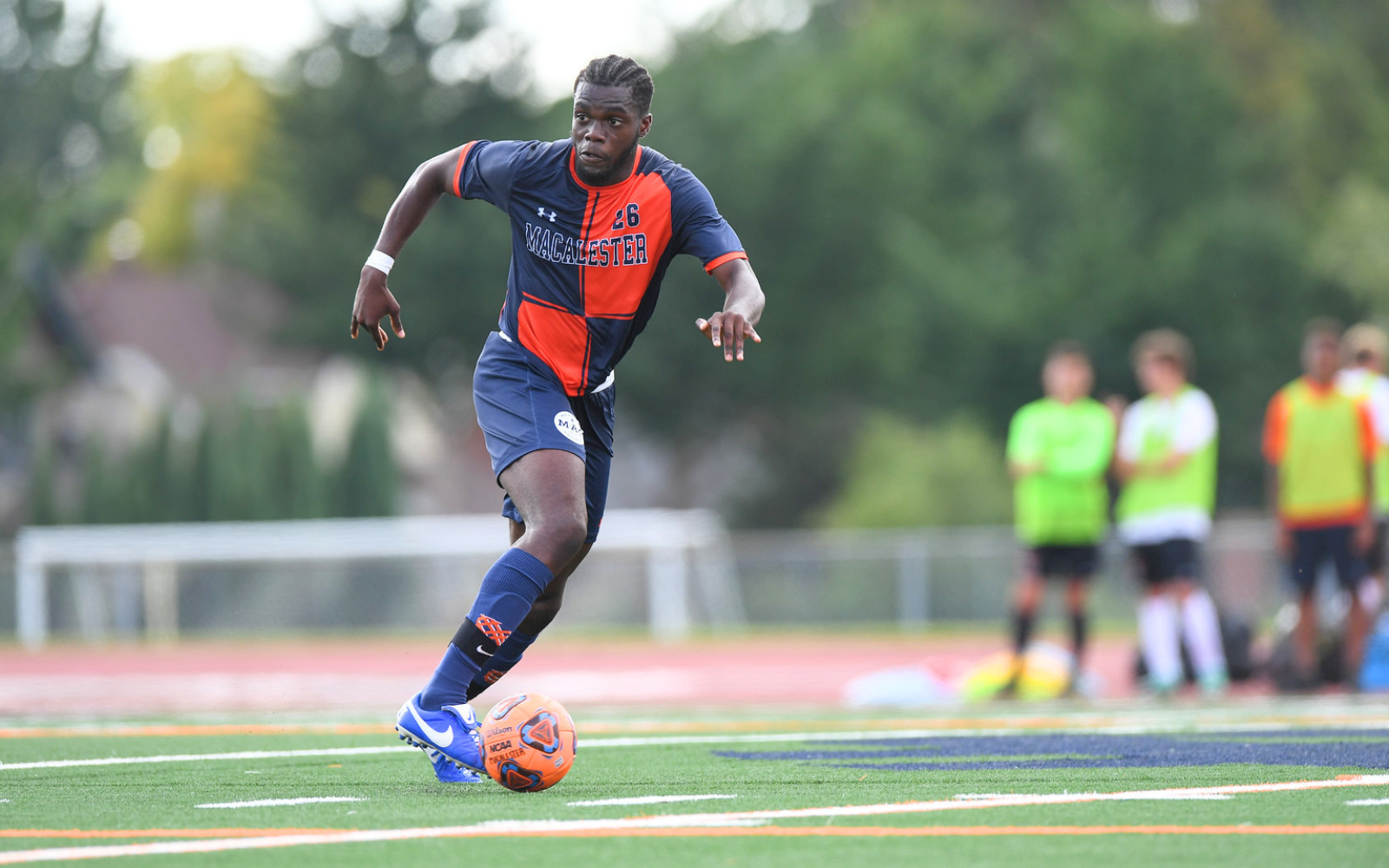
Chiagoziem Anigbogu playing soccer at Macalester College in Minnesota. Photo provided by Chiagoziem Anigbogu.
A kid in a candy shop
Anigbogu had another passion growing up: soccer. He was a top-ranked high school athlete and had dreams of playing at an NCAA Division I soccer school, “but injuries kept happening, and eventually, that dream went away. So now I was thinking, ‘Where do I go to college?’ Typically, people from my high school go to the University of Minnesota or the University of Wisconsin-Madison. But one weekend, we played in a local tournament, and the coach at Macalester College, Gregg Olson, saw me play, and he was really interested and reached out. I applied, and it was one of the best decisions I ever made.”
Macalester is a small but highly regarded liberal arts college in the heart of St. Paul, known for its focus on public service and multiculturalism. “The environment pushed me academically and socially, and I got to play soccer at a collegiate level. Some of the relationships I developed there are still going. We’re all still in touch, and three of us started med school at the same time.”
At “Mac,” Anigbogu pursued the twin majors of religious studies and biology. “I was the student who would go to office hours because I had questions about the assignments,” he says. “It wasn’t questions like, ‘How do I do this?’ It was ‘Why are we doing it this way?’”
In Anigbogu’s first year in college, a professor invited him to spend the summer in her ecology lab, where he worked on analyzing the DNA of New Zealand’s unusual arachnids. “That was where I was introduced to the research aspect of biology – not just learning information to take the test, but to apply in the lab,” he says.
After Anigbogu’s second undergrad year, “I wanted to see what else was out there,” and he applied to a summer undergraduate research fellowship at the Mayo Clinic, about 80 miles away. He spent 10 weeks working in a biochemistry and molecular biology lab.
“Talk about a kid in a candy shop. I was at one of the best institutions in the world, around some of the brightest minds,” he says. “The whole time, I was thinking, ‘How do I get into this space? How do I have my own lab and do these experiments and ask these questions?’ It really opened my eyes.”
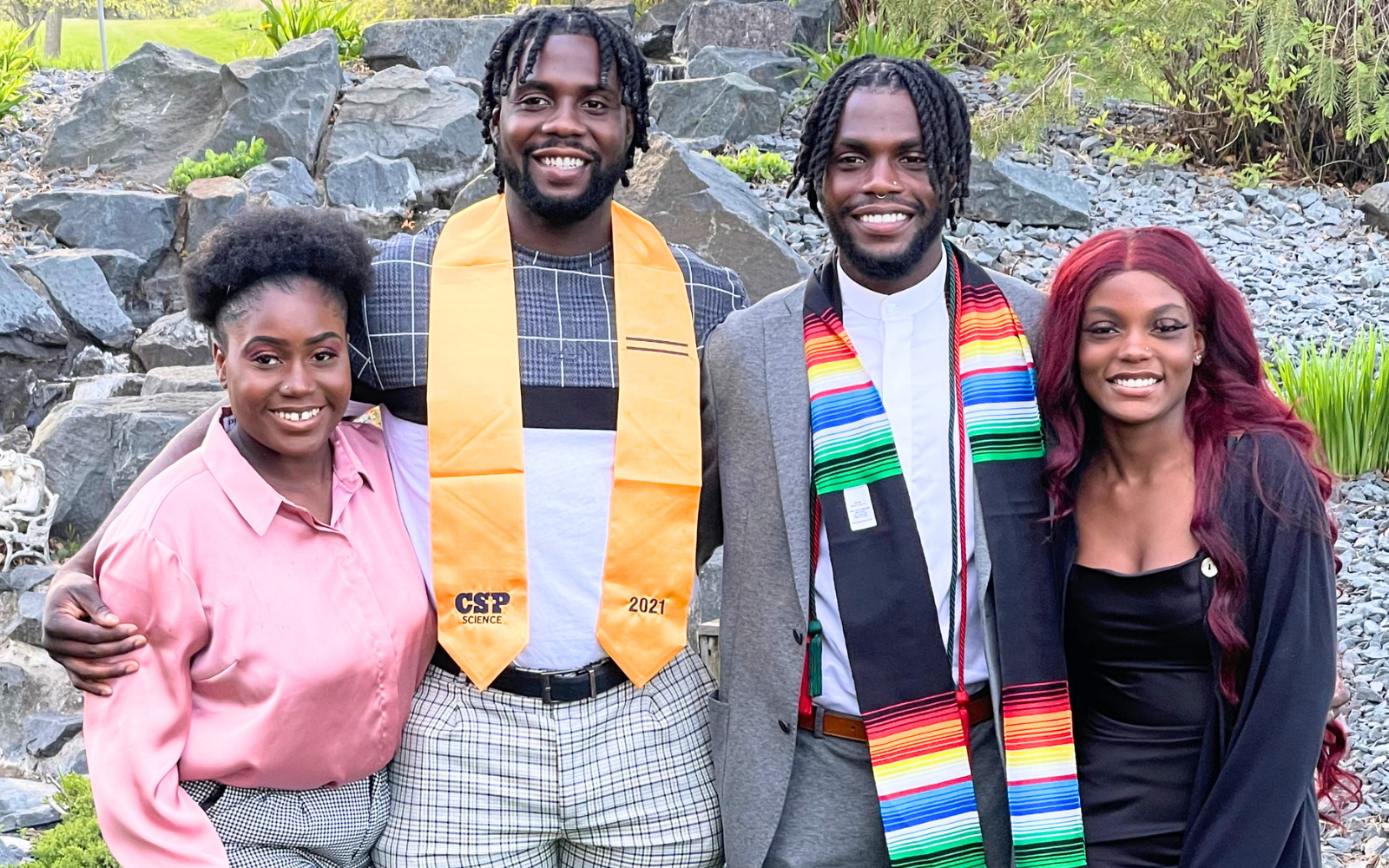
Chiagoziem Anigbogu with his brother and two of his sisters at his collage graduation. Photo provided by Chiagoziem Anigbogu.
A pivotal moment
Up to that point, Anigbogu hadn’t been considering medicine. But while at Mayo, a research assistant encouraged him to observe doctors at work.
“I finished my 10 weeks, and I stayed another week just to shadow physicians – pediatricians, pediatric thoracic surgeons, neurosurgeons, whoever was willing to have a student follow them,” he says. “That was a pivotal moment for me. Spending time in a lab was amazing, but then getting to see how physicians interacted with patients – that was the moment where I thought, ‘Oh, man, you can't get this in the lab. There’s something about this that I’m really drawn to.’ That’s when the possibilities of medicine started to formulate for me.”
One of the Mayo physicians Anigbogu shadowed also ran a lab, he says. “I saw him doing bench research, then talking to patients about their pulmonary hypertension and pulmonary interstitial diseases. He was navigating both of those worlds, and I could see the purpose behind what he was doing in the lab, and how it would potentially impact patients. The patients are the final goal. And I thought, ‘There’s something here for me.’”
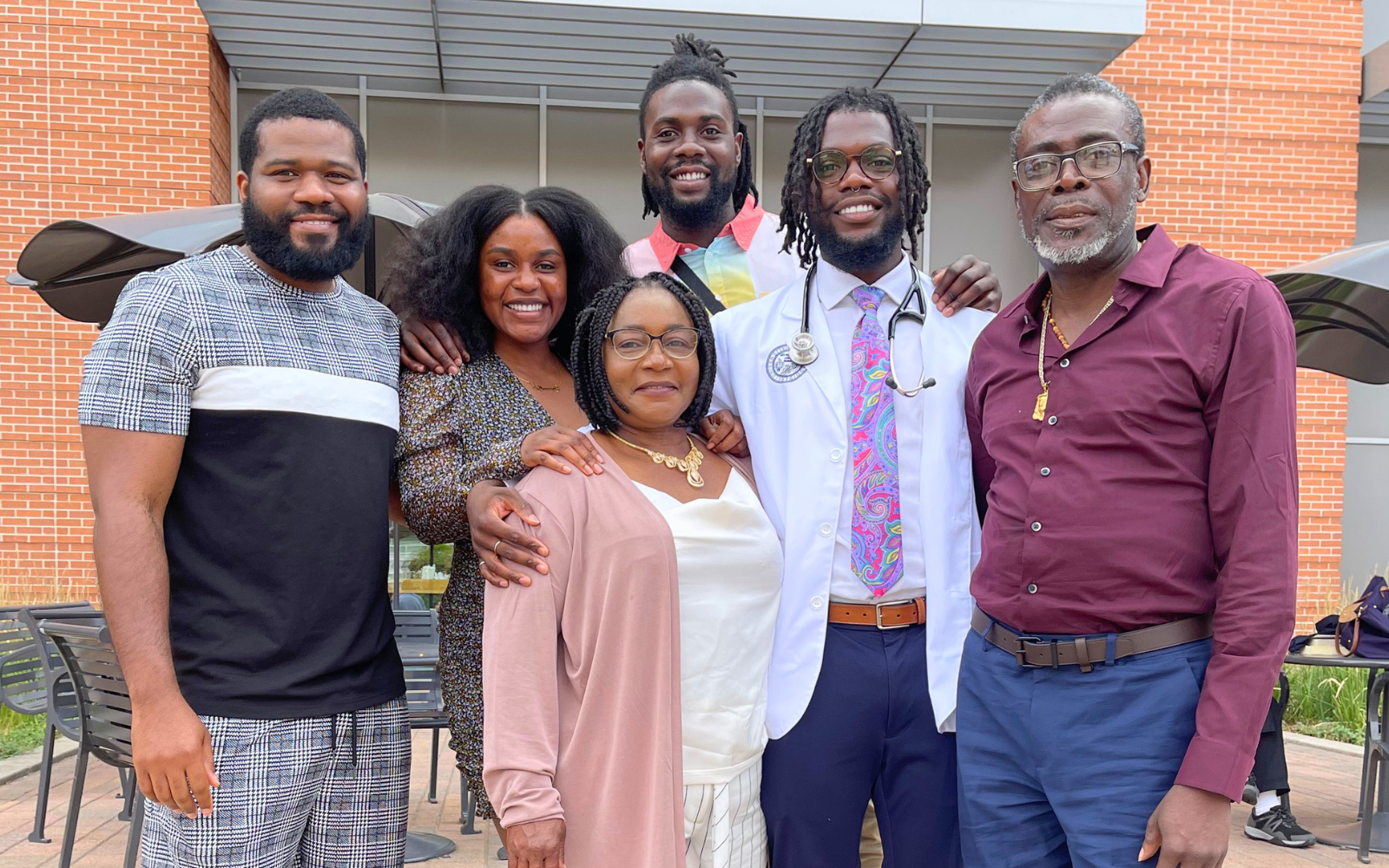
Chiagoziem Anigbogu with his parents, siblings and brother-in-law at his class Matriculation Ceremony. Photo provided by Chiagoziem Anigbogu.
Longitudinal relationships
Anigbogu graduated cum laude from Macalester. He considered CU Anschutz for medical school on the recommendation of an older soccer teammate he admired who also was pursuing medicine. “He spoke really highly of CU. He said, ‘You’ll fit in perfectly. They really care about their students.’”
After going through the application and interview process, Anigbogu felt CU “aligned really well” with his goals. “I wanted to go to a program where there's a huge emphasis on not just research, but also, how do we impact patient care? CU does a lot of great work when it comes to patient outreach.”
In particular, Anigbogu was drawn to the CU Anschutz School of Medicine’s Longitudinal Integrated Clerkship (LIC), in which students spend their second year placed in an LIC in a single health care setting and follow a cohort of patients all year. In Anigbogu’s case, he worked at the Rocky Mountain Regional VA Medical Center, a School of Medicine clinical partner.
“There was one patient who I saw once a month in my internal medicine rotation, and we developed a relationship,” Anigbogu says. “I felt like I was a big part of his care. He would seek me out. For me, as a student learning how to doctor, it was meaningful to have that type of longitudinal relationship with the patient who cared about what I had to say.”
Even after Anigbogu’s LIC year was over, “my attending will still reach out to me say, ‘Hey, [the patient] is asking about you and wants to know how you're doing.’” He calls it “a formative part of my journey in medicine.”
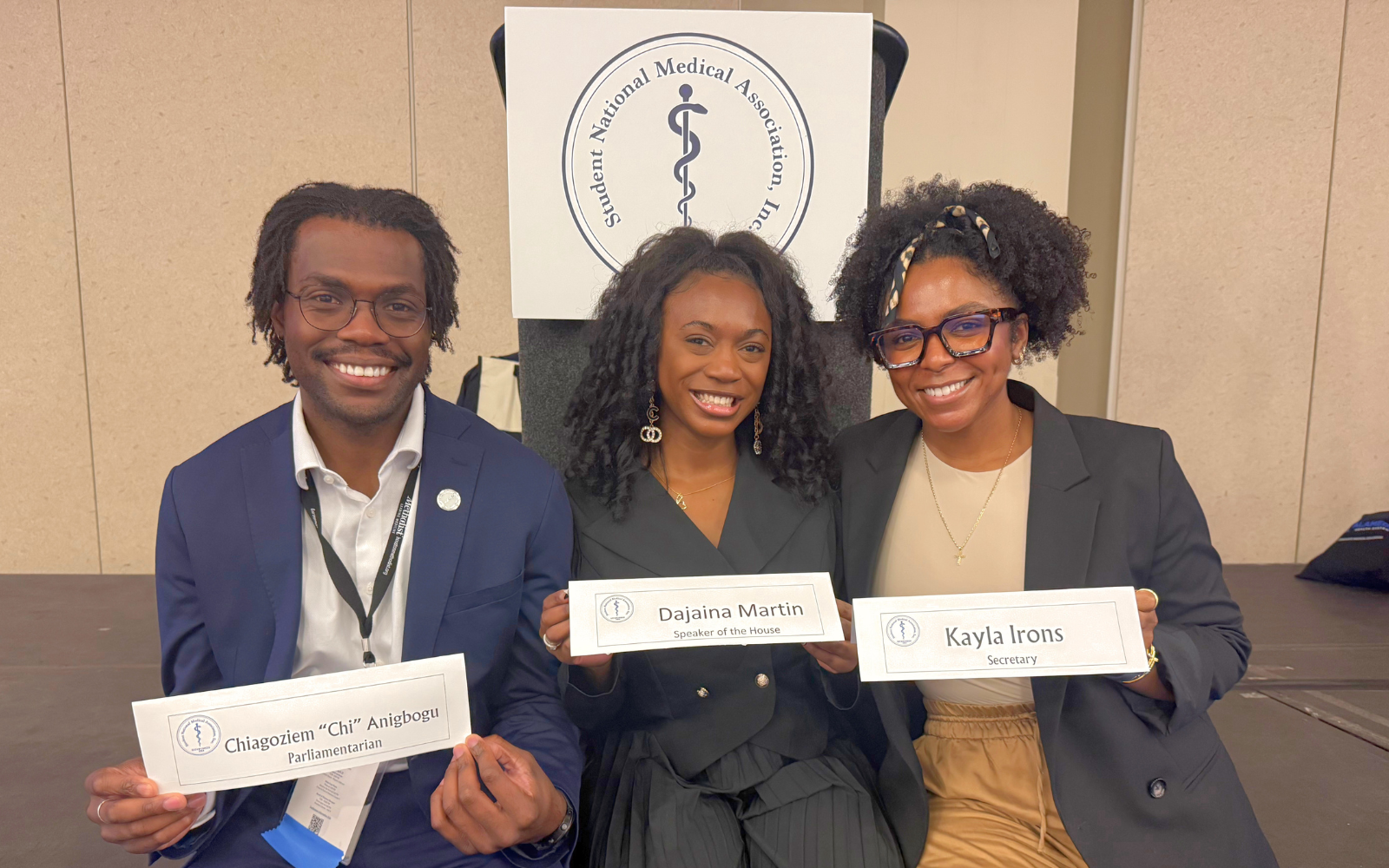
Chiagoziem Anigbogu with other leaders of the Student National Medical Association. Photo provided by Chiagoziem Anigbogu.
Lighting a fire
Anigbogu says he was on the path to internal medicine until his third year, when he did a two-week rotation on the neurosurgery unit. Besides being fascinated by the anatomy of the nervous system, he says that “working with the residents and seeing how dedicated they were to their patients, how they advocated for them, how tirelessly they worked, there was something about that specialty that lit a fire inside me.”
That fire grew even brighter through a year of research in the Neural Engineering Research and Design of Colorado Lab run by CU Anschutz Department of Neurosurgery faculty members Daniel Kramer, MD, and John Thompson, PhD. There, Anigbogu delved into the mysteries of the brain, working with data from the subthalamic nucleus, a cluster of neurons deep in the brain that plays a crucial role in controlling movement.
“Neurosurgery is at the frontier of medicine,” Anigbogu says. “We’re doing procedures to treat diseases that medication can’t touch. Think about patients who live with epilepsy: We've tried all the medications and they're still having seizures, but we can do deep brain stimulation and decrease the number of seizures they’re having. Here at CU, we’re doing deep brain stimulation for meth use disorder, depression, and obsessive-compulsive disorder. As this field grows and as technology improves, there will be so much more we can treat, and that excites me.”
Soon, Anigbogu will head to the University of Washington in Seattle for a neurological surgery residency. After doing a month’s rotation at UW over the summer, he saw that “it’s a program where excellence is the norm, and where the residents push each other with a level of grace, not beating each other down.”
He says it’s also important that he’ll be training at Seattle’s Harborview Medical Center, a county-owned urban hospital serving many economically challenged patients.
“Given my background, coming to the United States and relying a lot on others for support at a time when we could never pay them back for what they sacrificed for us, it feels right that I'll be at a place where a significant amount of our training is with that patient populations,” he says.
After residency, Anigbogu foresees a career where he can “stay in a space where I can mentor and teach future generations. In medicine, that typically looks like being in an academic setting. I always want to reach back and give back.”
Asked what advice he would give to incoming medical students, Anigbogu says: “Med school is a very hard and challenging process. Sometimes it’s easy to forget why you wanted to do it in the first place. I would tell people that whatever that reason is that brought you here, write it down somewhere and come back to it. If that reason is strong and you reflect on it, I think it will get you through the lows of medical school.”
.png)