.png)
Sheetal Rao, MD, has spent the last four and a half years making local communities healthier and greener through Nordson Green Earth Foundation, the nonprofit organization she founded as a result of her growing concern and passion for environmental health throughout her medical career.
In 2023, Rao completed a Climate and Health Science Policy Fellowship at the University of Colorado School of Medicine, a program centered on education, policy, and clinical experience. The fellowship deepened her understanding of environmental health issues, and she was able to bring the knowledge gained from collaborating with an array of industry professionals back to her non-profit work.
In addition to her Nordson roles of co-founder and Chief Health and Engagement Officer, Rao is also an assistant professor of clinical medicine at the University of Illinois, Chicago (UIC); an adjunct clinical assistant professor of environmental and occupational health sciences at the UIC School of Public Health; and a co-investigator for the Community Outreach and Engagement Core for their NIH P20 Center for Climate and Health Equity (CECHE). Her dedication to human health and climate health touches every part of her professional life.
When her father was diagnosed with a health condition in his 30s, Rao witnessed how deeply it impacted her family and caused changes in their lifestyle. Seeing what having a chronic illness entailed and learning about the intricacies and challenges of the healthcare system instilled an early desire to enter the medical field herself. Rao went on to become an internal medicine physician, a field where she can combine her love of science and medicine with human-centered work.
“Physicians are trusted messengers. Our voices mean something, whether it's talking to patients, communities, or legislators,” Rao says. “When we can speak out for our community's health, it's important to use that privilege whenever possible.”
Foundational fellowship
Rao participated in CU’s Climate and Health Science Policy Fellowship from 2022 to 2023 after learning about the program from a colleague and mentor in the environmental health field.
“I was amazed that something like this existed,” Rao says. “I didn't know it was possible to combine my love of the environment with medicine in this revolutionary way.”
During the fellowship, she worked with FEMA as the agency’s first Extreme Heat Fellow. Rao helped create a panel for their inaugural Extreme Heat Summit, focusing on occupational health and heat.
Her other key work at FEMA centered reservists, a group of people who are called on as additional support during crises like major storms and hurricanes. The average age of the reservists is around 60 years old, placing them in a higher risk category for heat-related illness. Rao created a survey that helped to stratify them based on risk factors. The goal of the survey was to highlight vulnerabilities and inform guidance on heat protection while reservists oriented for their deployment. “It was a great way to apply my training in chronic illnesses and how they intersect with heat,” explains Rao.
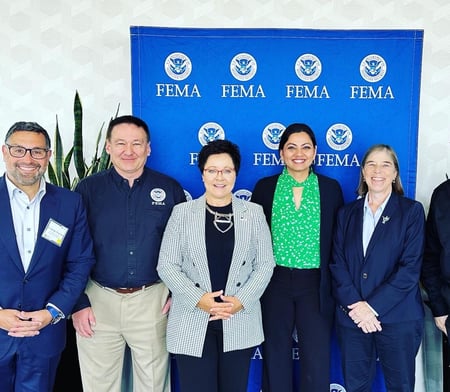
Rao with the occupational heat panelists at the FEMA Heat Summit.
With its adaptable structure, the CU fellowship allowed Rao to balance her own environmentally-focused nonprofit, Nordson Green Earth, with projects at FEMA. She also spent time with Healthcare Without Harm, a global healthcare sustainability organization and EcoAmerica’s Climate for Health Initiative This breadth and scope of work sharpened her expertise in environmental issues and helped her establish valuable connections with a variety of multidisciplinary experts working in climate and health.
In addition to the fellowship, Rao has completed three of the five certificates available in the Diploma in Climate Medicine at the CU School of Medicine: Foundations in Climate Medicine, Sustainable Healthcare, and Community Resilience.
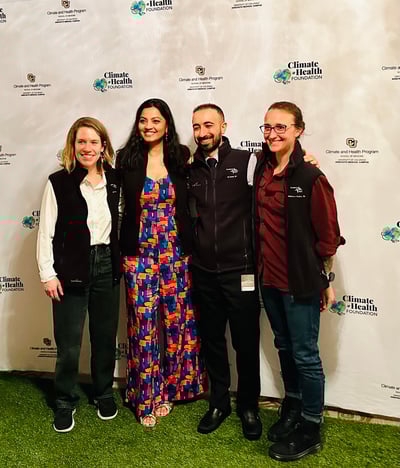
Rao alongside the other 2023 fellows at their Climate and Health Science Policy Fellowship graduation.
Creating a greener world
In 2020, seven months into the COVID-19 pandemic, Rao stepped away from her medical practice due to a combination of moral injury and shifting responsibilities at home. Like many others in medicine and public health, she had grown frustrated seeing the most vulnerable populations repeatedly pay the price for the nation’s lack of investment in primary and preventative care. She also saw how the pandemic had brought to light the harms of unaddressed health and racial inequities. When a dear friend, Christine Diploma, approached her to start an environmental non-profit, indoor restrictions from COVID policies drew their attention to the lack of availability of safe, green, and accessible outdoor spaces. They learned that previously redlined communities have roughly 30% less tree canopy, which can make them 5-12 degrees Fahrenheit warmer than non-redlined areas and more prone to flooding.
Rao decided to take action.
Rao and Diploma created the Nordson Green Earth Foundation with inspiration from Diploma’s octogenarian uncle, Nordy, who planted 200 acres of native forest in an industry-degraded area of the Philippines. His efforts blossomed into a lush forest that helped the local community with food and jobs and encouraged the building of a STEM school in the area.
The mission of Nordson is to work with communities that have historically been disinvested of tree canopy and green spaces, adding nature back into those communities with a focus on physical and mental health benefits.
Using the Miyawaki method of planting for urban areas, Nordson implemented the first Miyawaki mini-forest in Illinois. “All you need is a couple of parking spots worth of space, and you can plant a tiny forest with all native plants that will grow to maturity in 20 years,” Rao says. “It requires no pesticides and only three years of weeding and watering, followed by periodic invasive species removal throughout its life.”
Their forest reached the three-year mark this May.
The mini-forest is located at the Cook County courthouse in Markham, Illinois, a southern suburb of Chicago that experiences many of the same economic and health inequities as the city but less resource allocation. Nordson then partnered with the local library to create more green programs. The latest two projects are a butterfly garden at the library and a native prairie walking path funded by a corporate donor.
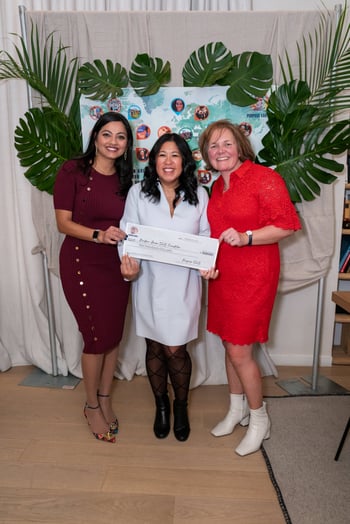
Rao and her colleagues at the Nordson Green Earth Foundation celebrating their first grant.
Rao, Diploma, and their foundation emphasize the health and community co-benefits of their environmental work. In the butterfly garden, local high school art students created murals and the library hosts children’s reading programs. A citizen science project is planned for the walking path involving the new bird habitat that was created through the installation of native plants. A community volunteer committee guides project development, species selection, and helps with local engagement.The mini-forest invites biodiversity and helps fight flooding in cases of extreme weather. In addition to the environmental and heat-shielding benefits of the new plant life, Nordson’s projects have reach into literacy, art, and community action.
Rao takes her commitment to climate health beyond her nonprofit and clinical work. When the UIC School of Public Health’s Center for Climate and Health Equity kicked off its new Green Remedies for Optimal Wellness (GROW) program this summer, Rao’s role involved developing and teaching climate and health content to a group of 14–21-year-olds in the climate justice community of Broadview, Illinois. Students then applied their knowledge to solve priority climate issues in Broadview like heat and flooding. They also learned how to market their ideas to local leaders and apply for micro-grants to implement their solutions in real life.
Across all her fields of work, Rao strives to bring community, health, and justice to people on the front lines of climate change.
“Working in the climate and health field can be very challenging because there are so many ups and downs,” Rao says. “Yet having this kind of upstream impact on health and a chance to work with smart, caring, like-minded people from different backgrounds and disciplines – it gives me hope.”
.png)