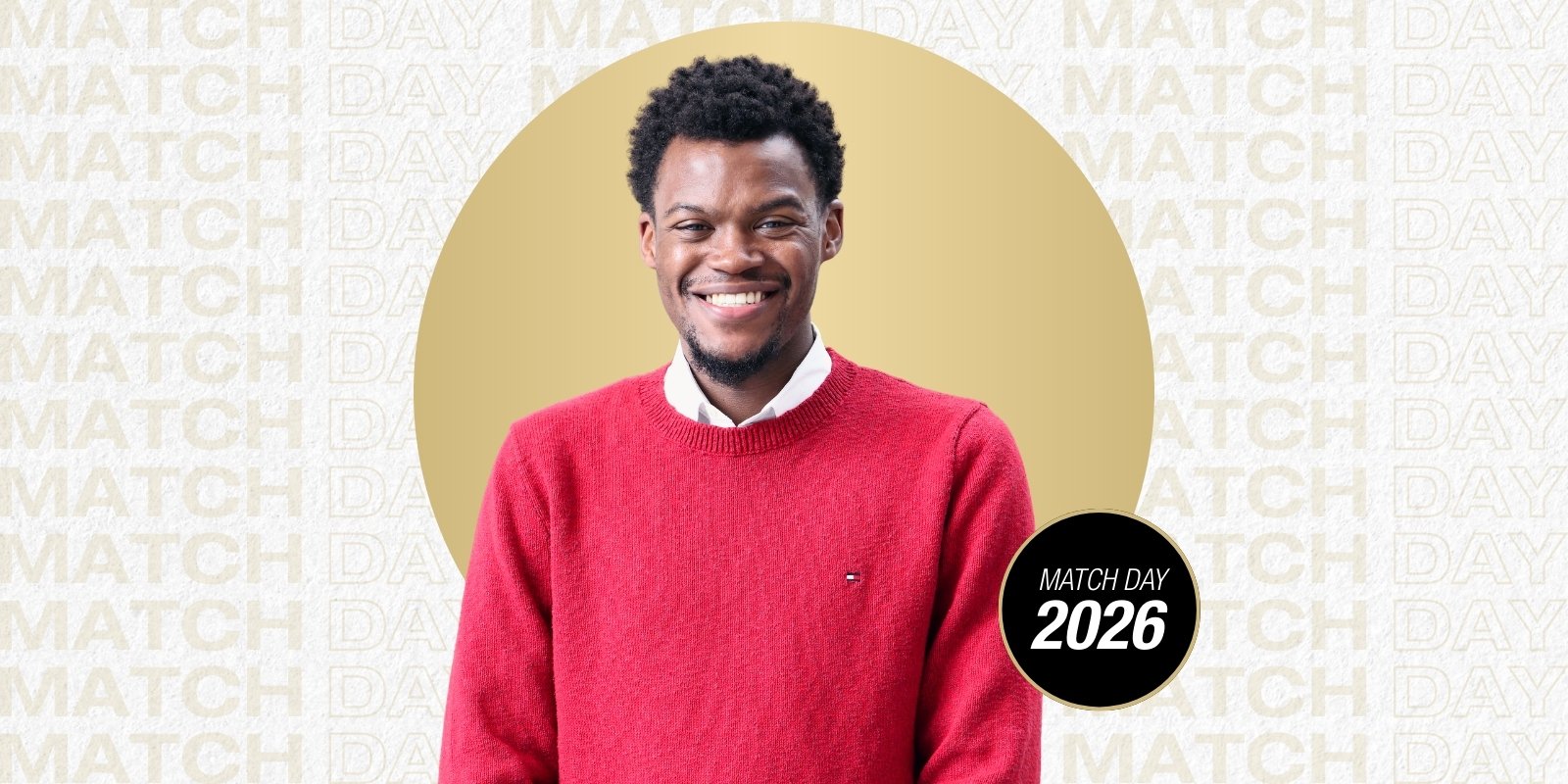
As a young adult considering his career options, Peyton Boyd saw two clear — but very different — paths: acting or medicine.
“During undergrad I was at a crossroads. Do I want to do something more science based or something in humanities? In my mind I was either going to be a doctor or an actor,” says Boyd, who is solidly on the path to becoming the former.
On March 20, he’ll join his classmates at the University of Colorado Anschutz School of Medicine in learning where his medical training will take him next. Each spring, the National Resident Matching Program releases results to applicants of residency and fellowship programs. Match Day, as it’s been dubbed, is a moment that often defines the trajectory of a medical student’s professional career.
For Boyd, that’ll hopefully be in a family medicine residency program where he’ll get to hone his skills so that one day he can work in a community clinic helping patients be their best selves.
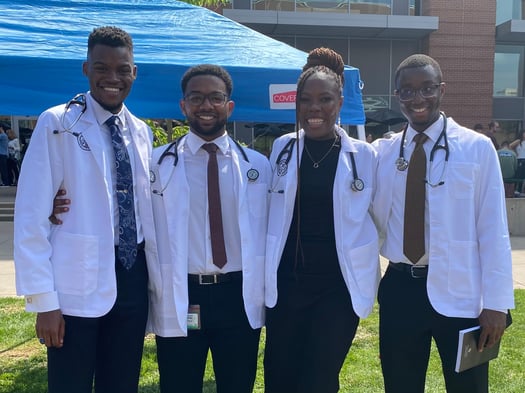
Peyton Boyd, left, with students in their white coats. Photos courtesy of Peyton Boyd.
Finding a calling
Outside of seeing his pediatrician as a child, Boyd says he didn’t have many interactions with medicine – but he was always interested in science, and when a family friend let him shadow at a health clinic during college, it all began to click.
Now, a future in medicine is more tangible than it’s ever been. Boyd sees himself in family medicine. It’s a decision he’s confident in thanks to the ambitious Trek Curriculum at the School of Medicine, which allows students to immerse themselves in a variety of specialties early on in their education.
“There was a lot that I liked in my rotations, but ultimately, family medicine gives me the full flexibility to do a little bit of everything,” Boyd says. “If there’s a time in my career where I want to carve out a niche space for myself, I can do that.”
Meaningful connections from classroom to clinic
In addition to medical education, the past four years have full of opportunities for Boyd.
“I’ve made great connections with my classmates,” he says. “Having good peers makes the journey of medicine so much easier. There’s definitely some benefit to having conjoined commiseration when you’re up late studying for an exam, but it’s also important having people who know how unique this journey is.”
Those peers voted Boyd executive president for the School of Medicine’s student council this past year. The role has lent a lot of perspective the ability to grow in a leadership capacity. Often, Boyd says he’s a liaison between students and school leadership. It can sometimes be a challenging place to be, but it’s mostly rewarding.
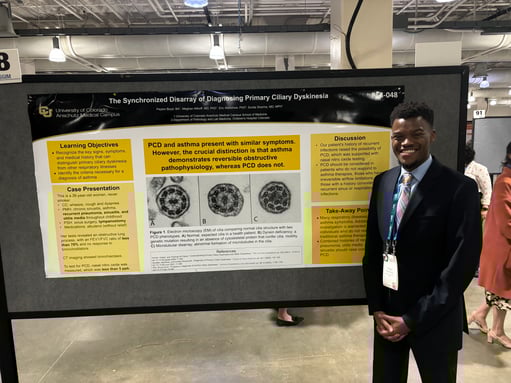
CU Anschutz medical student Peyton Boyd poses along side a poster presentation.
Off campus, Boyd volunteers at the Center for African American Health, which he says has been an eye-opening experience.
“A free clinic is much different than what you see in a university clinic. These are patients who are often underinsured or uninsured and don’t have access to primary care. This clinical experience has helped me exercise problem solving skills that are crucial in medicine.”
Finding a cross section of art and medicine
Despite devoting his life to medicine, and not acting, Boyd has still been able to incorporate his passion for the arts into his education.
During this last year of medical school, Boyd took a longitudinal course focused on the intersection of medicine and humanities. He was able to analyze movies, visit art museums, and examine other media and compare presentation of illness to real life.
He also worked on a narrative medicine project designed to help medical trainees reflect on their work – something that will likely serve him long-term.
“It’s been an enlightening way to use art in a way to help both reflect and describe the nuance and the beauty in the work that we do,” Boyd says. “It’s been one of my favorite parts of medical school.”
.png)