University of Colorado Anschutz School of Medicine student Nickole Moon, PhD, still remembers the phone call that changed everything for her family. It was roughly 5 a.m. on a cold winter morning, and Moon, a 12-year-old competitive figure skater, was riding in the car with her mother, headed to the ice rink. Then, her older brother called in a panic.
A freshman in college, her brother explained he had locked himself out of his dorm room because he thought he needed to check his car. He was certain someone had stolen his car, returned it, flattened his tires, put sugar in his gas tank, and was now stalking him. Moon’s mother was confused and scared for her child, who she would later learn was experiencing psychosis.
“He was terrified that someone was going to harm him,” Moon says. “He ended up in the hospital, and he was diagnosed with schizophrenia.”
Not knowing what the diagnosis really meant, Moon began searching for answers in textbooks at the public library, hoping to find ways to help. Much has changed in the nearly 20 years since then, but Moon’s search continues. Except now, instead of consulting the Encyclopedia Britannica, she is conducting her own neuroscience research while simultaneously training to become a clinician through the medical scientist training program (MSTP) at CU Anschutz, a program in which students earn both an MD and PhD.
On March 20, Moon will be among thousands of medical students across the country who will learn, on the same day at roughly the same time, which residency program they will join after graduating medical school this year — an annual occurrence known as Match Day. It represents the next major step in her pursuit of becoming a psychiatrist, researcher, and advocate who helps improve care for people with psychotic spectrum disorders.
“Hope, in some ways, is something we choose,” Moon says. “When someone faces really difficult situations, it can be difficult to find. If we have a sense of where we want to go, that makes it easier to find hope within us — and that’s such a privilege for me to help people figure out what that is for them.”
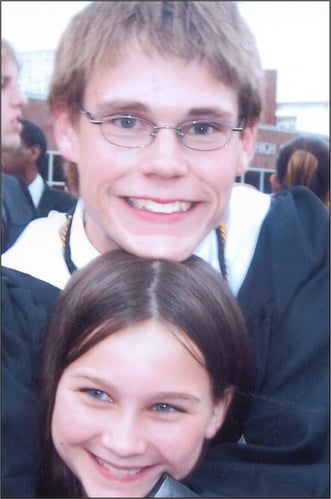
Nickole Moon smiling with her brother at his high school graduation in 2006. Images courtesy of Moon.
An unexpected diagnosis
Growing up in Harford County, Maryland, Moon’s initial aspirations were to either be a competitive figure skater or a marine biologist. Her brother, who was president of student council and captain of the lacrosse team in high school, dreamed of entering politics.
As Moon began middle school, she started to notice her brother acting out of character, such as accusing her of stealing from him and looking through her purse. Looking back, she sees the behaviors were early signs of schizophrenia, a condition that usually becomes apparent in men during their late teens or early 20s.
When Moon’s brother was first diagnosed with schizophrenia in 2007, it marked the beginning of a long, complex journey, with her brother seeing more than 45 doctors, trying over a dozen combinations of medications, and ultimately being diagnosed with treatment-resistant schizophrenia. Moon researched alongside her mother for answers, thinking, “There must be something we could do to bring him back to where he was before,” she says.
“Now, he has found a medication that has helped him move forward and identify what his goals for recovery are,” Moon says. “Recovery is day by day, but he’s doing much better than he was.”
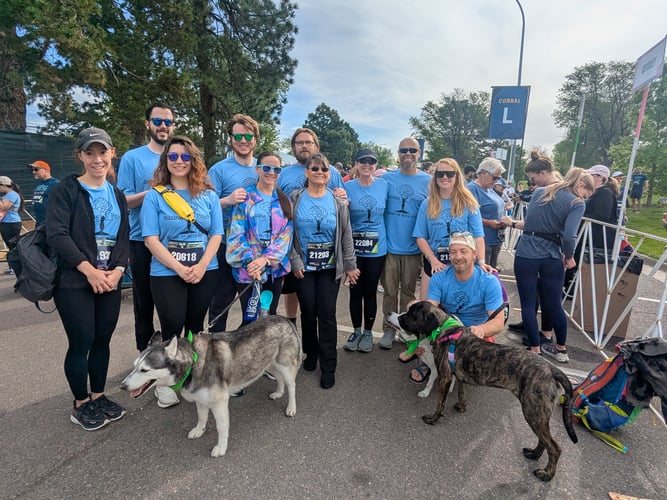
The SeizingPsych team smiling for a group photo during the 2025 Denver Colfax Marathon race weekend. It was the organization's third consecutive year as a charity partner with the race, and SeizingPsych will be a charity partner again for 2026. The 2026 Denver Colfax Marathon will be Moon's ninth marathon, commemorating nine years of training for her PhD and MD and nine years since SeizingPsych was founded.
How a class assignment became a national organization
When Moon was assigned by her seventh grade English teacher to write a persuasive speech, she never expected it would eventually lead to her co-founding a national organization, SeizingPsych, that aims to help individuals with mental health illnesses and their caregivers.
Her speech highlighted the barriers that can impact people with mental health conditions, including funding discrepancies in research and care, the potential for discrimination, and the experiences of families like hers. Moon was asked to present the speech at a National Alliance on Mental Illness Maryland conference in 2008, and it led to her connecting with other local organizations to do similar outreach.
“During college, I recognized that this work was great at starting discussions and addressing stigma, but there were so many other families who are experiencing that loneliness and confusion about how to navigate the health system like my family had,” Moon says. “I went to my mom and asked what she thought about turning this public outreach into an organization that can actually feed back into helping families directly.”
It was the start of SeizingPsych, which is now a 501(c)(3) organization that offers support groups for caregivers, one-on-one calls, and helps connect people with additional resources and experts in the field. Moon serves as president of the organization, her mother works as the executive director, and her brother works as the social media director and a peer contact, meaning he meets with individuals and families to offer his perspective on certain aspects of his medical journey.
A long-term goal for Moon is to develop a peer-facilitated treatment facility where people with a mental illness diagnosis and caregivers can be paired with someone, or a group of people, to get support. She would also like to incorporate medical care, providing access to psychiatrists and counselors at the facility.
“No one should have to walk this path alone,” Moon says. “Everyone should have the opportunity to be active in their own recovery and decide what their goals are.”
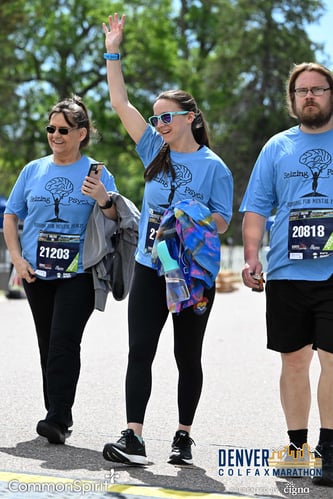
Nickole Moon, center, smiles with her mother, left, and brother, right, as they finished the 2025 Denver Colfax 5K race.
The journey to CU Anschutz
Moon started college at Suffolk University in 2012 with the intention of becoming a counselor, but as she progressed in her studies, she missed the hard sciences. Being a first-generation college student with no other family members in medicine, she was unsure if it was possible to blend her interests. She searched online to learn whether people can conduct research and work with patients at the same time. That led her to MD-PhD programs.
Moon connected with an advisor and began searching for a college that would help her become a competitive candidate for MD-PhD programs. She transferred to the University of Pennsylvania in 2014 and completed a bachelor’s degree in 2017.
After college, Moon matriculated directly to the University of Maryland as an MD-PhD candidate in a medical scientist training program. She was interested in epigenetics research, which examines how people’s gene expression may be affected by their surrounding environment, such as what they eat and their physical activity. Moon found a mentor in Tracy Bale, PhD, whose research focuses on understanding the role of stress dysregulation in neurodevelopmental and neuropsychiatric diseases.
“I started my PhD with her, and she was working on studying paternal stress in sperm, asking questions such as what the mechanisms are by which a cell changes its trajectory, and whether stress through sperm could influence offspring development," says Moon, who worked in Bale’s research lab.
After a few years, Bale shared that she planned to transfer her work to CU Anschutz, where she is now a professor of psychiatry, to collaborate with C. Neill Epperson, MD, chair of the psychiatry department. Wanting to continue this work with Bale, Moon proposed that she transfer to CU Anschutz as well.
“We’ve been working to translate our research findings from animal models to the human population, and that has been a really impactful and helpful process for me to see,” Moon says. “It shows how collaborations between researchers can be successful — because just like recovery, science is not something you can do by yourself.”
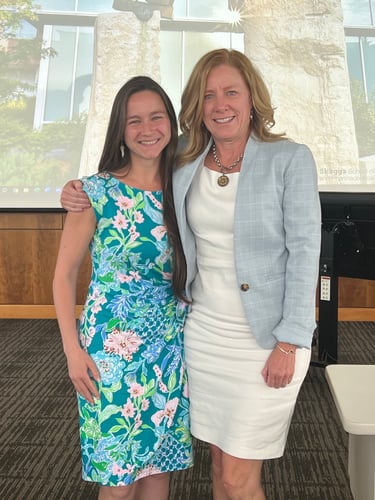
Nickole Moon, left, smiling with Tracy Bale, PhD, after Moon passed her PhD defense in 2024 at CU Anschutz.
‘A phenomenal experience’
Once at CU Anschutz, Moon quickly immersed herself in the student community, joining the MSTP national MD-PhD student conference planning committee and the MSTP student council at CU Anschutz, where she helped foster connections and mentorship opportunities.
She also joined the Health Professional Students for Public Health Advocacy and Policy Participation, an organization that helps students learn how they can get involved in their communities and create positive change for patients.
“I think developing community is so important, and it’s something I’m proud of doing,” Moon says. “It’s been such a phenomenal experience. At CU Anschutz, the people are there for each other, they want others to succeed, and they’re all so good at what they do.”
In 2024, Moon completed her PhD in neuroscience, and this May, she will earn her MD. Moon knew psychiatry was the right path for her once she began working in the Program for Early Assessment, Care, and Study (PEACS), a program devoted to helping young people at risk for psychosis and their families.
“I loved the idea of following patients closely who are at high risk and seeing them as frequently as they need,” she says. “Providing multidisciplinary care through psychology and psychiatry to help them and their family understand what is happening is so important.”
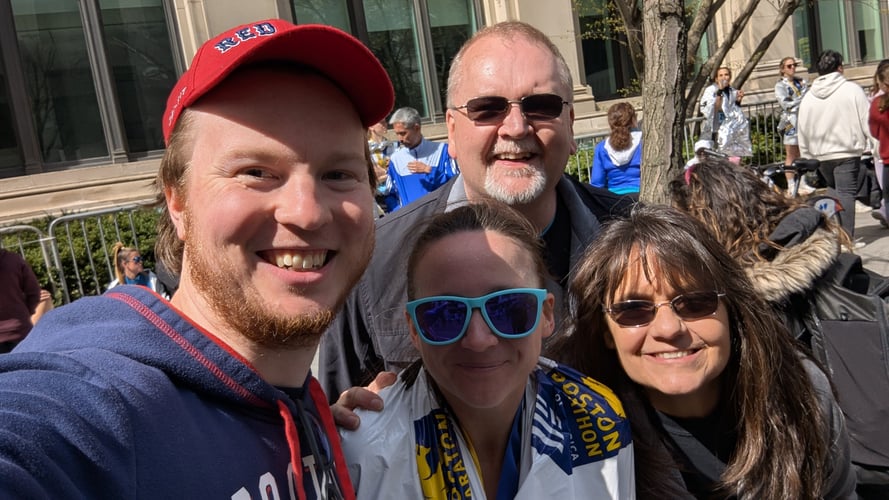
Nickole Moon, center, smiles with her husband, left, her mother, right, and her stepfather, back, after Moon finished the 2025 Boston Marathon.
The next chapter
For residency training, Moon hopes to match into a research track psychiatry residency program. This type of program provides time to conduct research and further hone clinical skills.
Some of Moon’s research goals include uncovering how psychosis can manifest and affect people differently, whether there are different subtypes of schizophrenia, and ways to improve treatments.
“Ultimately, there must be reasons why so many people are like my brother and don't respond to many of our treatments,” Moon says. “What is different about that? Is there something occurring early on that we’re missing, or is it due to different populations of people presenting with similar symptoms?
“Because I hypothesize that schizophrenia is probably not one disorder, but rather a number of disorders with different molecular mechanisms that converge on similar symptoms.”
Clinically, Moon wants to help populations who have a high risk for psychosis, as well as provide care to families of these individuals to help create strong support systems for these patients.
When she imagines her career 20 years from now, Moon hopes it will be a blend of her clinical and research interests. One idea she has is to develop a longitudinal clinic where patients can get care for years while simultaneously participating in research, allowing Moon to document changes over time, reactions to medications, incidents of psychosis, and potentially translate her scientific findings into tangible ways to help patients.
As Match Day approaches, Moon feels both nerves and excitement as she awaits what will come next.
“No matter what your journey is — whether it’s a mental health journey, research journey, medical journey, or a combination — there is light at the end of the tunnel,” Moon says. “The journey to that light can be exciting, and it can also be hard. Having hope and being curious through that process is a great way to get there. No one should walk these journeys alone, so finding a supportive community is key.”