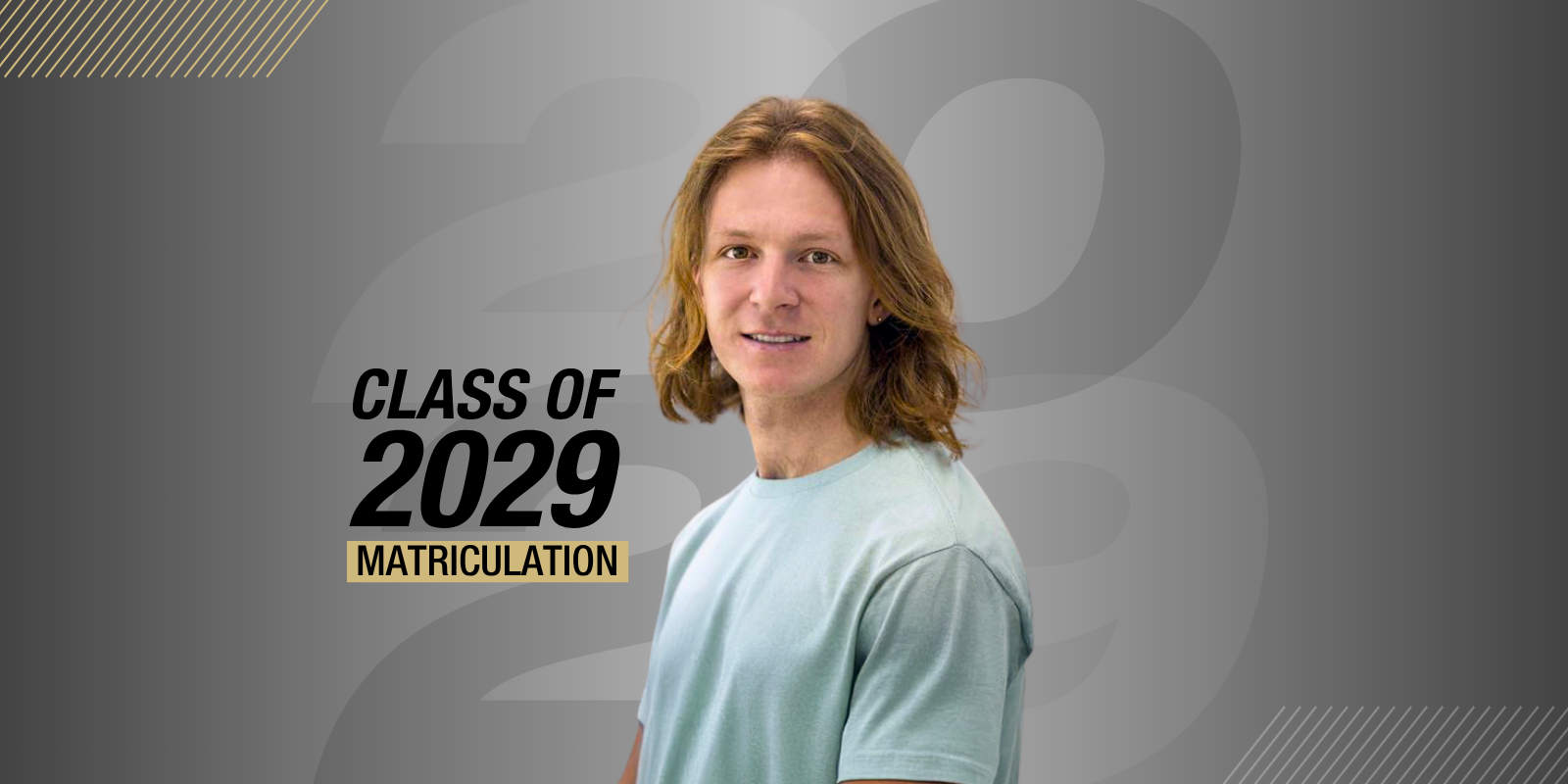
Whether conducting research in the Democratic Republic of the Congo or rock climbing above the Pacific Ocean in Canada, Cameron Meikle follows where adventure calls. Now, he’s preparing to embark on one of his biggest adventures yet — joining the University of Colorado School of Medicine to become a physician.
Raised in the small rural town of Hamilton, Montana, Meikle found a passion for science at a young age, thanks to the frequent at-home science experiments created by his dad, an ecologist. But his desire to become a doctor didn’t come until later, after a series of research projects that took him to different continents and an experience as an environmental educator.
“I think about medicine as very interdisciplinary. That’s why I came to Colorado, because there is a need for doctors who are a jack of all trades,” he says. “I have a lot of interests and ideas, and I want to be someone who can think about both the science and the human aspect as well.”
Delving into science
Meikle witnessed the power of research in 2014 when he saw scientists rapidly transfer their laboratory findings into clinical practice in response to an Ebola outbreak in West Africa. Still in high school at the time, he was working at the Rocky Mountain Laboratories in Montana.
“It was interesting to get a glimpse into how the field of infectious diseases works,” he says. “I always thought it was really unique how scientists have to take their basic research and find ways to apply it clinically to respond to an outbreak of something.”
Although his grandmother always told Meikle that he would be a great doctor, he wasn’t initially sold on the idea. He thought that academia and being a professor may be a better fit, so he majored in biology at Carleton College. At the same time, he continued his legacy as a track star, serving as captain of the college’s varsity cross country and track and field team from 2017 to 2020.
“Because it was a liberal arts school, I also took a lot of classes outside of the sciences, and I think that gave me a real appreciation for the humanities,” he says. “That was the start of when I began considering a career in medicine.”
‘Fit my personality better’
In 2018, two years after starting college, Meikle worked in Seattle for the summer as an undergraduate researcher in a virology laboratory at the Fred Hutchinson Cancer Research Center, learning how viruses can evolve. The following summer, in 2019, he traveled internationally to work as an undergraduate researcher at Imperial College London, conducting biochemical analyses of virus-like particles and influenza.
In 2020, when COVID-19 halted plans for fellowship in the United Kingdom, he joined the University of Utah School of Medicine as a laboratory technician, where he connected with influential mentors.
“I started thinking more seriously about medicine because I had done some shadowing with Dr. Jamie Dwyer, a nephrologist and family friend who also does clinical trials,” he says. “I like research a lot, but it was quite isolating. Seeing Dr. Dwyer interacting with patients was amazing, and I realized that getting to work with people would fit my personality better.”
With thoughts of becoming a physician still on his mind, Meikle went to the University of Wisconsin-Madison as a research assistant in 2022. While there, he shadowed another physician who encouraged Meikle to consider — before starting medical school — a job that was outside of the world of research and medicine to see if he would enjoy it. That advice led him to join the AmeriCorps VISTA program and work for a year as an education coordinator at the Great Basin Institute in South Lake Tahoe, California.
“I secured $10,000 in funding and was able to develop and run a citizen science project for high school students, many of whom had never done anything like that before. It was amazing seeing some of those students light up and talk about how much better this learning experience was compared to sitting in a classroom,” he says. “That job clarified to me that I liked working with people, but I also missed some of the rigor of the sciences. It solidified that I should head into medicine.”
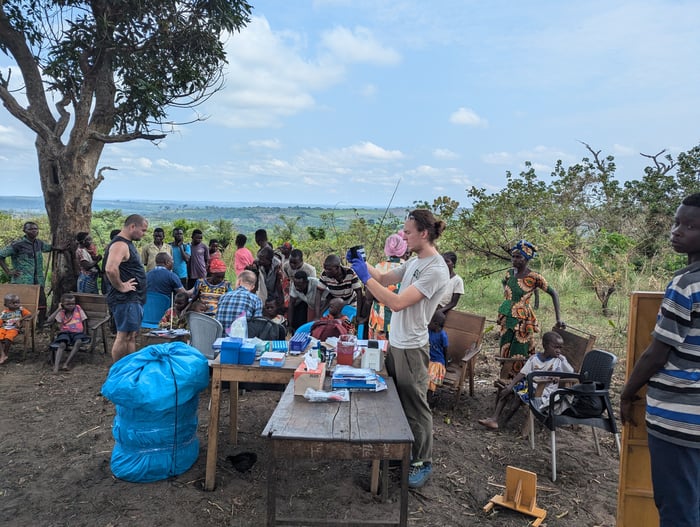 Cameron Meikle, standing in the center, spent nearly a month in the Democratic Republic of the Congo in October 2024. Image courtesy of Meikle.
Traveling to the Congo
After completing his time in the AmeriCorps program, in 2024, Meikle began the process of applying to medical school.
He also joined the University of Nevada, Reno as a research staff member, where he helped David McIlwain, PhD, an associate professor of microbiology and immunology. Meikle was able to travel with McIlwain to the Democratic Republic of the Congo to learn how to apply medical research in communities with fewer resources. They were studying a neurological disease called konzo, which is associated with eating a root vegetable called cassava that has cyanide in it.
“To get rid of the cyanide, you usually have to soak the cassava in water,” he says.
There was a group of scientists who tried to address this issue by building wells in these villages, Meikle explains, but the problem was that some people took ownership over the well and charged others to use it, resulting in the wells not being used and going dry.
“That is a human problem and a barrier to solving this medical issue, and I’m intrigued by that. I wonder, how do you apply innovative ideas in these settings? Because it was an idea with good intentions, but it didn’t fit the actual needs of the community,” he says. “Figuring out how to use cheaper technology effectively in low-resource settings is interesting and something I would like to explore in the future.”
 One of Cameron Meikle's passions is rock climbing, which has taught him how to trust himself when taking on daunting challenges. Image courtesy of Meikle.
A new adventure at CU
Meikle was selective about which medical schools he applied to. CU stood out to him because of its robust infectious diseases program, the One Health concept at the Fort Collins Regional Campus that focuses on health connections between humans, animals, and the environment, and the school’s unique longitudinal integrated clerkship model.
“I also wanted to have access to the mountains, because I find a lot of solace and purpose in being outdoors,” he says.
In the four years ahead, he aims to be a sponge, absorbing as much information as possible, exploring different medical specialties, and building his skillset in helping patients. Ultimately, he hopes his future career will involve research, clinical work, and innovation, brainstorming better ways of improving patient care in real-world settings.
.png)