
It wasn’t one lightning bolt moment where Jaydep Halder knew he was destined for a career in medicine, but rather a series of small glimmers that kept guiding him toward a unique path, carved by his desire to combine policy and health care.
The incoming University of Colorado School of Medicine student, who will be part of the Colorado Springs LIC Program, says those flashes of a future in medicine started early. At 11 years old, a primary care physician became a beacon of hope for Halder during a period of allergic dermatitis.
“It was a moment of despair for me, and I was in a lot of pain and discomfort, but my doctor helped me realize the power a physician can have on a patient’s life,” Halder says. “Having somebody who could guide me through treatment, provide reassurance, and help me understand made a big difference.”
From there, Halder took up an interest in science. He double majored in microbiology and sociology at the University of Pittsburgh, where he also co-founded the Pittsburgh Policy Initiative, a think tank dedicated to helping students pursue policy research experience.
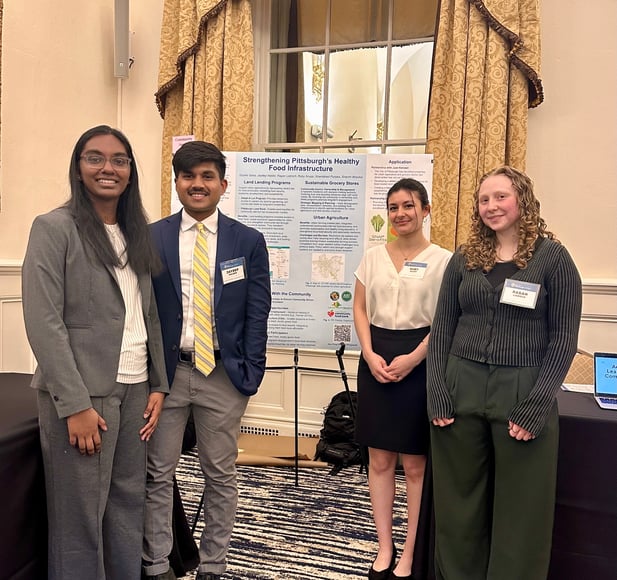 Jaydep Halder and PPI’s Food Security Team presenting at the Spring 2025 Frederick Honors College Research Symposium.
Through student government, schoolwork, and internships, Halder, who originally hails from Jefferson City, Missouri, has amassed a distinct perspective that will set him up for future in medicine.
On July 25, at the Class of 2029 Matriculation Ceremony, Halder will join 183 fellow incoming students and begin the next leg of his medical education journey.
A ‘two-pronged approach’
Halder says he wasn’t set on applying to medical school when he first took up his microbiology studies, but over the course of a year while he shadowed physicians, he again saw the positive impressions they were leaving with their expertise and care.
“At the same time, I’d really developed a passion and interest in health policy, and I spent a lot of time thinking about how to create community engagement and bridge communities and policy. As a health care professional, you can advocate for those that are less privileged than you and promote policies that can increase the ability of medicine to cure diseases, increase access, and improve affordability and feasibility of medicine,” he says.
“In my career, I would love to have this two-pronged approach, where I can have population-level impact, but also contribute to meaningful patient care,” he continues.
In student government, he got a taste of the policy piece by advocating for various health policies, including successfully pushing for the acceptance of SNAP benefits at the university-owned market, and in an internship with the U.S. Senate, he got to see how laws and policy affect communities and constituents.
Embracing the next chapter
As the start of medical school approaches, Halder says he’s keeping his options open to various specialties and opportunities — just as he always has — so that he can learn as much as he can to further sculpt his space in medicine.
“As much as I’m not sure what exactly to expect yet, I am excited for the experience,” he says. “It’s going to be great to dive deep into medicine.”
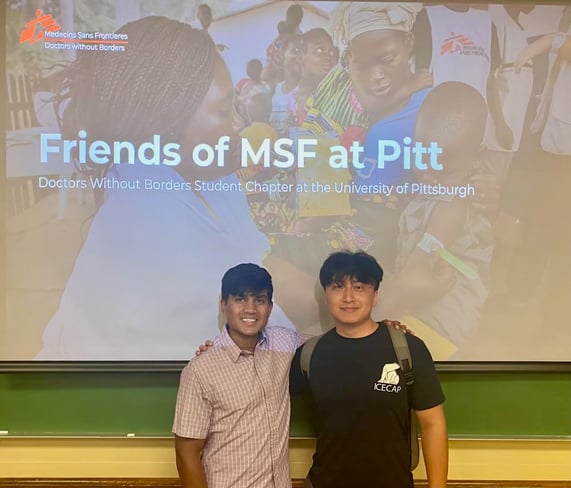 Jaydep Halder, left, with another member following a Médecins Sans Frontières general body meeting. Halder served as president of the chapter his junior year of college.
With a solid foundation in policy and advocacy, now is the time to work on the clinical side.
One of the appeals of choosing to attend the CU School of Medicine, he says, is the emphasis on early clinical exposure and the focus on community engagement. As part of the Colorado Springs LIC Program, Halder will interact with various patient populations, communities, and develop a comprehensive understanding of health care and medicine.
“I want to see everything,” he says.
.png)