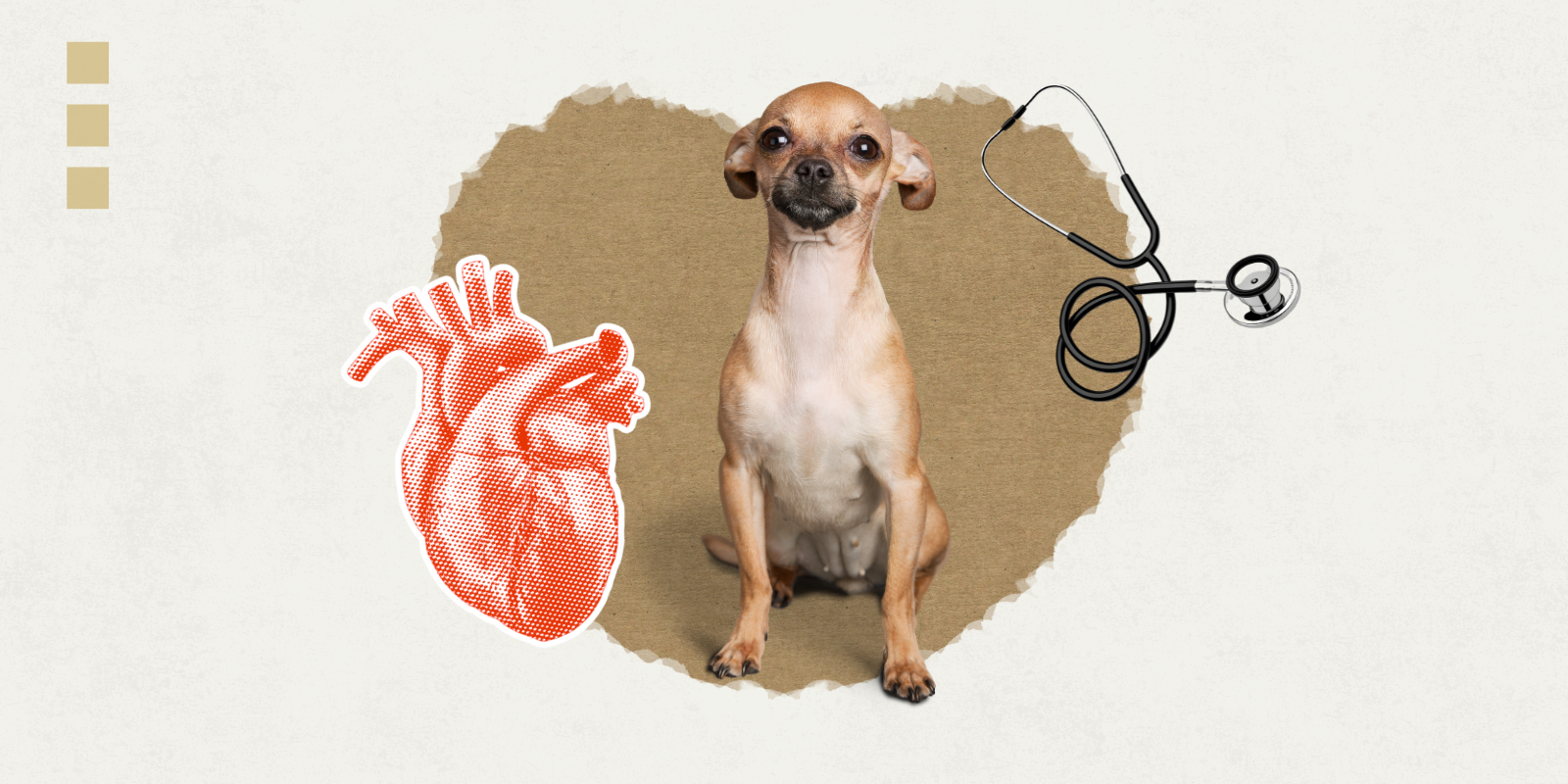
Mitral regurgitation is the most prevalent valvular heart disease in humans. It’s also common among dogs, especially older and smaller breed dogs.
In both species, the mitral valve fails to close tightly enough to keep blood from flowing back into the left atrium as the heart is contracting. Untreated, it can lead to heart failure. Surgery is often needed to repair this issue in humans. For dogs, treatment has historically been less advanced, but veterinarians and animal researchers are taking cues from the human health world.
Interventional cardiologist John Carroll, MD, professor emeritus of cardiology at the University of Colorado Anschutz School of Medicine, has been performing these procedures in people for decades. In 2013, when the mitral transcatheter edge-to-edge repair (M-TEER) procedure became available in in the United States, it was considered a gamechanger due to it being minimally invasive and non-surgical. Now, a similar approach might be for dogs with mitral regurgitation, too.
“Both animal and human cardiologists have a lot to learn from each other,” says Carroll, who has been working with researchers at the Colorado State University College of Veterinary Medicine and Biomedical Sciences for over a decade.
Together, they’re pushing forward thoughtful and innovative ways to adapt human health interventions to dogs.
The promise of M-TEER
During the M-TEER procedure, an interventional cardiologist guides a catheter up the femoral vein to the heart and clips the valve leaflets together with a clamp at the anatomical location where the two mitral leaflets fail to form a tight seal. This helps reduce the backflow of blood and alleviate symptoms and problems that arise in mitral regurgitation.
In many cases, Carroll says, patients are discharged from the hospital the next day and recovery is far less rigorous than that of open-heart surgery.
Animal researchers around the world are looking to the M-TEER procedure and how to best translate that success to canines. A notable challenge, however, is that a dog’s veins are much smaller than that of a human, so using the same tools isn’t a feasible option.
Instead, a veterinarian can achieve a similar result through a small chest incision. Just like in humans, transesophageal echocardiography helps guide the placement of the clips.
Early results of using M-TEER in dogs holds promise, but there’s a “steep learning curve” of the novel therapy, say Carroll and veterinarian Chris Orton, DVM, a professor of clinical sciences at CSU, who recently published a paper in the Journal of Veterinary Cardiology that compares the procedure in humans and dogs.
Orton, a cardiac surgeon, has been a leader in this application for dogs.
“Likely, we are at a critical juncture. It is reasonable to expect that for canine M-TEER, the various members of the team will be working on a variety of learning curves, some similar to the human M-TEER experience and some unique to M-TEER in dogs,” the duo writes. “Centers achieving early competence must share their experiences with other centers and report outcomes.”
Training will be key, they continue: “There is an opportunity for collaboration rather than competition with a shared goal that high-competency M-TEER will be available to any dog that needs it and any dog owner who desires a less-invasive interventional option.”
‘Just like the patient I treated two days earlier’
In his work in the clinic, Carroll saw patients with mitral regurgitation every day — and he was able to help many of them — but it was Mango, his daughter’s small chihuahua, who opened his eyes to the need for more research and treatment options in dogs.
“Mango started coughing and not looking well, and it turned out he had severe mitral regurgitation and was in heart failure,” Carroll says. “The pathology of mitral regurgitation in dogs is very similar to humans, a degenerative form with mitral valve prolapse. The treatment in dogs, and in Mango’s case, was some of the same medications we use in adult medicine.”
Carroll remembers being at Mango’s cardiac ultrasound. “It looked just like the patient I had treated two days earlier,” he recalls. “The same anterior leaflet of the mitral valve kept going backward into the left atrium, opening this big gap between the leaflets where blood was reverse in its flow.”
Eventually, Mango’s condition worsened despite medical therapy. The family made the difficult decision to put the dog down. TEER procedures and surgical procedures for valve repair are limited, so most dogs with mitral regurgitation share similar experiences to Mango and live the remainder of their lives on medication with ongoing symptoms, including reduced exercise tolerance.
Developing TEER procedures in dogs could change that, but it’s not yet widely available to most pet owners.
Rewarding partnerships
Over the years, Carroll’s partnership with animal cardiologists has been beneficial, he says.
“Dogs can’t come in and say, ‘I’m short of breath’ so it’s interesting to see how vets assess animal symptoms. Working with human patients, this lends appreciation and you learn some subtle clinical insights that are germane to the human condition,” he says. “While the main focus has been on how the human experience can help the experience of TEER in dogs, really, the information and the clinical experience flows in in both directions.”
For more than 10 years, he’s been collaborating and sharing insight with Brian Scansen, DVM, professor and director of the Don Lockton Family Heart Center at CSU. In 2015, Scansen arrived at the university hoping to pave the way in animal interventional cardiology, so he reached out to Carroll.
Over the years the two have observed each other’s operating rooms, shared parallels in cases, and sought advice in training the next generation of cardiologists.
“The way I look at it, human medicine has the research and development and industry to develop more treatments and therapies, and we in the animal world can look to them for what works and what they’ve discovered and apply it to our patients,” Scansen says.
In many ways, it closes the loop, he continues, because research for human medicine often relies on research in animal models: “Why not complete that circle and take what we know works and bring it back to animals that suffer the same diseases?”
“I've always felt that collaboration in medicine can be very rewarding,” Carroll says. “In human medicine, I've collaborated with cardiac surgeons, neurologists, and other specialties. This foray into veterinarian medicine was new, but also very, very rewarding.”