With funding from the National Cancer Institute (NCI), the University of Colorado Cancer Center is launching a new program to engage youth in the neighborhoods around the CU Anschutz Medical Campus and inspire their interest in careers in science and research.
The CU Cancer Center’s Office of Cancer Research Training and Education Coordination (CRTEC) received the funding through the NCI’s Youth Enjoy Science (YES) Program, part of the National Institutes of Health Research Education Program that aims to encourage individuals who have not had substantial biomedical research experience, or who have the potential to significantly benefit from additional biomedical research experience, to pursue further studies or careers in research. Additional funding for the program comes from the Department of Medicine and the Division of Medical Oncology.
“A pilot for this program was established in Baltimore, with the idea of, ‘If we organize a program led by faculty, medical students, and PhD students, with the intention of mentoring and helping foster the education of children, specifically children in high school, could we make a positive impact on the community by mentoring them?’” says Eduardo Davila, PhD, professor of medicine and associate director of CRTEC. “It turned out to be an incredibly fruitful program that dramatically increased graduation rates, truancy rates, and the students’ grades. The side benefit was that it was entirely based on cancer research.”
Engaging students and teachers
At CU, the YES program will recruit students from seventh grade through 12th grade, as well as teachers from local schools.
“The students will have different participation levels,” Davila explains. “High school students will participate in research in the laboratories of cancer center members. We're also recruiting teachers from local schools to help lead research experiences for their students. Prior to that, we will train the teachers to train the students.”
The teachers will come to campus in December or January, Davila says, where they will be paired with a research laboratory on campus. The teachers will learn to conduct a specific research project focused on cancer, and in the summer, two students and one teacher will conduct research in the laboratory of a faculty member. Teachers also will bring the research protocol back to their classrooms to train younger students. Students and teachers will be paid for their work.
“On top of that, now that we have the teachers engaged and the students engaged, we also wanted to engage our community,” Davila says. “The YES funding will also allow us to host workshops on Saturdays for parents, guardians, family members, and other members of the community. We'll provide breakfast and lunch for them, and the idea is to share with them what we do on our campus that benefits them, their students, their family members, their children, their grandchildren. We want to make this a community event to showcase how much our cancer center and our university cares for the community.”
YES program co-director Aimee Bernard, PhD, associate professor of immunology and microbiology, adds that the program’s success in other cities demonstrates the impact of getting students into real-life labs to work with real-life researchers.
“The community will be let into the wonders of science behind the scenes,” Bernard says. “They will get to see what happens in cancer-focused laboratories at a medical campus and work alongside the scientists who move innovation forward. The parents and guardians of the future scientists who participate will get to hear from their children just how impactful the experience is on their academic growth and development. Our faculty and trainees will also benefit by connecting with the community and having an opportunity to share what we do and how much we love and care about the science we do every day.”
Successful pilot
The CU Cancer Center ran a pilot of the program in summer 2025, originally funded by the CU School of Medicine.
“We were fortunate to get that funding from Dean John Sampson and Rich Schulick, director of the cancer center,” Davila says. “We were able to get our feet wet and get some experience, so we know what to expect.”
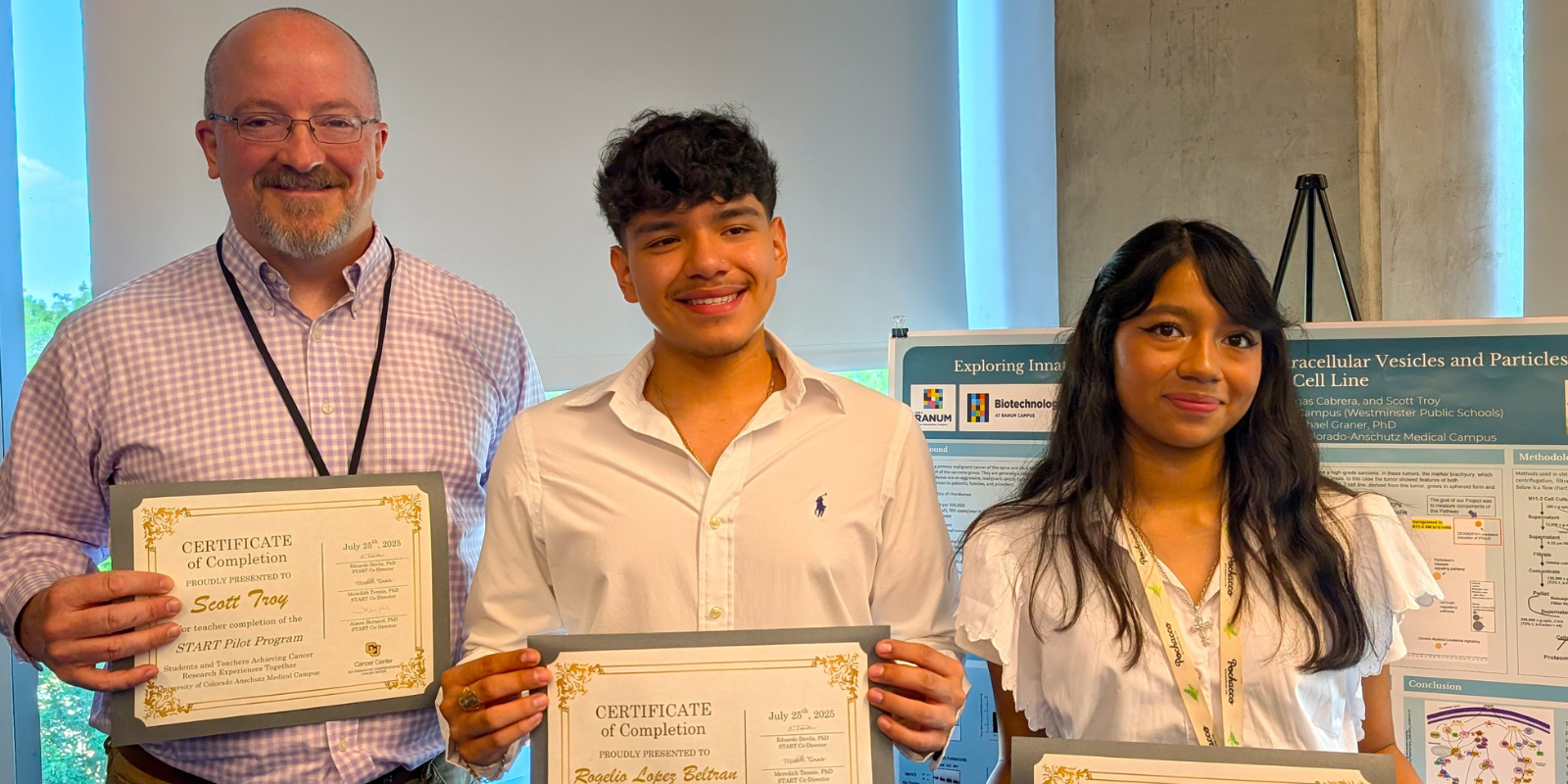
Two students and one teacher from Westminster High School worked in the lab of CU Cancer Center member Michael Graner, PhD, where they conducted research and created a poster on “Exploring Innate Immune Activation by Extracellular Vesicles and Particles in a Novel Chordoma Cell Line.”
“They did a good job, and I think they learned a lot,” Graner, research professor of neurosurgery, says of the YES pilot participants. “There's something about seeing the research develop in front of you that’s sort of like uncovering a treasure. As a scientist, that never goes away. For them to know that this wasn't just part of a class — these were real experiments, and they were doing things no one had ever done before — that sort of excitement is contagious.”
Mentorship opportunities
CRTEC plans to begin recruiting teachers for the YES program this fall. In addition to the benefit it provides to the students and educators, Davila says, YES also offers new opportunities to the graduate students, technicians, and postdocs that will serve as the participants’ lead contact in the lab.
“Because the CU School of Medicine is a professional school and it doesn't have any undergraduates, there are very limited teaching opportunities and mentoring opportunities for our students and our postdocs,” Davila says. “This program extends a unique opportunity for them to teach and mentor. It’s a win-win, in so many ways, for so many people.”
Once in place, the YES program will join other CRTEC programs — including Learn About Cancer Day, Cancer Center Research Rangers, the Cancer Center Student Symposium, and the Emerging Cancer Research Scientist Program — to continue its efforts to build the next generation of cancer researchers.
“What I've heard time and time again from students who have participated in similar programs on our campus, as well as the two students who participated in the pilot program this summer, is that they had never considered research as a career,” Davila says. “They didn't realize what scientists do. They didn't realize what it is to be in the laboratory. This was a transformative moment in their life when they said, ‘I never knew that I could make a career out of something like this,’ or ‘I didn't know I could combine my passion for medicine with research.’ It’s a truly impactful program.”
Building relationships
YES co-director Meredith Tennis, PhD, associate professor in the Division of Pulmonary Sciences and Critical Care Medicine, says the program has the potential to create a long-lasting relationship between local students and the CU Anschutz Medical Campus.
“Potentially engaging with the same students from seventh to 12th grade will build strong relationships with CU that could lead students into our undergraduate, graduate, or health professions programs,” Tennis says. “Combined with CRTEC’s BEST teacher training program, this new program could significantly increase engagement with local bioscience secondary teachers, exponentially increasing the number of students who benefit from resources at CU Anschutz.”
Featured image: Science teacher Scott Troy and students Rogelio Lopez Beltran and Leslie Vargas Cabrera, all from Ranum Innovation Campus/Westminster High School, participated in the YES pilot in summer 2025.
.png)