Amid the federal research funding disruption and updated policies of recent years, researchers at the University of Colorado Anschutz School of Medicine and across the U.S. continue to navigate a challenging and complex landscape as they seek to advance scientific knowledge.
Many research studies take years to complete and rely on continuous funding to support various needs, such as paying salaries of lab staff and students. Any interruption in the research process can delay, complicate, or even end a study.
That’s why departments within the CU Anschutz School of Medicine and Dean John H. Sampson, MD, PhD, MBA, developed a gap funding program in 2025 that would help researchers keep critical projects afloat. The program was designed specifically to provide funding for researchers impacted by funding changes from the National Institutes of Health (NIH).
Newly available data shows the program, administered by the CU Anschutz School of Medicine’s Office of Research, successfully awarded more than $1.8 million in funding to 25 awardees across campus over a period of about six months. All 24 departments within the school of medicine contributed funding, according to Leslie Berg, PhD, the school’s senior associate dean for biomedical research, and professor and chair of the CU Anschutz Department of Immunology and Microbiology.
The funding enabled numerous researchers to continue their work, and it also had a major psychological impact on campus, Berg says.
“I think it helped everybody to feel like the School of Medicine felt their pain, saw the situations our faculty were in, and did something about it,” she says. “The school’s 24 departments all provided support for people in dire situations, and the impact on morale was huge.”
Pausing research can have ‘multi-generational impact’
The CU Anschutz School of Medicine Office of Research’s NIH gap funding program was invaluable for researchers like Jeffrey Moore, PhD, a professor in the CU Anschutz Department of Cell and Developmental Biology.
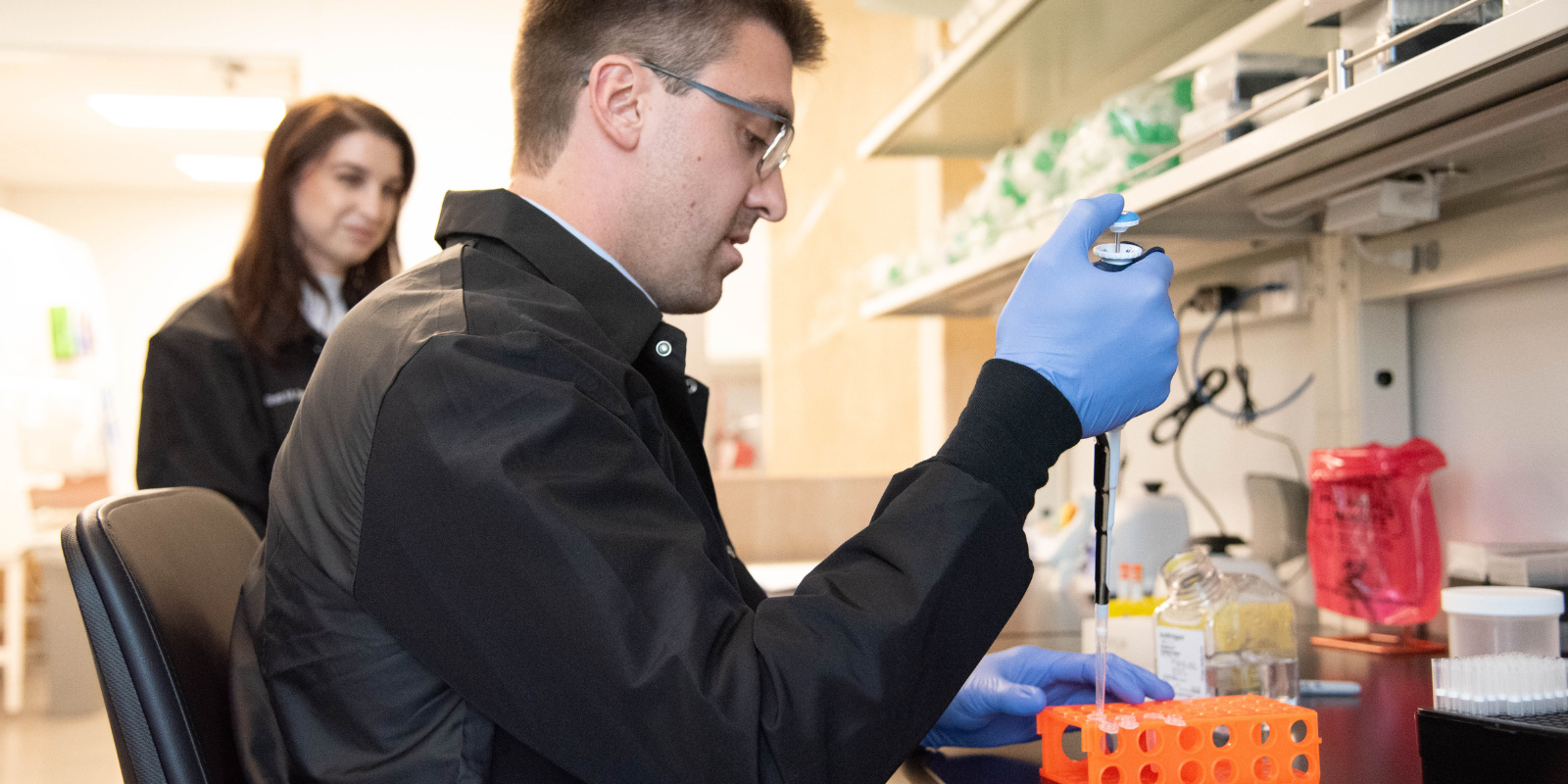
Moore has run the Moore Lab at CU Anschutz since 2012. The early 2025 NIH funding cuts were a first for him – and they posed a threat to long-term research projects in his lab that had been underway for several years. Among other projects, the Moore Lab was busy studying gene variations that cause neurodevelopmental conditions in children as well as developing new approaches to treatment. Another major project involved studying the cell biology and structure of neurons, or nerve cells.
The five-year NIH grant that funded this work was set to expire in May 2025. Moore had applied in 2024 for a new NIH grant to take its place, but by February 2025, he and his team still hadn’t heard whether they would receive funding. He spent several months waiting in limbo, but as the expiration date approached for his existing grant, Moore realized the money might not be coming. He needed to find another solution.
When faced with funding cuts, some researchers are forced to stop their work altogether. If they continue their studies, they may need to take cost-cutting measures like reducing lab staff. But Moore says when a research project is paused, a lab can also lose valuable work that’s already been done, like living cell cultures that need to be actively maintained.
“We have done all this work to build systems, cell lines, and experimental models that we wouldn’t be able to use anymore because we wouldn’t have the people or materials to keep those going,” he says. “It would be a wasted prior investment in things we could no longer use.”
Moore also notes that such pauses can disrupt the training and education of PhD students who are on their way to becoming the next generation of researchers.
“It has a multi-generational impact,” he says.
Gap funding ‘filled a void’ for impacted researchers
Fortunately, the NIH gap funding program was up and running by spring 2025. Peter Buttrick, MD, former senior associate dean for the Office of Research, originally spearheaded the program. Berg built upon the foundation Buttrick established and ensured the program’s continuing success when she stepped into the senior associate dean role last year.
The gap funding gave Moore, and many other researchers on campus, the money his lab needed to stay operational for several months. It allowed Moore to continue paying doctoral students working on their thesis projects, funding research reagents, and covering other key expenses.
Moore relied on the gap funding from May 2025 through the end of the year, and he was able to secure additional NIH funding in early 2026. Although he needed to cut spending in certain areas – such as travel to conferences – during that time, Moore was able to maintain his lab staff and keep his lab operating.
“We didn’t know what was going to happen at first,” Moore says. “The gap funding really filled that void for us.”
The gap funding program prioritized applicants like Moore who would have lost progress on their research without continued funding. The CU Anschutz School of Medicine departments rallied together to provide the funding for this crucial program, and each contributed funding regardless of whether their own researchers would benefit.
This unique interdepartmental partnership allowed CU Anschutz researchers to continue pursuing excellence in their fields even though resources were scarce and funding was uncertain.
“Just knowing the program existed, knowing that there was this help available – it meant a lot to people,” Berg says.