Before they began entering real operating rooms (ORs) as part of their clinical rotations during their second year of medical school, rising second-year students at the University of Colorado Anschutz School of Medicine got a taste of what the OR is like at a recent simulation exercise on campus.
“The operating room is a unique environment which is often first encountered during the clinical year,” says Anna Neumeier, MD, associate professor in the Division of Pulmonary, Allergy, and Critical Care Medicine, who helped design and run the exercise. “The purpose of the simulation was to introduce the students to the operating room — its environment, the roles, the culture — to improve their confidence and familiarity. The hope was that the students would practice not only technical skills, but also teamwork skills, and they would come out knowing not only what happens in the OR, but how surgical teams communicate and function.”
Multiple steps, multiple lenses
Included as part of the first session of the Basecamps course — an 8-week, longitudinal curriculum spread out over the clinical years of medical school — the OR simulation took place at the Center for Advancing Professional Excellence (CAPE) in the Anschutz Health and Sciences Building in September. Over two days, more than 180 medical students went through the simulation with the help of volunteers from the Department of Surgery, the Department of Obstetrics and Gynecology, and UCHealth nursing staff.
“We simulated the flow of a patient through all the phases of their surgery — the preoperative evaluation, the operative phase, and then the perioperative or postoperative phase — to help learners understand the critical steps of patient care,” says Neumeier, director of the Basecamps course. “In each phase, the learners were taught through multiple lenses — the patient's view, the nurses’ view, and the surgeon’s view.”

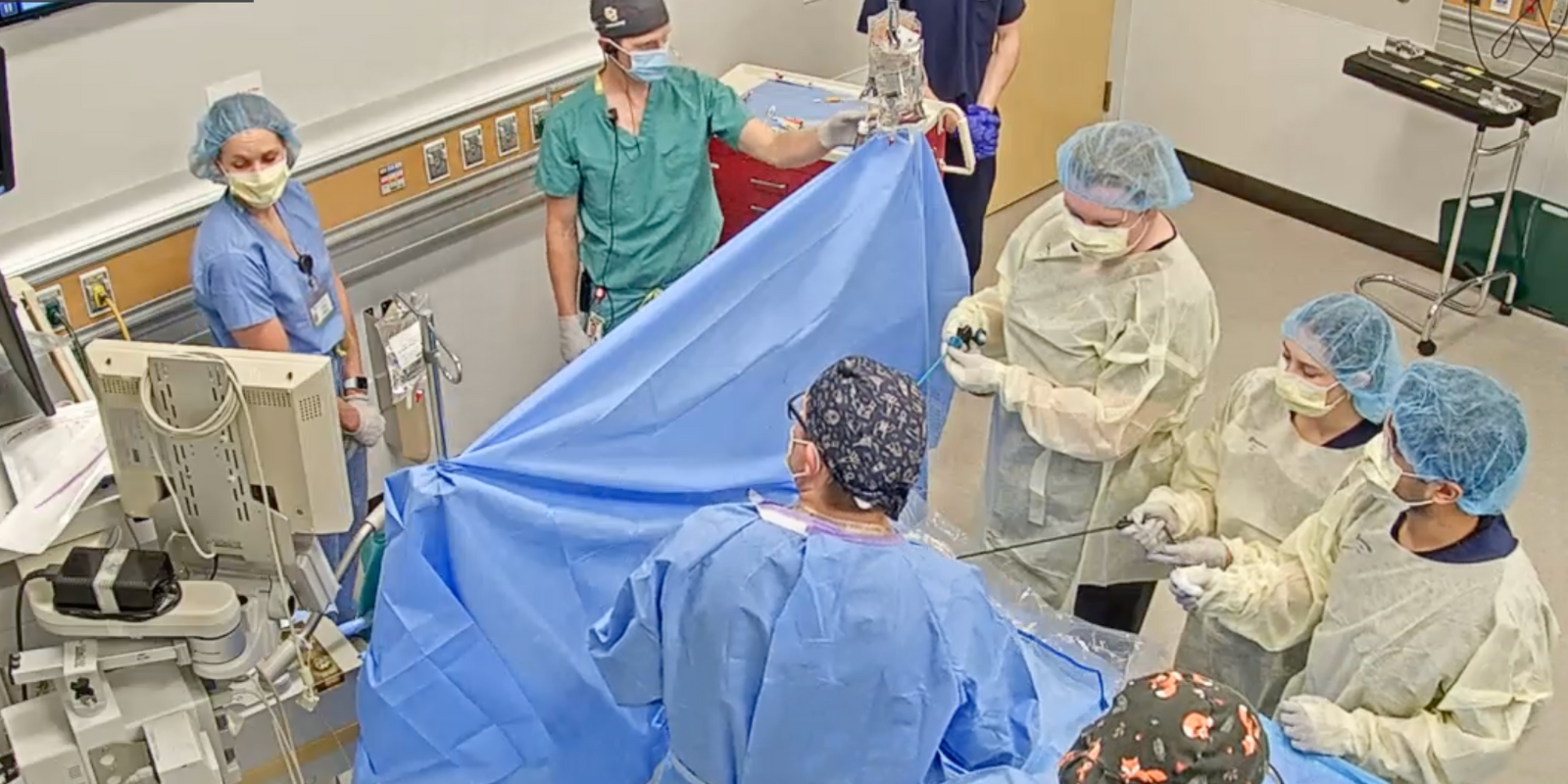
The exercise simulated the flow of a patient through all the phases of their surgery — the preoperative evaluation, the operative phase, and the postoperative phase.
To give the students an extra dose of realism, the simulation involved a laparoscopic surgery that becomes complicated when a blood vessel ruptures.
“The urgency of the situation mirrors real operating-room dynamics, where the teaching is put on pause and the patient becomes the top priority,” Neumeier says. “The goal is that the students can still learn through observation, through participating in the teamwork and the crisis management.”
Part of the team
In addition to gaining a nuts-and-bolts understanding of OR roles — what a surgeon does, what an anesthesiologist does, what a scrub nurse does — students going through the simulation also got a better sense of how they, as trainees, fit into the equation.
“We pair the simulation with a reflection exercise that allows them time to process their emotions and their professional identity as they're entering this new environment, to really help them see their place on the team,” Neumeier says, adding that the students did “remarkably well” during the exercise.

The simulation involved a laparoscopic surgery that becomes complicated when a blood vessel ruptures.
“We intentionally asked them to perform skills that they've never done before,” she says. “For example, we asked them to run down the hall to get units of blood, to transfuse the patients, and they immediately embraced that task and moved as fast as they could, even though there were no clear instructions on where the blood bank was. They embraced the opportunity and took on any responsibility they could.”
Sense of belonging
Neumeier says the simulation was created after she and other Basecamp leaders heard from students and faculty members that students would benefit from more practical preparation before beginning rotations in the OR.
“What we've noticed is that students often may feel peripheral in the operating room at first, perhaps unsure of their role,” she says. “Our hope with this session was to teach students that they can make even small contributions — for example, holding equipment. And that communicating clearly or simply being present with the patient matters to the safety and the success of the operation. Our hope is that we give them a sense of confidence, a sense of belonging, and that the OR becomes a less intimidating place where they can enter and begin to grow as future physicians.”

.png)