<img height="1" width="1" style="display:none" src="https://www.facebook.com/tr?id=799546403794687&amp;ev=PageView&amp;noscript=1">

CU Anschutz Launches Clinical Trial for CAPD Therapy That Reversed Hearing Loss in Models

The neurologic condition, the largest modifiable risk factor for dementia, affects 60 million Americans

minute read

by Chris Casey | April 20, 2026
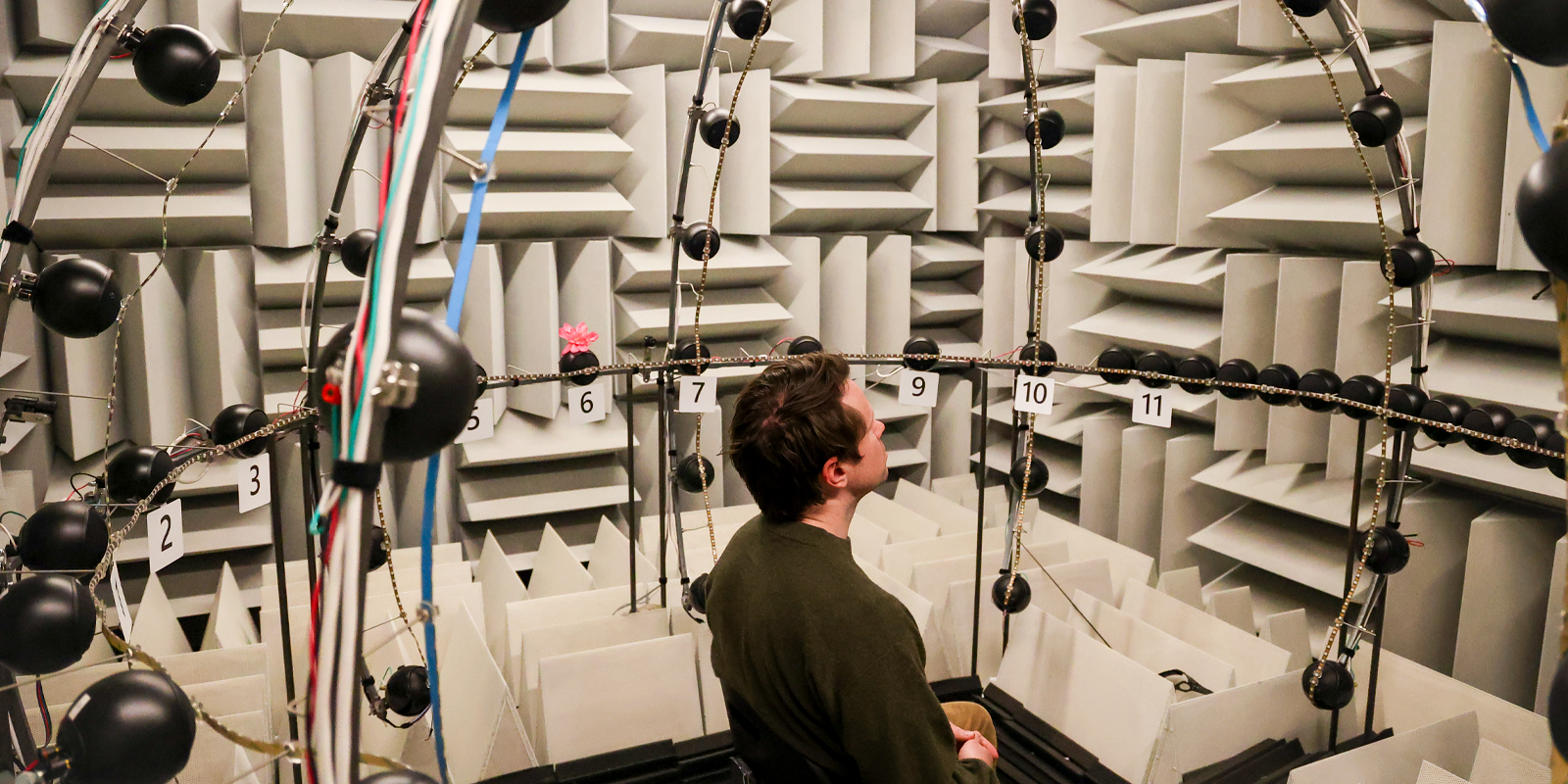
A man sits in the engineered acoustic therapy room at the University of Colorado Anschutz

A diner scans the menu with her eyes while strands of conversation and random noise – from her party, from other customers, from the kitchen – bombard her ears. She leans in but deciphering what’s being said just across the table can be challenging, if not impossible.

Sensory episodes like this unfold every day in crowded bars and restaurants.

While this scenario, oft-dubbed “cocktail party deficit,” can signal normal age-related hearing loss, especially for people over 50, it could also be a sign of central auditory processing disorder (CAPD). The condition, which currently has no U.S. Food and Drug Administration (FDA)-approved therapeutic treatment, affects about 60 million Americans and 800 million people worldwide.

What are symptoms of CAPD?

  • Difficulty understanding speech in noisy environments
  • Trouble focusing on conversations in groups

Researchers at the University of Colorado Anschutz are offering hope to this population with a groundbreaking treatment. The lab of Achim Klug, PhD, recently enrolled the first patient in a clinical trial of a novel combination therapy that aims to reverse age-related CAPD.

Preclinical animal models of age-related CAPD have shown the Klug Lab’s combination therapy – an oral FDA-approved drug with a proprietary acoustic therapy – produced near-complete reversal of central hearing deficit within 30 days.

Hearing loss is a risk factor for dementia

Just as doctors have long singled out obesity as a major risk factor for cancer, diabetes, heart disease and other serious conditions, Klug notes, the loss of hearing has a similar central position in mental health.

The 2024 Lancet Commission on Dementia Prevention identifies untreated hearing loss as the single largest modifiable risk factor for dementia.

Key points:

  • Age-related central auditory processing disorder (CAPD) affects approximately 800 million people worldwide, including about 60 million Americans.
  • A CU Anschutz-led new therapy combines an oral drug with an engineered acoustic therapy that has reversed CAPD in animal models.
  • The Klug Lab recently enrolled the first patient in a clinical trial of the novel combination therapy. 

“If somebody has hearing loss and it’s untreated, they’re at higher risk for not just dementia, but also Alzheimer’s, depression and a lot of other mental health diseases,” said Klug, a professor of physiology and biophysics at the CU Anschutz School of Medicine.

Because central hearing loss is a neurological condition, he said, hearing aids do not address the biological cause.

Brain circuits change with age

“Everybody knows about hearing loss at the level of the ear, and that’s when you need a hearing aid,” Klug said. “But there is a brain attached to the ear that processes all that information. Older people have a lot of trouble in the crowded-restaurant scenario, and it’s not because they need a hearing aid. It’s because the brain circuits have changed, and they don’t process that information as effectively as young people do. So that’s what we’re aiming to treat.”

Samuel Budoff, PhD, a postdoctoral fellow in the Klug Lab, is the CEO of Parley Neurotech, Inc., a startup that announced the enrollment of patients in the CAPD-LOOT (localized oligodendrocyte optimization therapy) clinical trial.

He notes that one in 12 cases of dementia could have been prevented with adequate hearing treatments.

When a person loses the ability to filter and focus on relevant speech in noisy settings, “more often than not they are going to self-isolate,” Budoff said. “So, they remove themselves from social or professional settings where they’re using their brain writ large. And that’s how we think about this longer-term problem that we’re trying to stave off.”

Clinical trial overview


What is being tested: A combination therapy using clemastine fumarate (oral drug) and engineered acoustic therapy.


Trial design:

  • Phase I/II randomized, double-blind, placebo-controlled study
  • Up to 344 participants
  • Ages 45-65
  • Four treatment arms

Goal: To restore myelination in brain circuits involved in auditory processing and reverse CAPD symptoms.


Why it matters: CAPD affects approximately 800 million people globally and is the leading modifiable risk factor for dementia.


Additional testing: Parley Neurotech, Inc., plans expanded access testing in Montana under the state’s Right to Try law. The law allows patients in Montana to use experimental treatments that have not yet received FDA approval. 

In the following Q&A, Klug and Budoff discuss the biological causes of CAPD, research into possible therapies, CU Anschutz’s bench-to-bedside ecosystem, and the combination therapy that shows promise to reverse CAPD.

The interview has been edited for length and clarity. 

Photo at top: A man sits in the engineered acoustic therapy room at the University of Colorado Anschutz.

Q&A Header

What are the neural mechanisms responsible for CAPD?

Klug: Neurons, the cells in the brain, talk to each other with what’s called action potentials, little flashes of electricity, and they run between cells through axons. The axons have insulation – a fatty sheath – that’s called myelin. And when that gets damaged, problems occur. 

Your novel treatment is a combination of an FDA-approved remyelinating agent and an acoustic therapy developed in the Klug Lab. How did you arrive at this treatment?

Budoff: A drug called clemastine fumarate was approved in the 1960s as a first-generation allergy medicine. Modern antihistamines are better than their original counterparts, like clemastine, because they don’t cross the blood-brain barrier very well (and don’t result in as much drowsiness).

dementia_prevention_brains

This graphic illustrates how one in 12 cases of dementia could have been prevented with adequate hearing treatments.

As part of multiple sclerosis research, studies looked at whether clemastine could turn down the immune system after crossing the blood-brain barrier. They found it didn’t act on the immune system, but it did act on stem cells that make oligodendrocytes (which form the insulating sheath around axons). In addition to crossing the blood-brain barrier, clemastine acts on a biochemical pathway that makes those stem cells mature.

Here’s where the combination comes in. Oligodendrocyte precursor cells are a very special kind of cell. They’re not neurons, but they can listen to neural communication and differentiate into myelinating oligodendrocytes. What we’ve discovered here is that when you have a very highly activated circuit and clemastine, you can adjust an oligodendrocyte precursor that’s not maturing correctly to return to the path of maturation and remyelination. And within that circuit activity, you can drive it to say, OK, remyelinate this circuit in particular.

That’s where this combination effect happens, and Achim’s preclinical models of age-related CAPD included all of those controls. There were four arms: placebo-placebo, placebo-sound plus the clemastine, placebo-drug plus the engineered sound, and then this combination of the highly engineered sound with the drug. It was only in the combination case that there was any effect at all, and this is exactly how we’ve built this clinical trial.

Klug: The effect is basically complete recovery. 

As part of the clinical trial, non-placebo-sound participants will listen to the engineered acoustic therapy for an hour a day for 30 days. What does it sound like?

Klug: The sounds are designed to optimally stimulate the affected brain circuit. It’s essentially a background noise. And while it plays – participants will listen while wearing special headphones – they don’t have to sit and focus on it. They can go for a walk, clean the house, garden, do whatever they choose. As long as they don’t watch TV, let’s say, because that would interfere.

Budoff: It’s very tolerable. After maybe two or three days, you don’t even notice it. 

You went from your investigational new drug (IND) submission to first patient enrollment in 229 days. How do you account for the expedited process?

Budoff: There are a couple factors, and I think it’s really important to highlight how great the CU Anschutz environment is. There were a lot of excellent resources on campus that took this investigator-led study from the preclinical models to the IND. The other side is that Achim’s done exceptionally good science. The data is rock solid. It’s just a real testament to the underlying basic research that made the FDA not have any hesitation with what we were proposing, and then the people on campus, including at CU Anschutz Innovations, helping us get from A to B.

 “It’s just a real testament to the (Klug Lab’s) underlying basic research that made the FDA not have any hesitation with what we were proposing, and then the people on campus, including at CU Anschutz Innovations, helping us get from A to B.”

– Samuel Budoff, CEO of Parley Neurotech, Inc. 

Klug: I would also like to emphasize, in addition to the clinical trial expertise we have access to on campus, we are fortunate to work in a remarkably collaborative environment. The basic science experiments and data would not have been possible without my close collaborators in the Department of Physiology & Biophysics, specifically the Ethan Hughes, PhD, and Dan Tollin, PhD, labs. 

What is the age range where people typically start to show symptoms of CAPD? Is it changing?

Budoff: What we know is that approximately a third of the population, age 40 and over, has this problem. When we’re talking about 65-year-olds, it’s approximately half the population. If you talk to my 80-year-old grandma, she’ll tell you everybody she knows has this problem.

Klug: In our experience, people are showing symptoms younger than we thought. In our personal experience, it seems even more frequent and starts younger. We have questionnaires from people in their 30s who have CAPD and would like to participate in our clinical trials. I have an email from a 21-year-old who has central hearing loss. 

Are there any other specific populations who are affected by CAPD?

Budoff: Achim’s lab has done extensive work, especially with autistic mouse models, where the signs and symptoms are identical. While we’re not saying we have a cure for autism, we do know that many individuals on the spectrum really struggle in noisy places … to the point it’s debilitating for their lives.

Klug: We know the same demyelination is happening in autism as well, in exactly the same place (in the brain). So, the obvious question is: Would the treatment work for those people as well? That’s a little further down the to-do list, but it’s an obvious question that we want to address as soon as possible. 

Featured Experts
Staff Mention

Samuel Budoff, PhD

Staff Mention

Achim Klug, PhD