On a rainy June afternoon in 2023, Kathleen Flarity’s life changed forever. Not in a war zone, not on a medical evacuation flight but while driving on I-25 in Aurora.
Traffic slowed. She did too. The car going 75 mph behind her did not. The impact was shattering. Metal crushed, mirrors imploded. Her vehicle lifted onto its nose and spun 360 degrees. Then silence.
When she came to, she thought, “I am alive.”
Her instinct kicked in.
“When something bad happens, I run to the gunfire. I run to the chaos,” she said. “That’s what I’ve always done.”
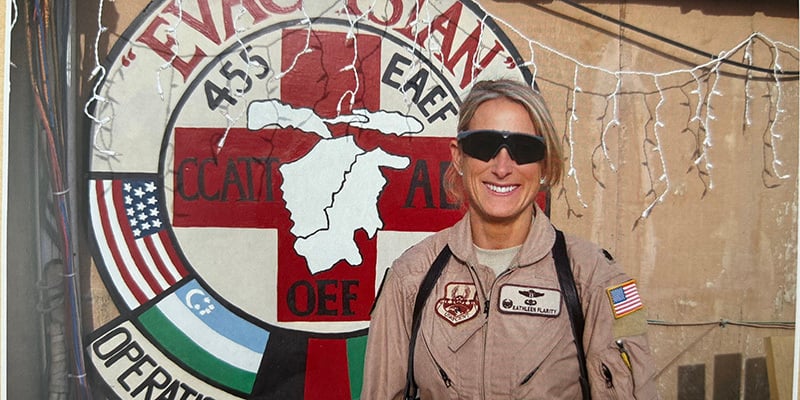
Across four decades, that instinct shaped her career, from combat medic to flight nurse, commander to U.S. Air Force general. She was disciplined, steady and did hard things well.
But this was something new. Now the chaos she chased was inside her own brain.
Dream bigger
At 17, Flarity enlisted in the Army as a combat medic. She ran a small emergency room in South Korea largely alone. Patients rang a bell. She assessed, treated, and stabilized them independently.
During one mentoring session with her commander, she outlined what she felt were reasonable career goals.
He interrupted.
“Dream bigger than that,” he said.
“To me, that was a wildly audacious idea,” Flarity recalled.
She became the first in her family to earn a bachelor’s degree. She then earned two master’s degrees, a doctorate and became a nurse practitioner while rising through the ranks.
Her philosophy was simple.
“Our patients often experience profound renewal. They rediscover hope, healing and purpose.”
– Brig. Gen. Kathleen Flarity, DNP, PhD
“Do an exceptional job in whatever role you’re in,” she said. “No matter the title, do it well. When you consistently deliver excellence, new opportunities will present themselves.”
She brought that mindset to CU Anschutz, helping Vik Bebarta, MD, build the Center for Combat Medicine and Battlefield Research, known as COMBAT, while serving in the Air Force.
“When we started, it was small,” she said. “But there were critical gaps in combat casualty care and operational medicine.”
COMBAT grew into a collaborative network with over 100 investigators and 94 Department of Defense-funded studies, bridging military medicine, industry, and academia. It required clarity, collaboration, and disciplined execution.
Then came the crash.
A new kind of battle
By Monday, she realized something deeper was wrong.
“I knew who I was,” Flarity said. “But I couldn’t formulate my thoughts correctly.”
Her balance was off, vision blurred, words sometimes vanished mid-sentence. Migraines and nausea followed. The crash twisted her brain, “like a wet towel being wrung out” disrupting cognition, balance, and emotional regulation.
“I want people to see that you can have a brain injury and still make an impact. You can still set a vision, mentor others, drive meaningful change. You can still serve. You can still lead. It just looks different, and that is OK.”
– Brig. Gen. Kathleen Flarity, DNP, PhD
A CT scan ruled out bleeding, but the effects were largely invisible.
“That’s the iceberg,” she said. “You look normal, but everything takes more energy and more work.”
For someone used to commanding complex environments, this required adaptation.
“It’s horrible,” she said. “But I still lead with strength and purpose, and I hope that shows others with traumatic brain injuries that a meaningful, purpose-driven life is possible.”
A mission refined
Leadership after TBI is about moving forward while honoring the injury.
“I plan differently. I conserve energy differently. I structure my time intentionally. I use strategies, tools, and support systems to keep showing up as the person I want to be.”
She believes TBI has sharpened her leadership.


“TBI teaches you to prioritize what matters, brings discipline and clarity, and teaches you to listen more deeply, because there is less room for noise,” she said.
By speaking openly, she hopes to shift the narrative around TBI for high-performing professionals and service members.
“I want people to see that you can have a brain injury and still make an impact. You can still set a vision, mentor others, drive meaningful change,” she said. “You can still serve. You can still lead. It just looks different, and that is OK.”
Key points:
- Brig. Gen. (Ret.) Kathleen Flarity brings decades of front-line experience to CU Anschutz Marcus Institute for Brain Health.
- She says healing from brain injury requires treating the whole person physically, cognitively and emotionally.
- Flarity’s advice for rising in the ranks is to do an exceptional job in whatever role you’re in and when you consistently deliver excellence, new opportunities will present themselves.
In early 2024, she became executive director of the Marcus Institute for Brain Health at CU Anschutz.
“I view MIBH as the traumatic brain injury treatment arm of the COMBAT Center,” she said. “If COMBAT advances research, MIBH delivers healing.”
She starts with the people.
“Healing from brain injury requires treating the whole person physically, cognitively, and emotionally.”
Neurology, rehab, neuropsychology, speech and physical therapy, and behavioral health work together in a co-located, coordinated system. “Patients should not have to navigate a complex system while trying to heal,” she said.
Patients also participate in art therapy, yoga, canine-assisted therapy with Buffy, and equine therapy. These approaches help regulate the nervous system and rebuild confidence.
“Our patients often experience profound renewal,” she said. “They rediscover hope, healing and purpose.”
Flarity understands that personally.
“The gift in having a traumatic brain injury is that I am a more empathetic clinician because it is a shared, lived experience I share with our MIBH patients.”
Still running toward the chaos
Her message to someone newly diagnosed with TBI is simple - it’s going to get better.
“It’s not a promise life will return to exactly what it was, but a promise of forward movement,” she tells patients. “If you show up and do the work, you will get better.”
After the crash, surrounded by shattered glass, she chose gratitude. Now she chooses growth. “When something bad happens, I still run to the chaos,” she said.
The chaos is quieter now, neurological, but the instinct is the same. She is still building systems and solving problems.
Only now, she is leading from inside an experience she once treated from the outside.
.jpg)