What do we know about the differing symptoms of a heart attack between women and men?
Men will typically complain of chest pain – a radiating pain– where women may experience more of a tired feeling, nausea or they might attribute some of their symptoms to less-serious conditions. Clinicians, too, might say, ‘Oh, you might just have some heartburn going on.’ So, their symptoms are different. And then when women have a heart attack, their outcomes are often much worse compared to men.
(Women have a greater risk of developing heart failure or dying within five years after their first severe heart attack compared to men, according to the AHA. They also have a higher likelihood of suffering a second heart attack.)
We also know that the type of heart disease they develop varies. Men develop more of what we call an obstructive heart disease where arteries get clogged, plaque builds up. Women are more likely to have non-obstructive heart disease where their arteries are more susceptible to vasospasm – a sudden, temporary constriction of an artery due to the involuntary tightening of its muscle walls – so more related to vascular dysfunction. And so, the signs and symptoms are different. Men can have vasospasms, too, but it’s a more common condition in women who have smaller arteries. The vasospasm of these smaller arteries contributes to ischemia in women, the lack of blood flow to the heart.
Have researchers seen a decrease in heart attack deaths in women since we finally began paying attention to the biological differences between genders?
It’s a great question. When we started to examine sex differences in cardiovascular disease mortality, you would think that women started to have more heart attacks in the early 2000s, but maybe it was because we actually started including women in research and studying CVD in women. It wasn’t that women were having more heart attacks or having more cardiovascular dysfunction, maybe we just didn’t realize what it looked like in women.
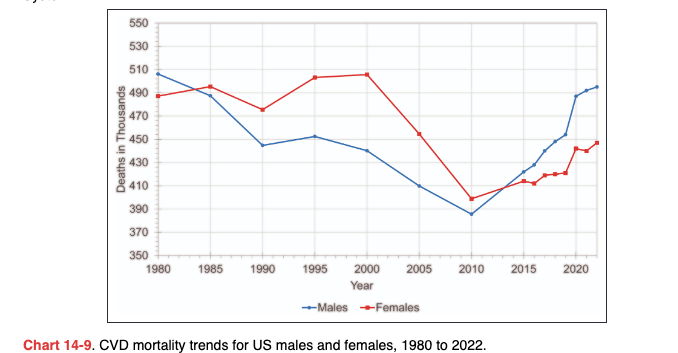
2025 Heart Disease and Stroke Statistics: A report of U.S. and global data from the American Heart Association.
Overall, we had seen a sharp decline in cardiovascular disease deaths in both women and men, particularly in older adults but those rates have remained stagnate in midlife adults, particularly women. One thing that was driving those rates of decline are probably the new treatments. Putting folks on therapeutics does help, and we’re seeing those benefits, especially in older adults.
Research has shown that testosterone plays a role in cardiovascular health risk in men. What does recent research show as to whether there’s a higher risk of cardiovascular disease due to lower testosterone levels?
Yes, the data overwhelmingly would suggest that having low endogenous testosterone is associated with an increased risk of cardiovascular disease and cardiovascular events. Now, where there are data discrepancies, are with administering exogenous testosterone therapy. For instance, does giving men testosterone help lower the risk? We don’t know that. A study came out in the past couple years that pretty much said, ‘We can put this to rest: Giving men testosterone is not going to increase their risk, but it may not also offer the benefits for lowering the risk of cardiovascular disease.’
What has your research shown in terms of men with lower testosterone levels being more susceptible to having stiffer arteries?
We have studied the effects of having low endogenous testosterone on the cardiovascular system. We’ve published several papers (including this one) showing that healthy men over the age of 50 with low testosterone (defined in our study as total testosterone levels less than 300 ng/dL) have what we call an accelerated cardiovascular aging phenotype. They had higher inflammation – and some biomarkers that regulate metabolism were lower – compared to their age-matched peers who had higher testosterone levels (levels greater than or equal to 400 ng/dL.
FAQ:
What are common heart attack symptoms in women?
Women may experience fatigue, nausea, shortness of breath, and jaw or back pain rather than chest pain.
Why is heart disease under diagnosed in women?
Symptoms are less typical, and women were historically underrepresented in research.
How do hormones affect heart disease?
Estrogen protects blood vessels in women. Testosterone also protects blood vessels in men.
Does exercise benefit men and women differently?
Yes. Men often see stronger vascular benefits, while postmenopausal women may see less benefits.
What are “exercise snacks”?
Short periods of physical activity throughout the day that may improve heart health.
Our data showed that middle-age and older men with low testosterone had worse age-related vascular dysfunction. And their overall mean level was 268 – which is close to the lower end of normal for healthy men ages 19-39. Their arteries were stiffer, and they didn’t dilate as well. Also, we assessed the function of their baroreceptors, which are located in our carotid arteries and aorta that detect blood vessel stretch caused by changes in blood pressure. They function to “fine-tune” the blood pressure response, so you don’t pass out upon, say, standing up. In general, the sensitivity of these baroreceptors decline with aging and what we showed is that these receptors were more desensitized in the men who had lower testosterone levels than their age-matched peers with higher testosterone levels, making them more susceptible to orthostatic hypotension (where a person is more likely to pass out). We also used MRI to measure brain perfusion (blood flow), and some preliminary data suggests that they have lower resting brain perfusion.
We are trying to get funding to study that further because there is some evidence that men who have lower testosterone maybe at a greater risk for developing dementia.
How can some of your ongoing research change the trajectory of cardiovascular disease risk among both women and men?
As part of an ongoing, five-year NIH-funded study, we’re trying to understand exercise response variation – who is getting or not getting the benefits. We’re going to be studying sex hormones as well, both testosterone in men and estrogen in women, to try to see how our hormones play a role in reaping some of the benefits we see with exercise.
While exercise has been shown to restore the youthfulness of endothelial cells lining blood vessels in men, the same benefit isn’t as apparent in postmenopausal women. Research suggests that their lack of estrogen may reduce their ability to counteract the cell-damaging effects that get released during exercise.
Also, we know exercise lowers cardiovascular disease risk, but how do we get more folks to exercise? In Colorado, we’re lucky in that we have the environmental structures in place to encourage people to get outside and exercise. But when you look at some of these Southern states, where you see higher rates of cardiovascular disease, obesity, etc., it’s at least partially because they don’t have the environment in place to go out there and exercise.It goes back to the social determinants of health and the environment that you’re living in.
It’s a misnomer that you need to go out and do planned exercise. There are many ways to get creative in your day. My former division chair, Dr. Robert Schwartz, would tell his patients, ‘In between commercials on TV, just get up and walk around the room.’ They call these exercise snacks – introducing more physical activity into your life. It’s all about increasing physical activity, improving our diet and lowering stress.




%20(1).png)

.jpg)