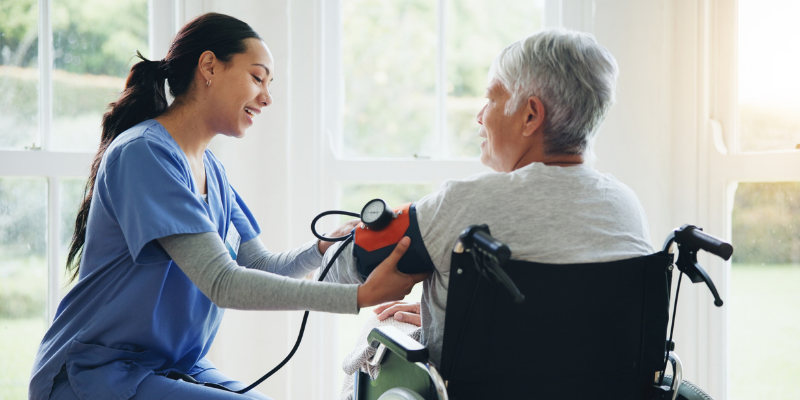
Rural critical access hospitals can face many unique challenges. They can be far away from other health centers, lack resources and funding, or experience personnel shortages. This means nurses often have to adapt, make do, and lean on their team's strength to get creative and get the job done.
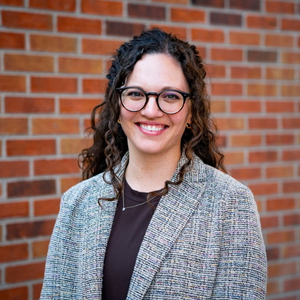
Ruth Lewis, MSN, RN, is a PhD student at the University of Colorado Anschutz College of Nursing. Her dissertation research looks at understanding the lived experience of creative emergence as inner healing for nurses working in rural Colorado critical access hospitals.
Lewis has been a nurse for over a decade. She worked as a nurse leader in a rural hospital in Nebraska during the height of the COVID-19 pandemic. She saw first-hand what it meant to make do with what you had.
“Rural critical access hospitals are often out in the boonies. There’s not a lot of staff there. It's 25 inpatient beds or fewer, and it's farther away from any kind of bigger facility,” she says. “And so, the kind of nurse that works there has a different level of autonomy and a lot of grit and tenacity. And they have to get creative with resources in the professional sense, to create positive patient experiences and successful patient outcomes.”
Process
For her research, Lewis interviewed nurses working in rural Colorado critical access hospitals about different ways they experienced a sense of inner healing and new possibilities for growth. For example, she asks, “Can you tell me about a specific time where you had limited resources, but you still experienced a sense of connection, creativity, or strength within your work?”
She says this framing encourages the nurse to reflect on the lived experience of some tough situations to explore how inner healing might have emerged within these challenging circumstances, or what might have constrained that growth. She also gives nurses an invitation to create art to respond to this question. She says many nurses do create art in response.
“It's been a really amazing way to connect with them further and to see a really unique perspective through art. I think art is a universal language.”
Lewis is an artist herself. She paints landscapes and portraits, and her passion for painting motivated her to find ways to incorporate art in her research.
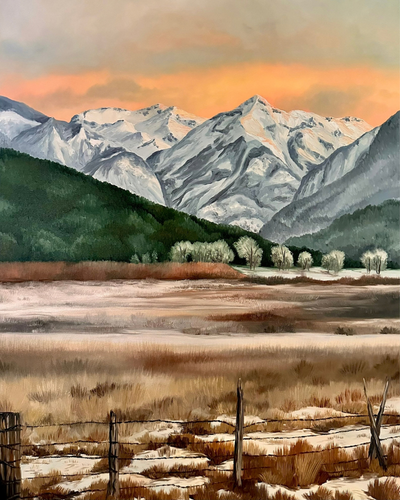
A landscape painting by Ruth Lewis |
“I really wanted to always find a way to interweave creative expression with whatever research I'm doing,” she says.
Her work was guided by Max van Manen’s Hermeneutic Phenomenology, a qualitative research approach that seeks to understand and interpret the meaning of lived experiences.
“I chose the methodology of Hermeneutic Phenomenology because there's a huge celebration of sharing lived experiences through any modality that speaks best to you. A lot of it is through spoken word, but there's also the invitation of what if you wanted to create art with it, and it's whatever the participant feels drawn to,” she says.
Reflections
Throughout her conversations with nurses, she noticed a strong sense of community within the hospitals and organizations. Nurses in these small, rural towns often know their patients personally or have a connection. This strengthens their relationship and care.
“Patients have a name, and nurses really take ownership of that care,” she says.
She heard from nurses how hard they work to provide care for their patients, even when resources are tight. But, so far in this work, Lewis has also found that creativity has its limits.
“Creativity kind of flirts on the edge of enough, and so these nurses are going in and they're teetering right at the edge where they don't have what they need, but they're still able to pull from some sort of an internal resource and that relational harmony with their coworkers and their community,” she says.
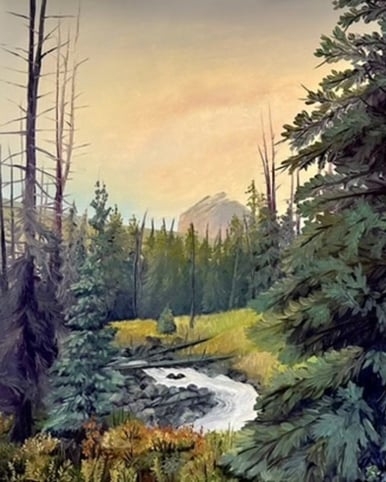
A landscape painting by Ruth Lewis |
When limited resources narrowed the possibilities of being able to create solutions, nurses reported feeling as though they were in survival mode and lacked a sense of creativity.
There comes a time when limiting factors like time, money, distance, or staff shortages make it hard for nurses to operate. She says these repeated challenges highlight a tension between a nurse's creativity and the conditions that exhaust it.
Lewis saw this exhaustion in some of the nurses she interviewed. One nurse used AI to create an art piece to save time, despite wanting to spend more time doing something herself.
Nurses found creating art to illustrate their experiences helpful. Some of them said that spending time reflecting back on themselves and being creative outside of work made them more focused on their purpose as a nurse and more productive.
“I've noticed that the people who engage in the arts-based invitations are creative in some sort of sense already, but this experience made them more mindful of the time that they're spending at work and how they want to create the time to honor that art for their lives,” Lewis says.
One nurse regularly used dance as a form of creative expression and said she looked forward to it each day, which helped her focus better while nursing.
For Lewis, viewing nursing and her research through an artistic lens has allowed her to be reflective and make stronger connections.
“I can appreciate moments of beauty and connection in a very human and also beautiful way,” she says. “Painting has also been a great point for reflexivity within the research, meaning how I address my own assumptions and biases.”
Lewis wants people to take away from her research an understanding of the intense humanity that exists within rural nursing. She also wants nurses to be able to find a balance between work and life so they can continue caring for patients, which may also mean that the nurse needs to turn the care back to themselves and focus on their own inner healing. She says, the nurse’s capacity to care for others is deeply connected to opportunities to care for oneself as a whole person and in the meaningful relationships they cultivate in their communities.
“That kind of investment in another human being and their soul and their whole mind, body, spirit really makes a difference between the kind of care you're providing and what they feel,” she says. “The kind of purpose that you're given back to remain in nursing and fall in love with it all over again, and to be able to tie the creativity to it, I think it gives that sense of balance.”