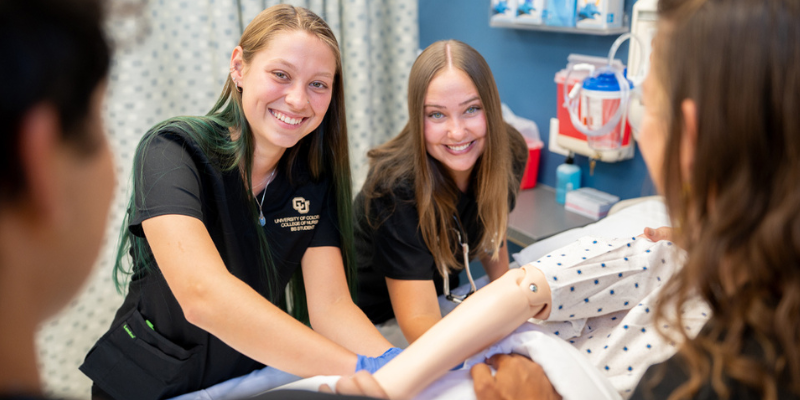

| Julie Grant, PhD, RN, CNRN, SCRN, presented her dissertation research at the 2026 Fall PhD Intensives week. |
When patients are suffering from life-limiting illness, nurses are often the ones by their side, supporting them physically and emotionally. They play a key role in providing palliative care, which prevents suffering, helps maintain quality of life, and reduces stress from illness at any stage.
Julie Grant, PhD, RN, CNRN, SCRN, is an associate teaching professor at the University of Colorado Anschutz College of Nursing. She recently presented her dissertation research on how acute care nurses provide support to patients with life-limiting illness. She explained her research during the 2026 Fall PhD Intensives week.
Grant worked as a nurse in neuroscience units before earning a PhD in Nursing with a focus on Caring Science at the college. She chose Caring Science to better understand nurse-patient relationships.
“I focused on that nurse-patient connection, but also palliative care, which I wasn't seeing implemented nearly as much as it should be on those neuroscience units,” she says.
Purpose
The purpose of Grant’s work was to understand how acute care nurses communicate and advocate for people in need of palliative care. She defines this advocacy as “nurses’ efforts to support and promote their patients’ right to self- determination by helping them discern their holistic health and wellness situation, then clarify their values within reality.”
Grant’s literature review found that the majority of formal patient-reported complaints emphasize ineffective communication with a healthcare professional, and 70-80% of healthcare errors can be traced back to poor communication within the healthcare team.
Grant noticed that most of the research looking into nurse communication and palliative care focused on nursing deficits and areas for improvement without noting any strengths or positive takeaways from nursing work.
According to the Gallup Poll, nursing is the most trusted profession, and Grant speculated that the nursing expertise responsible for that trust was often overlooked because of the “everydayness” of nursing work. Grant wanted to build on what acute care nurses were doing well in palliative care communication, understand their communication styles, and identify emotional takeaways. One of her goals was to empower successful early palliative care communications and show what is working well in the field.
Methodology
Grant interviewed 17 acute care nurses of varying ages and years of experience. She encouraged them to create art or bring an item to the interview that described their nurse-patient relationship. Grant says this helped start the conversation and spark a memory for a nurse about a specific patient or interaction.
Each nurse talked about how they handled hard moments and how they communicated with their patient when they were experiencing a life-limiting sickness or diagnosis.
“In nursing, we need to equally prioritize quantitative research with finding the meaning of our patient connections and the qualitative side,” she says.
When Grant looked at the notes she had taken on scraps of paper and in notebooks during the interviews, she realized she had a tendency to draw sketches to illustrate a theme or scenario described by the nurses.
She committed to this technique, comparing her sequential art narratives to comic strips, or panel art that shows essential meaning.
She shows the group of PhD students a comic she created. “In this anecdotal narrative, I took one of the interviews I had with a nurse, and I condensed it, not to weed out anything, but to try and get to the essence of what they were saying,” she says.
This art was not the result, but instead became a key data analysis tool.
Throughout her process, she used Hermeneutic Phenomenology as a framework to guide her research. Hermeneutic Phenomenology is a qualitative research approach that seeks to understand the meaning of lived experiences.
“Hermeneutic Phenomenology is more than a method; it's also a philosophy that allows researchers to humanize the life world to help people become more thoughtful and better prepared to act insightfully,” Grant says.
She wanted to understand what human connection and interaction can look like in a palliative care setting.
“The most meaningful part was definitely getting to do these interviews with a very wide variety of acute care nurses,” she says. “Having worked in many different areas of acute care nursing, and hearing what meaning they found in their patient relationships, and then getting to just revisit that over and over, and trying to do it justice with my research.”
Results
Grant found that acute care nurses do provide palliative care and support, that “attunes to a compassionate reality.” This means they communicate with patients in a way that both validates their struggle and focuses on realistic goals.
“The nurses were earning trust amid vulnerability, fostering mutuality, and giving their time,” she says.
She described a situation she heard from an acute care nurse. A patient is nearing the end of their life. The patient and their family members keep asking, ‘what is the next thing we can do?.’ Instead of giving false hope or trying to find a cure, the nurse redirects the questions to attainable goals, responding with “let’s talk about the patient’s pain control’ or ‘let’s ask the doctor more questions.’”
Grant concluded that the nurses utilized complex problem solving and data integration when working with a range of patients or with the same patient over a period of time. She realized just how present acute care nurses are before and after critical moments. They got to know their patients at a deeper level to know when a patient was changing or in need before other health care providers, she says.
Takeaways
Grant says this work recognizes and informs what nurses are already doing to support palliative care, and can support advocacy for the conditions that allow them to do it well, providing things like resources and time.
“I was getting the most wonderful information from these acute care nurses, and I would say they're doing all these incredible things, but they've never had the time to sit down and reflect on it,” she says. “Guided reflections allow their education to go further than nursing school and continue it in their nursing practice.”
Grant explains that positive and effective acute care nursing communication is often called “good nursing instinct.” She says this term equates to providing emotional support and high-quality palliative care to innate talent instead of a practiced skillset. She hopes nurses gain a sense of empowerment from her work.
“I hope that it empowers them to recognize their expertise in nursing. While we do like being referred to as having good nursing instinct or good nursing intuition, to also recognize that as something that we have gained through hours of practice and education, and that we can also consider this our nursing expertise,” she says.