
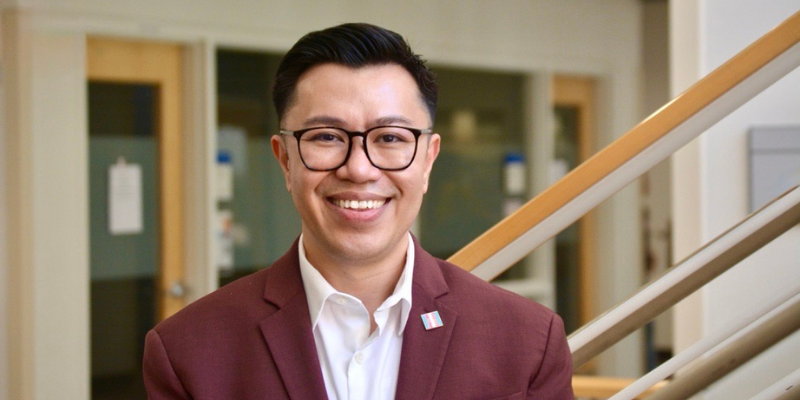
Anthony Velasco, PhD, AGPCNP-BC, AAHIVS
During PhD Intensives week this fall semester, Anthony Velasco returned to the University of Colorado College of Nursing to present his PhD dissertation research exploring how stigma shapes primary care access for transgender and gender-diverse older adults to current PhD students and faculty.
Velasco identifies as a queer person of color and an immigrant. With a diverse background, he has been able to connect with and care for a wide range of communities throughout his career as an advanced practice nurse. After earning his PhD from CU Anschutz College of Nursing in 2025, he currently practices as an adult gerontology primary care provider in Palm Springs, California.
Velasco became very involved with the local transgender community in Palm Springs. He built strong relationships and trust long before he even started his dissertation research.
“As I became more comfortable in my queerness, I also came to realize the power that came with it. And as a nurse practitioner working with the trans community, day in and day out, I became acutely aware of the challenges trans people face when asked to seek care,” he says.
The goal of his work is to improve access to and experiences in primary care for the transgender and gender-diverse community. He also wants to be careful not to speak for the trans community, but instead to give their voices a platform.
“I gravitated towards narrative inquiry as a qualitative methodology to amplify people's voices and as a way for me to hand over the mic,” Velasco says.
Methods
The participant pool included transgender adults ages 50 and older. Velasco used interviews and surveys to gather sigma narratives. He asked them questions about their experience accessing health care and working with a primary care provider.
“I focused my research on older adults because of my background, and I’m really drawn to this population. I'm an adult gerontology primary practitioner, so I remember my patients with their stories, always like a wealth of information,” he says.
He adds that in the Coachella Valley, where Palm Springs is located, more than 50% of the residents are aged 50 years and older, and it has one of the highest populations of LGBTQ+ people in California.
Rather than working only with participants, Velasco partnered with members of the local transgender community to create an advisory board.
“This group informed decisions throughout the research process, ensuring the study remained accountable, that it aligned with community priorities, and that it reflected trans experiences throughout the analysis of the study.”
He says these relationships with the community were essential in conducting ethical and impactful research.
Findings and Takeaways
Velasco found that stigma often prevents transgender and gender diverse people from accessing care. He also heard from some transgender people that they would rather go to urgent care than have an uncomfortable, ongoing relationship with a primary care provider.
Velasco found three main thematic threads throughout his work. The first theme “illustrates how stigmatizers keep transgender and gender diverse people down by leveraging social, political, and institutional power.” Velasco refers to stigmatizers as people in the health care system who create barriers and add stigma to transgender and gender diverse people seeking care.
This can look like a provider withholding a health-related resource, like a necessary hormone. In one case, Velasco found that when a participant was not given the necessary hormone she needed, her other health issues became more severe.
The second thematic thread highlights how healthcare providers stigmatize transgender older adults by enforcing social norms.
“Stigmatizers accomplish this by using mechanisms such as moral framing, shaming and ridicule, norm enforcement, and forced internalization of stigma,” he says.
Many transgender people described instances of healthcare providers misgendering them or using the wrong name during patient visits.
Lastly, the third thematic thread described how stigmatizers used social segregation and rejection to keep transgender older adults out of the health care system.
“For instance, the limited number of gender affirming clinics, primary care providers, and specialists in the area, which was also magnified in rural areas, resulted in longer wait times for other people, reflecting those mechanisms,” Velasco says.
Despite having finished and defended his dissertation, Velasco is far from done.
“When I was studying nursing in my undergrad, I don't think I ever had any topics or any lectures about trans people,” he says. “I'm hoping that as I'm doing this research and presenting what I have learned in my study, it will help nursing programs really reevaluate the curriculum and the importance of including that particular population throughout their career.”
“The research process may end, but the relationships, the questions, and their responsibility to act continue,” he adds. “Ultimately, this work is part of a much broader arc towards justice, dignity, and health equity for the trans community.”