

-1.png)
Shu-Yi Wang, PhD, RN, APRN-CNS, CGNC, Interim Specialty Director of the Clinical Nurse Specialist program, facilitates an international partnership between students at the University of Colorado Anschutz College of Nursing and the National Taiwan University. She connects nursing students (both graduate and undergraduate) through the MENTOR (Meeting, Evaluating, Nurturing, Teaming, Opening, Reflecting) Virtual Exchange program, allowing students to have conversations with peers across the world and build cultural awareness and understand global perspectives.
Dr. Wang’s work to establish partnerships between universities began in 2018, before she started working at CU Anschutz College of Nursing. Wang created the PRACTICE (Pray, Read, Ask, Connect, Team, Ignite, Cherish, Evaluate) framework, which outlines strategies for fostering a strong mentoring culture and sustainable collaborative partnerships.
She talked with CU Anschutz Nursing to give her insights into the program and how it has a positive impact on nursing students.
What is the structure of the virtual exchange program?
My students engage in meaningful conversations with peers from Taiwan on Zoom. The students and faculty gain firsthand insight into different healthcare systems, professional roles, and approaches to patient care. These experiences help students develop cultural awareness, global perspectives, and the collaborative skills needed to thrive in today's interconnected healthcare environment, all without leaving their classrooms. They also make personal connections with each other, learning about each other’s interests, and what they enjoy about nursing.
How do these conversations impact students?
Program Information
|
These conversations encourage students to broaden their perspectives and recognize multiple approaches to delivering high-quality, patient-centered care. Learning from peers and faculty across cultures deepens their understanding of how culture, healthcare systems, and available resources shape the nursing practice worldwide. Many describe these experiences as transformative, noting that they have become more aware, more confident in communicating across cultures, and more reflective about their own assumptions regarding healthcare.
Accelerated BSN student, Amee Patel, provided written feedback to me that the conversations broadened her perspective.
“Every culture has its own perceptions of nursing and healthcare. There was a perspective that I was not aware of until this experience. I was disheartened to learn that many Taiwanese nurses come to the US because the nursing profession is not as highly regarded in Taiwan as it is here,” she said.
Not only are our BSN students benefiting from this program, but so are our Adult-Gerontology Clinical Nurse Specialist (AG-CNS) students. One of my students, Elizabeth Persico, told me she used the conversations to look more deeply at the American healthcare system.
“Before meeting with the students, I learned that Taiwan has one of the best healthcare systems in the world. Its universal coverage and patient-centered approach inspired me to explore how similar ideas could improve healthcare in the US," she said.
Elizabeth recognized that, despite differences in healthcare systems, nurses worldwide share a common commitment to improving patient outcomes, quality, and patient-centered care.
“Hearing a familiar enthusiasm for nursing, along with many of the same worries about beginning practice. Although our experiences sometimes differed, it was reassuring and exciting to realize that, no matter where we come from, the qualities that draw us to nursing are similar.” - Erik Bengston, BSN (’26)
What is the value of international learning?
Ultimately, I believe this partnership has strengthened our mission of preparing nurse leaders who are culturally responsive, globally minded, and equipped to lead in diverse healthcare environments.
AG-CNS student Kayneynia Burney shared with me the lasting impact of the experience: “Since participating in the exchange, I have sought opportunities to learn in person about healthcare delivery in other regions, including South America and Africa. I will carry these lessons forward in both clinical practice and healthcare leadership because I have seen firsthand how diverse perspectives strengthen our ability to address health disparities and improve patient care.”
Her classmate, Andrea Hillard, said having conversations with international students showed the universality of putting patients first.
“This experience showed how individuals from two countries can come together and find ways to communicate a shared mental model to improve patient care; truly a beautiful thing."
The program is offered every spring semester, and faculty and students interested in participating are encouraged to contact Dr. Wang for more information.
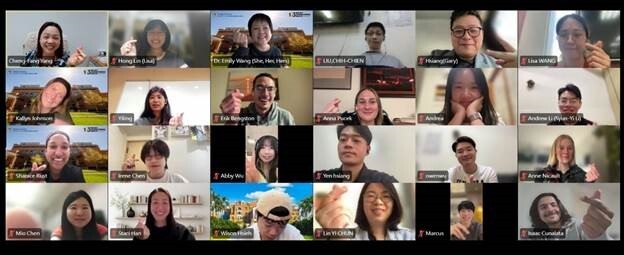
Students from Taiwan and Colorado send hearts to each other during their Zoom session. |
.jpg)


.png)