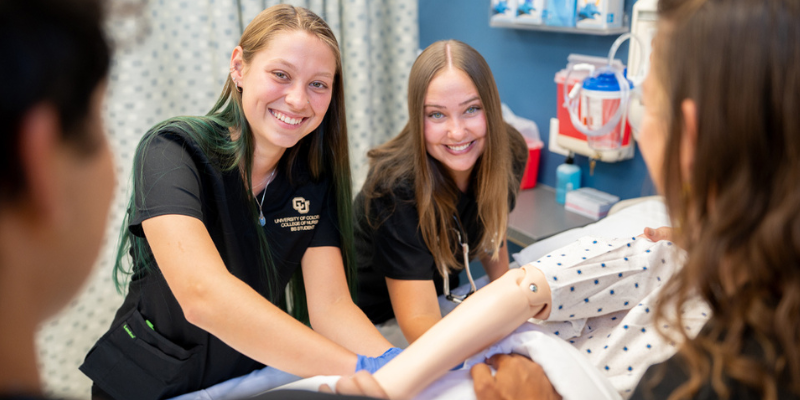
For much of the 20th century, hospitals trained their own nurses. Students learned on the job, in the wards where they would eventually work, and earned diplomas from the very institutions that would hire them. The skills gap between academia and practice was virtually nonexistent because there was no separation between the two.
That changed as nursing education moved into universities and colleges, where curriculum is shaped by academic standards, accreditation requirements, and nursing faculty, not necessarily by the hospitals waiting to receive new graduates. Decades later, that divide is still playing out in real and consequential ways.
“Hospitals and health systems differ in what they expect new graduate nurses to be competent to perform,” says Dr. Fara Bowler, assistant dean of clinical simulation science at CU Anschutz College of Nursing. “Without a shared understanding of those expectations, it becomes difficult to ensure graduates are consistently prepared to transition safely into practice.
It's not that nursing programs are failing to teach skills. The problem is alignment.
"We're all working toward the same goal—preparing safe, competent nurses—but educators and healthcare employers don't always define readiness in the same way," Bowler says. "Creating greater alignment between academic preparation and practice expectations is essential for supporting graduates as they transition into clinical practice."
“Psychomotor skills are only one part of nursing competence,” Bowler says. “Nurses also need strong clinical judgment, communication, teamwork, and professional decision-making. But they must also be able to safely perform the fundamental skills required in practice. Competence in those skills is essential to reducing patient harm and providing safe, high-quality care.”
Dr. Bowler, along with Dr. Susan Hébert from the University of Tennessee, Knoxville, College of Nursing, and Dr. Beth Fentress Hallmark from Belmont University’s Center for Interprofessional Engagement and Simulation, examined the psychomotor skills development of pre-licensure nurses. The research was recently published in the Journal of Nursing Education.
Psychomotor skills are tasks that require coordination, precision, and timing. These skills are essential for carrying out various clinical procedures and require a deep understanding to ensure patient safety and quality care.
“We’re intentional about the skills we teach and continually evaluate our curriculum to ensure our graduates are prepared to provide safe, effective patient care from day one.”
Bowler says psychomotor skills are often overlooked because national nursing guidance lacks specificity about which skills should be taught, where they should be taught within the curriculum, and which require demonstration of competency. She adds that inconsistent assessment methods, limited faculty preparation, reluctance to fail students who are not yet competent, and cognitive overload all contribute to the challenge.
Another challenge is the absence of standardized employer expectations. Hospitals and health systems often differ in the psychomotor skills they expect new graduate nurses to demonstrate upon entry into practice.
Bowler, Hebert, and Hallmark hope their research will provide nursing programs with a consensus-based guide for teaching and assessing psychomotor skills, creating greater alignment between nursing education and the expectations of clinical practice.
“Our goal was to build consensus between nursing education and clinical practice,” Bowler says. “We wanted to hear directly from clinical educators about which psychomotor skills new graduate nurses should demonstrate and how those skills should be assessed.”
Essential Nursing Skills
Bowler and her team reviewed seven fundamental nursing textbooks and divided more than 170 skills into 15 categories. They asked nurses in academic and clinical settings to rank these skills to better understand which are considered essential.
“We wanted to understand from clinical education experts which psychomotor skills should be taught in the classroom, simulation, or clinical practice setting,” Bowler says. “We defined an essential skill as one that every new graduate nurse should be able to perform safely and competently upon entry into practice."
Of the more than 170 psychomotor skills evaluated, 95 were identified as essential for entry into practice, and 46 were recommended for formal competency assessment before graduation. Many of these skills centered on medication administration, patient safety, infection prevention and control, and fluid, electrolyte, and acid-base balance.
At CU Anschutz Nursing, essential skills are introduced early in the curriculum and reinforced midway through, allowing students to develop them through graduation.
“When we're teaching students, we need to focus on reinforcing high-volume, high-risk skills like medication administration and urinary catheter insertion,” Bowler says. “We weave those skills throughout clinical education so students have repeated opportunities to practice them. It's not that students aren't prepared; we want to ensure they have enough deliberate practice to build confidence and competence before entering practice.”
The skills most frequently recommended for formal competency assessment included patient safety, fall risk assessment, medication administration, respiratory care, and wound care. The study also highlighted simulation as a critical learning environment for teaching, practicing, and assessing essential psychomotor skills before students enter clinical practice.
What Comes Next
Bowler says strong partnerships between nursing programs and healthcare organizations are essential for preparing practice-ready graduates, but acknowledges that curriculum changes alone cannot address the variability in employer expectations.
“We rely on the best available evidence and the literature on practice readiness to ensure our curriculum is evidence-based,” she says. “However, there is no national consensus defining which psychomotor skills new graduate nurses should be able to perform at entry into practice. Studies like ours help build that evidence so educators and clinical partners can better align what we teach with what new nurses need to know.”
Plans for future research are already underway to better understand the academic-practice gap in expectations for psychomotor skills among nursing educators and clinical practice experts.
“We found that the strongest predictor of whether a psychomotor skill was considered essential was whether the expert came from an academic or clinical practice setting,” Bowler says. “Clinical experts were more likely than academic experts to identify certain skills as essential. Our next step is to better understand why those differences exist so we can strengthen alignment between nursing education and clinical practice.”