
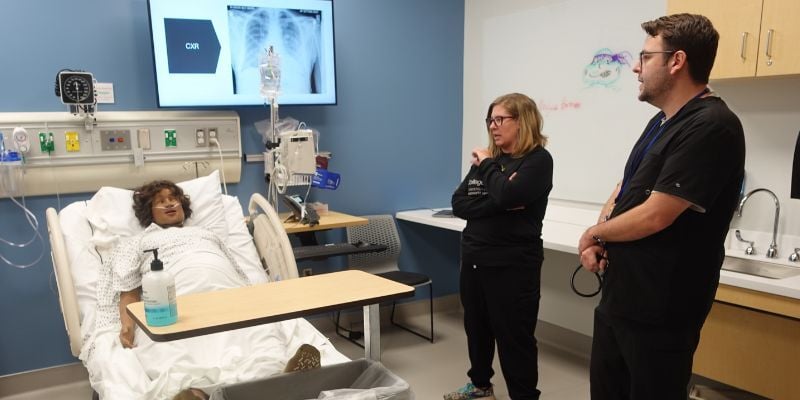
Imagine walking into a hospital room and preparing to see a patient, but you have no idea what’s wrong with them or what condition they’re in. It’s something nurses do every day, but there are ways to prepare for the kinds of patients they might see.
At the University of Colorado Anschutz College of Nursing, students (both BSN and MSN) participate in simulation scenarios in the college's state-of-the-art simulation lab, allowing them to practice their nursing skills in a safe, controlled environment. It's also an opportunity for students to practice their leadership skills, particularly as they transition into a nurse practitioner role.
Students in the Adult-Gerontology Acute Care Nurse Practitioner (AG-ACNP) program recently participated in a simulation scenario involving a patient they rarely see: a pregnant woman with high blood pressure who is being taken to a rural hospital, meaning an obstetrician isn’t immediately available.
In a hospital setting, particularly in rural areas, healthcare providers might see a variety of acute care patients. Nurse practitioners and other providers need to be prepared for any patient situation and ready to ask many questions to find the best course of treatment.
Nurse v. Nurse Practitioner v. Doctor. What's the Difference?
A registered nurse (RN) treats patients, administers medication, performs assessments (vital signs, patient evaluations), and educates patients and their families. A nurse practitioner (NP) prescribes medication, evaulates patients, and assesses, diagnoses, and treats health conditions. A doctor (MD) diagnoses and treats diseases, prescribes medications, and performs procedures or surgeries, and manages highly complex medical conditions. |
What do students do in a simulation scenario? And how do they figure out a diagnosis?
“There are a couple of complicated things students are dealing with in this scenario,” Interim Specialty Director of the AG-ACNP program and Teaching Professor Laura Rosenthal, DNP, ACNP, FAANP, says. “Most nurses would know what to do if it was a male patient with high blood pressure, but a lot of students in this program aren’t sure what to give a pregnant person. A pregnant person might need different medication or different doses.”
AG-ACNP students typically learn about treating patients who have had a heart attack, are recovering from surgery, have suffered a serious injury in a car accident, or have had a severe infection, so seeing a pregnant patient might be completely new to them.
“The Adult-Gerontology Acute Care Nurse Practitioner program isn’t focused specifically on women’s health, and in my current nursing role I only take care of a few pregnant women, so I was out of my comfort zone,” AG-ACNP student Hope Gamble says. “This was such a good clinical experience because we could practice our skills in a low-stakes, safe environment.”
How a Simulation Scenario Works
The AG-ACNP students weren’t given any information in advance about their simulation scenario, but they do know it involves acute care. They talk to a simulation technician to run through the basics (they won’t be treating a real patient; this is practice, etc.), and then walk into the simulation room, which is set up like a hospital room.
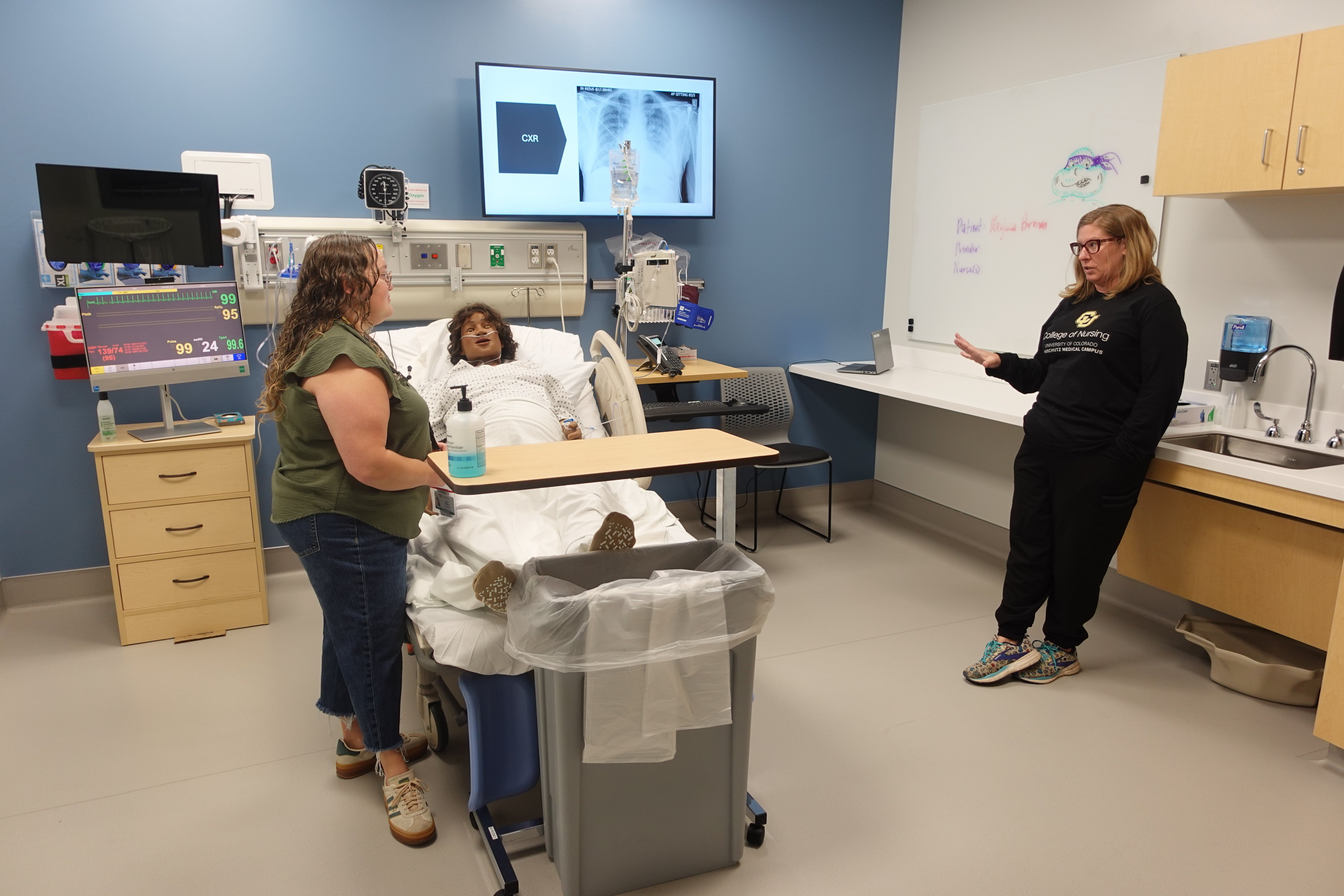
AG-ACNP student Hope Gamble talking with program Interim Specialty Director Dr. Laura Rosenthal during a simulation scenario. |
Then they walk into the scenario and immediately start acting like a provider. And they’re only given 15 minutes with the “patient.”
“Sometimes it’s hard to get into that mindset of telling someone what to do like a provider would, instead of doing whatever I’m told,” Gamble says. "So being able to think quickly on your feet and knowing you have a limited amount of time with the patient is a lot of pressure, but I also know this is a learning experience to prepare me to become a nurse practitioner.”
Students walk in, introduce themselves, and ask the patient [a life-like manikin] questions. The patient would reply like any patient would [the simulation technician is acting as the patient’s voice in a nearby room]. In this scenario, the patient, Meghan, was 40 years old and pregnant. She didn’t know where she was or what day it was. As students start getting more information from the patient, they’re supposed to start thinking about what could be wrong with the patient and how to treat them.
“I like getting thrown into situations with little to no information,” AG-ACNP student Andreas Pausch says. “I thought at first the patient might be going into hypertensive crisis or cardiogenic shock, and I wasn’t sure if the patient was supposed to be pregnant. I should’ve asked that right off the bat!”
Rosenthal is also in the room (acting as a bedside nurse) and serves as a guide to help students. She might give them prompts or questions so that if a student feels lost, they can get back on track.
“I can ask them things like ‘Do you want to talk to anybody? Any tasks you want me to complete? Do you want to see the patient’s chest X-ray?’” Rosenthal says.
Students could also look up medications on their phones.
“A lot of us use an app called Open Evidence,” Gamble says. “It’s kind of like a chatbot where you can explain what type of scenario you’re in and you’ll get information back about what type of medication you can provide evidence to back that up.”
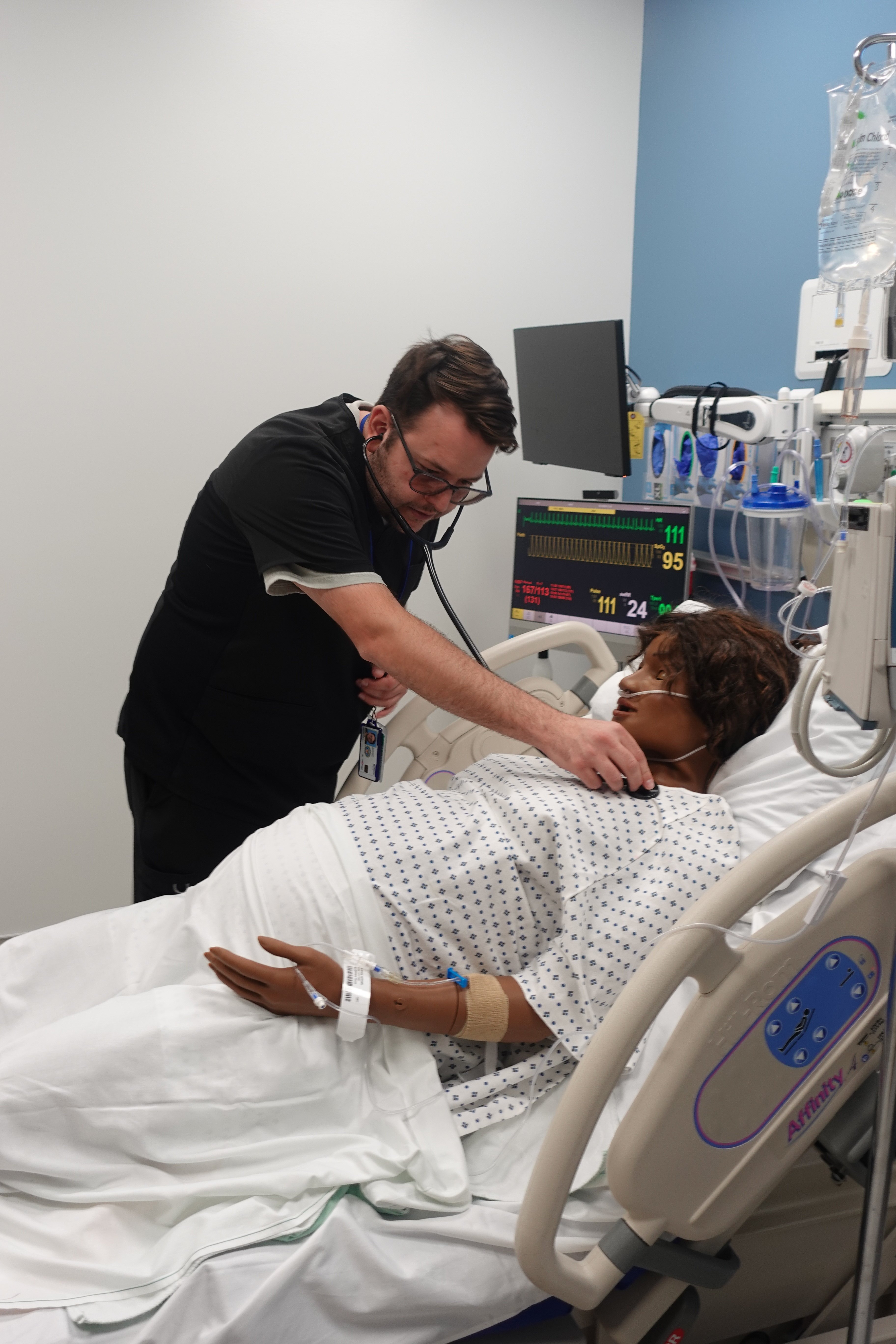
AG-ACNP student Andreas Pausch checking vital signs of a "patient" during a simulation scenario. |
A student then takes all this information, including information that Rosenthal provided, to determine what’s wrong with Meghan. If they’re correct, they would have figured out she had preeclampsia.
Preeclampsia is a pregnancy-related condition associated with high blood pressure and high levels of protein in urine that can cause organ damage, most often in the kidneys. If left undiagnosed, it can lead to complications for both the mother and baby.
“The goal of this simulation scenario is to get students to recognize the patient is pregnant, she has high blood pressure that needs to be handled right now, and that you can’t always rely on someone else to help. You may need to manage a few things,” Rosenthal says. “We really wanted students to get Megan’s blood pressure down, to get her stabilized until OB can see her, and then have the baby delivered.”
A Time for Learning
After the scenario ends, students debrief with Rosenthal about how they felt, what went well, and what didn’t.
“These simulations are great for putting us into that provider role, because as a bedside nurse, you have a different mindset about what you’re thinking about and your knowledge is different,” Pausch says. “It’s great to have this opportunity to get reps and practice as we transition into a new nursing role.”
Students then do another debrief as a class and with other faculty (including Rosenthal), which is beneficial because it gives students a chance to learn from their peers and get a more in-depth look at what they did well or what they might need to work on.
“I’ve been doing simulation with students for almost a year now, and doing this has helped me learn about how our students think,” Rosenthal says. “It’s so much fun for me to be involved in the scenarios, and it’s wonderful to have this safe space where students can practice their skills.”
“Simulation is really important, and it’s one of the best ways to become a better nurse and provider,” Pausch says. “If there were a way we could do simulation all the time, I think that would be great for everyone’s learning.”