
If you are a nursing student practicing your patient communication skills, you now have the option to talk to Grace. Grace is not real – she is a live artificial intelligence (AI) avatar designed by a team at the University of Colorado Anschutz to support student learning.
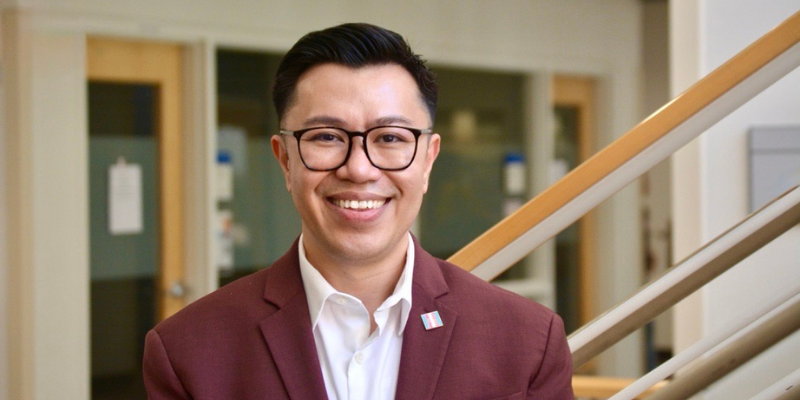
Clint Carlson is the director of education technology innovations at CU Anschutz. His team created the Live AI Avatars @ CU-AMC Project and have been teaching faculty across campus how to use them.
So far, a range of schools and departments, including the CU Anschutz College of Nursing, have utilized the Live AI Avatars tool.
“This project is really about building confidence to improvise with who you're interacting with,” he says.
Avatars like Grace are powered by three different types of AI: natural language processing, speech synthesis, and computer vision. Together these technologies create a life-like interaction between the user and the avatar.
Talking with a Live AI Avatar simulates direct patient interaction. The avatars act as standardized patients that can portray different emotions to simulate different scenarios health care professionals might encounter. The goal is to use the avatars to help increase student readiness and confidence during patient sessions.
Some clinical simulations use human actors (also known as standardized patients) with set characteristics to act as the patient and interact with the student. Afterwards, the actor will provide the student feedback about how their care made them feel. Carlson says the AI avatars are designed to do the same thing but with more efficiency.
“The traditional standardized patient experience can be resource intensive, and so practicing this in an early stage may be not achievable. And so this avatar can provide a student to practice their skills early on in a safe environment,” he says.
Standardized patients are not always readily available to practice and can get tired. They may not be able to practice with more than a few students at a time. Humans can also be more subjective, and form biases. Live AI Avatars, on the other hand, can be used on-demand and can be standardized to eliminate subjectivity when it comes to providing feedback and grading.
“The power of just having Grace and many avatars in our catalog in your pocket for on-demand practice has just been fantastic for our students and beyond,” Carlson says.
He says the goal is not to eliminate human standardized patients, but to supplement them with AI avatars to provide more access for students.
Faculty can assign an avatar, like Grace, a set of characteristics and emotions to perform. They can also provide a rubric that outlines the requirements for the provider-patient interaction. This allows the avatar to keep track of the student’s ability to communicate throughout the session.
“At the end of your students' conversations, you can click ‘Create Assessment Report’,” Carlson says. “You can tell Grace, ‘Hey, break from this role play and give me some feedback’, and she will verbally give you that feedback according to the rubric that we've preloaded as part of that exercise.”
Students can receive the feedback and try again, allowing them to put their learning into practice.
Putting Avatars to Practice
Dr. Christina Baker is an assistant teaching professor at CU Anschutz Nursing. In the Fall of 2025, she received a Dean's Intramural Award, focusing on Innovation for Teaching Practice from Dean Elias Provencio-Vasquez, PhD, RN, FAAN, FAANP.
She used the grant money to support the development of five specific avatars. She worked with Carlson to design avatars that had specific characteristics that could be used to support student learning in Baker’s Foundations of Health Care Informatics course. The nursing students in this class used the avatars to practice telehealth interactions.
“For the assignment, students pick one of these five patient case studies, and then they research what digital tools would be helpful for this patient,” Baker says.
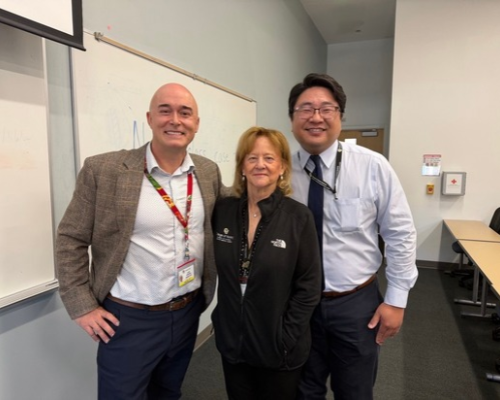
Clint Carlson, director of education technology innovations, presented the Live AI tools at a recent Nursing Grand Rounds. Dr. Christina Baker, assistant teaching professor at CU Anschutz Nursing, and Dr. Petros Yoon, assistant professor at CU Anschutz School of Dental Medicine, also presented on how they have utilized the Live AI Avatars with their students. |
Students said the avatar technology was easy to use and that they enjoyed the assignment. They noted that the avatars felt very real.
Baker noticed that when students went too fast through the telehealth simulation, the avatar didn’t respond as well, which she notes is reflective of a real-world situation, where nurses have to slow down to form a connection with patients.
“Some students took breaks and the flow worked much better,” Baker says. “So that's part of that communication and learning. That and being able to practice I think is helpful when you are speaking with your real patients.”
Being able to perform the simulation multiple times took the pressure off students, and instead allowed them to improve their skills.
“They liked that they could practice as opposed to having a human standardized patient where sometimes it's a one-time deal,” she says. “It was low pressure, they could build confidence over time.”
Encouraged by the results, Baker plans to incorporate more AI-enabled assessment tools into future assignments and hopes other faculty members will explore ways to integrate them into their own courses.
While Grace may not be a real patient, the communication skills students develop while working with her can have very real impacts in clinical practice.
“At the end of the day, it's about helping students feel prepared,” Baker says. “If tools like this help them become more confident communicators and better caregivers, then that's a win for everyone.”