When ophthalmologist Ronald Wise, MD, tells one of his patients that a herpes virus is affecting their eye, they often assume he’s referring to a sexually transmitted disease — but that’s usually not the case. Instead, it’s typically a dormant virus that is activating once more, potentially threatening a person’s vision if left untreated.
Herpes virus, a DNA virus, can affect various parts of the body, and there are different variations of it. Two different types — herpes simplex virus (HSV) and herpes zoster (HZV)— can affect the eye, leading to ocular herpes. However, there are key distinctions between the two.
“Although they are both herpes viruses, they are completely different. Really, the only similarity between the two is the word ‘herpes,’” says Wise, an associate professor of clinical practice at the University of Colorado Anschutz Department of Ophthalmology.
HZV, commonly known as shingles, is a condition that can affect people who have previously had chickenpox and is associated with a typical blister-like rash. HSV, on the other hand, is a virus that has two types: HSV-1 (commonly associated with cold sores near the mouth) and HSV-2 (often associated with genital herpes).
As the medical director of the UCHealth Sue Anschutz-Rodgers Eye Center – LoDo, Wise frequently sees patients who have some form of herpes in their eye, emphasizing the importance of patient education about these differing conditions.
How HSV can affect the eye
In general, when a patient has ocular herpes, it is typically HSV-1 and not HSV-2, Wise explains. According to the World Health Organization, an estimated 3.8 billion people under the age of 50 have been exposed to HSV-1.
“It’s quite common. Oftentimes, you are exposed to this virus during childhood or adolescence,” he says. “It’s almost impossible to not be exposed to it because it’s everywhere. Even if you think you haven’t been exposed, you probably have and just don’t know it because the first infection is usually insignificant."
HSV-1 can spread by someone having direct contact with viral particles from another person who has the infection. For example, if a person with a cold sore gives a kiss to another person, that can spread the virus.
Cold sores are commonly caused by HSV-1, but the virus can also affect a person’s eyes. This can occur by direct contact — such as someone touching a cold sore and then touching their eye — or by the reactivated virus traveling through the nerves to the eye.
Typical symptoms of the infection are a red inflamed eye, watery discharge, pain, and blurred vision typically in one eye. A bilateral eye infection can occur but is less common. When examining a patient for HSV, Wise says a key sign is if on the surface of a patient’s eye, they have a herpetic dendrite, which looks like branches of a tree with little bulbs on the end of each branch.
When a person contracts HSV, the virus never fully goes away. Instead, the virus remains dormant in the nerves of the body, and it can reactivate later on. This can manifest as cold sores or an eye infection. HSV may reactivate during periods of elevated stress or when someone is immunocompromised.
“I don’t think it’s reasonable for everyone who gets cold sores to be fearful of getting HSV in their eye. However, if you have a red eye on one side of your face and an active cold sore, you should get your eye checked,” he says. “Remember to not touch any of these open lesions and then touch your eyes.”
A main concern of HSV in the eye is damage to the cornea, which is the front clear window of the eye that a person looks through, Wise explains. The virus can also cause eyelid inflammation, inflammation inside the eye, as well as infection of the retina and optic nerve.
“The consequence of not getting treatment is scarring and blood vessels growing into the cornea, which can delay healing, lead to vision loss, and lead to the disease becoming chronic,” he says.
Shingles in the eye
HZV, also known as shingles, is a reactivation of the chickenpox virus. While chickenpox is typically a childhood disease, HZV usually appears later in life when someone is above the age of 50.
“Many individuals, when they’re younger, get chickenpox and it’s typically a rash that they will recover from, but that virus remains dormant in the nerves,” he says. “Later on in life, you can have a reactivation of that same virus, called HZV, and it can affect any part of your body, though it usually follows the distributions of the nerves.”
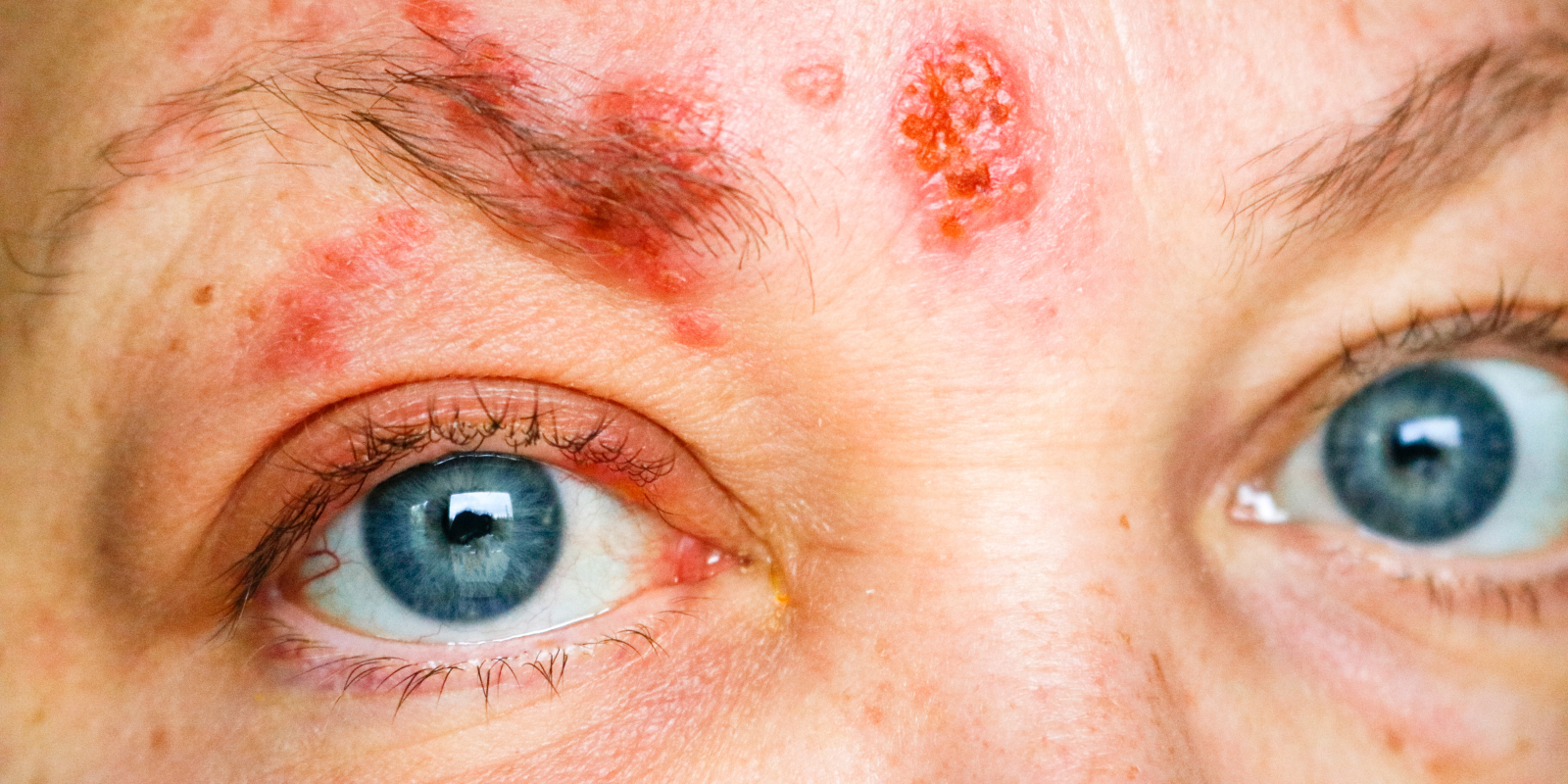
A shingles infection is characterized by a painful, blistering rash that affects one side of a person’s body or face. It may start as a tingling sensation in the forehead before later developing into a full rash with small blisters.
If the rash affects the nerves around the eye, it can result in herpes zoster ophthalmicus (HZO)— which Wise describes as a “potentially devastating eye infection.”
“HZO tends to be more painful than HSV. It presents with a painful rash, and even after a person heals from the rash, they may experience ongoing pain in the distribution where the rash was, called post-herpetic neuralgia,” he says, noting that there are treatment approaches he will use to try to reduce the likelihood of this pain and prevent recurrence.
“Anyone who has HZV anywhere on the face, specifically around the eye and eyelid, should see their ophthalmologist,” he says, explaining that the virus can affect the eyelid and almost every structure within the eye, potentially leading to vision loss if untreated.
Although there is no vaccine for HSV, there is a vaccine for HZV that Wise recommends people aged 50 and older get if they’ve had chickenpox. He says the vaccine has shown to be very effective — up to 97% — in preventing shingles.
Treating ocular herpes
Whether a person has a HSV or HZV in the eye, the treatment approach involves the same drugs — just at different doses, Wise explains. The patient will have a combination of an antiviral topical eye medication and antiviral oral medication. The two most common oral antiviral drugs are acyclovir and valacyclovir. For the topical medications, the typical options are either eye drops or a gel that patients will put in their eye.
For certain patients with HSV, Wise may propose removing the edges of the dendrite in the cornea to reduce the viral load in the eye.
“Similar to HSV, HZV can potentially cause lifelong corneal disease and vision loss, and it may require corneal surgery — including corneal transplantation,” he says.
Individuals who have HZO or HSV may also develop chronic disease, Wise adds, explaining there are additional treatment approaches he may use to help those patients. In general, there is a need for further research on how to reduce the risk of developing a chronic disease when it comes to HSV and HZO, he explains.
“These infections can bother people lifelong and can be devastating to their existence,” he says. “Overall, in my practice, it’s not a one-size-fits-all approach to treating these conditions. I personally individualize what each patient gets when it comes to their initial treatment and subsequent management.”