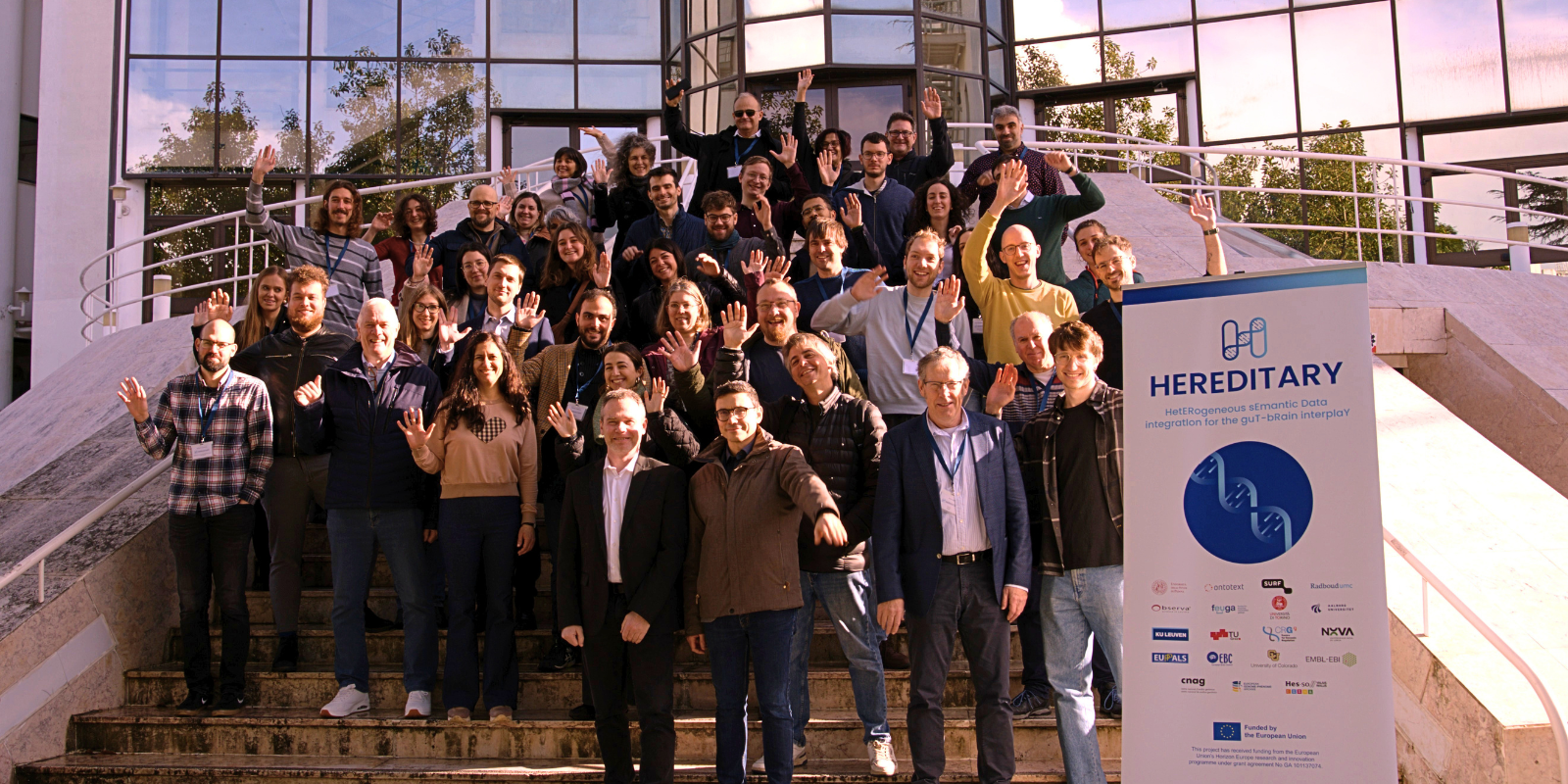
Researchers across the globe, including at the University of Colorado Anschutz Department of Ophthalmology, are working to better understand how the gut microbiome and brain interact, as these connections may provide key insights into neurodegenerative and gut microbiome-related conditions that affect millions of patients, such as Parkinson’s disease and multiple sclerosis. Artificial intelligence (AI) can advance these efforts, as demonstrated by an ongoing international project involving the Sue Anschutz-Rodgers Eye Center at CU Anschutz.
The project, titled Heterogeneous Semantic Data Integration for the Gut-Brain Interplay (HEREDITARY), is a multi-year effort funded by the European Union (EU) under the Horizon Europe program (GA 101137074) to uncover how AI may improve the prevention, detection, and treatment of neurodegenerative diseases and conditions related to the gut microbiome. It involves nearly 20 partners primarily based in countries across Europe, such as Austria, Belgium, Denmark, Italy, Portugal, Spain, and Switzerland. CU Anschutz is the only research partner based in the United States.
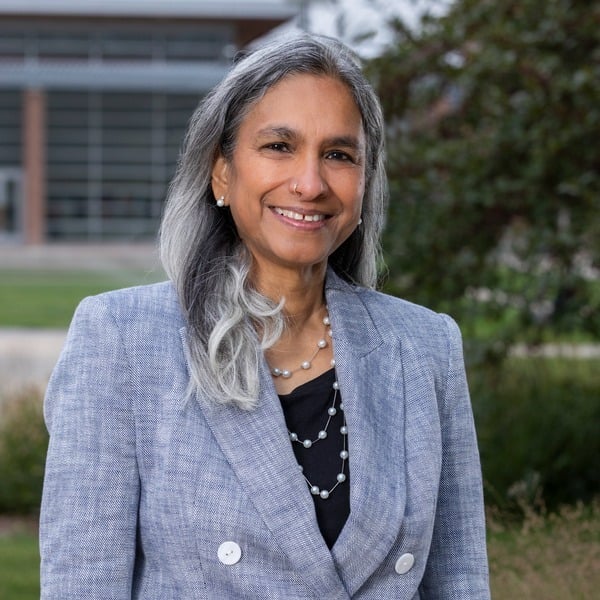
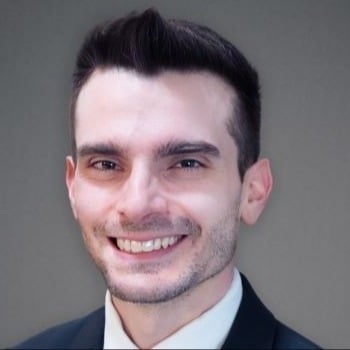
Each partner has specific research goals they aim to achieve by the project’s end date, set for December 2027. Jayashree Kalpathy-Cramer, PhD, chief of the CU Anschutz Division of Artificial Medical Intelligence in Ophthalmology, is leading the work at CU Anschutz in collaboration with Giacomo Nebbia, PhD, a data scientist in the division. They are investigating how AI can be used to scan images of people’s eyes and uncover biomarkers of conditions like Parkinson’s disease and multiple sclerosis, aiming for earlier diagnosis and intervention.
“The retina of the eye, which is part of the brain, provides a more accessible window into a person’s systemic health. It can help reveal if a person has a condition like diabetes, for example,” Nebbia says. “We are trying to find if there are markers of neurodegenerative diseases in the retina, as well as find potential links to gut-brain interactions.”
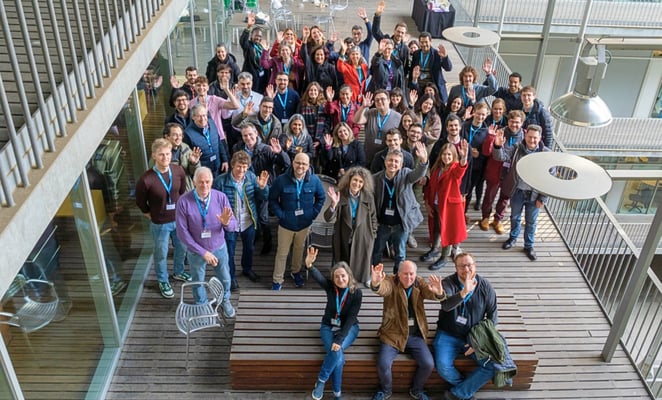
Jayashree Kalpathy-Cramer, PhD, and Giacomo Nebbia, PhD, smile alongside other researchers involved in the HEREDITARY project during a gathering in Barcelona, Spain, in 2025. Image courtesy of Nebbia.
Only U.S. partner in EU project
Kalpathy-Cramer has spent years working to develop AI tools that can scan images of retinas (called fundus images) and detect diseases such as Parkinson’s disease and lung, heart, and eye conditions in premature infants. She has received prestigious grants to conduct this work, including from The Michael J. Fox Foundation and The Anschutz Foundation.
“We’ve found that some AI models can examine a patient’s fundus image and predict the patient’s gender, age, and risk of developing certain diseases,” Kalpathy-Cramer says. “These models are able to do this by analyzing lots of data and identifying patterns that may not be obvious even to trained human experts. But it’s important to note that we’re still learning how these models work.”
Throughout her career, Kalpathy-Cramer has built a reputation as a leader in the field of AI in radiology, oncology, ophthalmology, and more recently oculomics, an emerging field that focuses on finding connections between biomarkers in the eye and systemic diseases. She also pioneered some of the early work in federated learning in medical imaging, a technique to build collaborative AI models without the need for data sharing.
Over the decades she has spent in research, she has built relationships with researchers across the world. When professor Gianmaria Silvello, PhD, from the University of Padua in Italy, began to gather a team for the HEREDITARY project, he asked Kalpathy-Cramer and her team to join the consortium.
“One of the reasons the Sue Anschutz-Rodgers Eye Center was invited is because the researchers in Europe were very excited about our oculomics work, which we are hoping to continue to expand upon,” Kalpathy-Cramer says.
As a result, Kalpathy-Cramer became the principal investigator for one of the five HEREDITARY use cases, titled “Signs of Parkinson’s Disease in Multimodal Data.” In this project, Kalpathy-Cramer is working with Nebbia and the HEREDITARY partners to identify Parkinson’s disease biomarkers in eye images, develop prediction models for early disease detection, and identify associations between ophthalmic and neurological biomarkers.
They aim to do this by using multimodal data, meaning they will use a combination of data types such as fundus images, text, and clinical data to train these AI models.
“We hope to find out if it’s possible to diagnose Parkinson’s disease from retinal imaging,” Nebbia says. “Research suggests there could be retinal biomarkers associated with Parkinson’s disease, but this area of research is still exploratory.”
The investigators hope their findings may eventually translate into clinical changes by creating tools that help detect Parkinson’s disease earlier and with less invasive testing. For example, if a patient is referred to a neurologist and it is suspected they may have Parkinson’s disease, perhaps the physician could scan the patient’s eyes — a noninvasive process that involves capturing fundus images — and have an AI model assess if the patient has any biomarkers associated with the disease.
“We are also working with our partners to train AI models on multiple sclerosis, which is work we hope to continue through the end of this project next year,” Nebbia says.
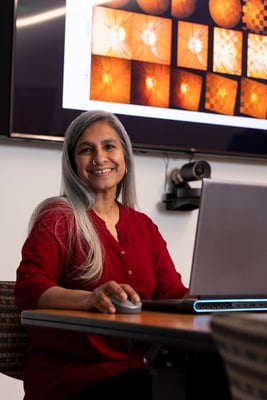
Jayashree Kalpathy-Cramer, PhD, leads the CU Anschutz Division of Artificial Medical Intelligence in Ophthalmology.
Expertise in federated learning
Another reason why Kalpathy-Cramer's team at CU Anschutz was asked to join the HEREDITARY project is because of her expertise in federated learning, Kalpathy-Cramer explains.
Federated learning is a type of AI training model that allows institutions to share AI models and knowledge without sharing raw data. This is important because current AI models require a lot of data to be developed, making collaboration between institutions of utmost importance. At the same time, data privacy regulations prevent institutions from sharing the data.
Federated learning makes collaboration possible without sharing raw data. In this case, researchers at CU Anschutz will use their raw data to identify patterns and develop AI models, and researchers at the partner institution will separately do the same. Then, the researchers can share the developed AI models to combine them into one, unified model — all without the individual patient cases of each institution being directly shared.
Not only does this help researchers from different institutions collaborate, but it also prevents patients’ private health information from being shared, resulting in a more secure AI training approach.
“These AI models require a lot of data, so one institution might not have enough data to properly train them,” Nebbia says. “By working together through federated learning, the hope is to have enough data.”
Federated learning also helps counteract any potential biases that AI models may have developed, as AI models can be prone to what is known as “shortcut learning.” For example, if an AI model is trained to detect a disease that is associated with older age, then the AI model may conflate being older with having this disease — an association that may not be accurate. Similarly, if the patient population is mostly male, then the AI model may be unable to properly assess the fundus images of female patients, which may differ from male patients.
“Through federated learning, these AI models are learning from more data, allowing them to have a more comprehensive training and potentially overcome biases inside each institution’s data,” Nebbia says.
Value of global partnerships
International research collaborations like HEREDITARY reflect an opportunity to make large advances in the field while simultaneously expanding the knowledge of researchers themselves.
“This is my third international project, and I’ve really enjoyed the collaborations. We get to learn from what people in different parts of the world are doing,” Kalpathy-Cramer says. “It’s such a valuable experience for us.”
Although there are many hurdles and challenges involved in navigating multicultural, multilingual, and multimodal data projects, Nebbia says the work “is worth doing and helps push the field forward.”
“We also get to help train the next generation of scientists,” Nebbia adds. “For example, we recently hosted a doctoral student from the University of Padua in Italy. This is how the ideas for future grants can start.”