From remote patient monitoring to electronic health records, drug discovery to disease prediction, artificial intelligence and new technologies are impacting patient care and pharmaceutical research in dramatic ways. When it comes to how digital transformation is impacting education, look no further than the CU Pharmacy classrooms and labs.
Earlier this year the CU Anschutz Medical Campus hosted an all-day faculty/staff AI Symposium. The overflow crowds heard from leaders in the history of artificial intelligence, digital adoption and information technology. When it came time to learn how people are actually operationalizing all of this technology, the School of Pharmacy was front and center.
AI as an Educational Tool
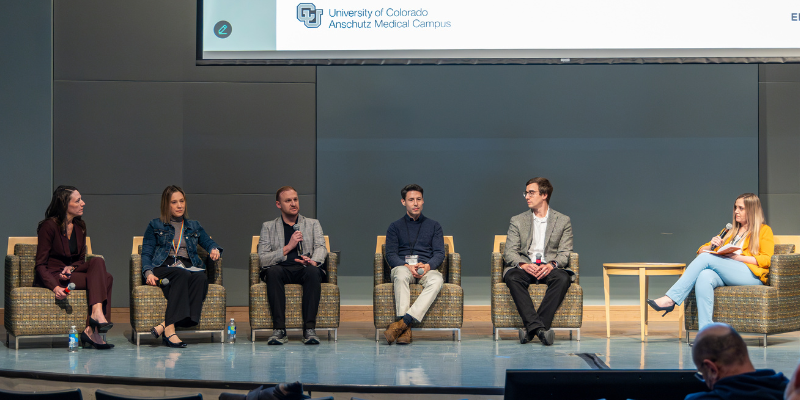
Heather Anderson, PhD, and Sunny Linnebur, PharmD, (top photo, far left) were part of a panel that discussed opportunities and challenges associated with AI in the classroom. Two of Dr. Linnebur’s classes put some of the most popular AI platforms to the test. They gave ChatGPT and Microsoft Copilot questions like, “Would coenzyme Q10 help my muscle pain from atorvastatin?” They then compared the AI-assisted responses with the trusted pharmacy references to identify potential differences.
“Our students and patients are using AI, so it’s our job as educators to help them develop critical thinking skills around the AI responses they receive,” said Linnebur.
Dr. Anderson has encouraged her evidence-based medicine students to come up with a research question and put it into AI to see what references it would provide. “Most of the actual references it provided were not correct,” said Anderson. “So, teaching students how to use these tools appropriately and vet the information is critical.”

Despite the challenges associated with AI-delivered results, Linnebur is hopeful that pharmacy schools will soon be able to harness AI to improve patient communications. “I look forward to our students being able to practice their counseling skills with diverse simulated patients from lots of different backgrounds – so when they encounter similar patients in practice, they will be better prepared.”
This spring’s Dean’s Convocations sought to prepare students to reimagine the field into which they will soon be entering. Erin Albert, PharmD, Vice President, Pharmacy Relations and Chief Privacy Office at Mark Cuban Cost Plus Drug Company spoke about how new innovations and agile strategies are leading to pharmacy disruptions and how students should be preparing for such a future. While Suresh Pavuluri, MD, from the Yale School of Medicine addressed the ethical implications and potential pitfalls of AI in healthcare. Meanwhile, CU Pharmacy faculty and staff continue to explore technology best practices through the AI Discovery Labs created by Jennifer Trujillo, PharmD, Associate Dean for Education. The monthly professional development series is a sandbox-style environment which encourages participants to test and practice AI tools in real time.
Technology Meets Patient Care
But it’s not just in education where CU Pharmacy is embracing the change that new technology brings. Numerous clinical faculty are leading efforts to better understand how digital modalities are impacting patient care. Joe Saseen, PharmD, Associate Dean for Clinical Affairs was a featured expert in an article exploring how the latest innovations, like mobile apps, ingestible sensors and smart pill bottles, are helping to prevent dangerous medication errors and empower patients and caregivers. Dr. Saseen also says that AI is being piloted during patient care visits in some of our ambulatory care clinics. Some School of Medicine faculty are using AI to help assist with medical documentation to facilitate more face-to-face interactions between patients and their providers. Other clinical faculty members were part of a cross-campus research team that conducted one of the largest and most diverse digital strategies studies of its kind examining the role that text messages play in medication refill reminders.
Innovation and Commercialization
Elsewhere in the School of Pharmacy, innovators are investigating how to expand new technologies toward commercialization in the clinic and to other stakeholders. Melanie Joy, PharmD, PhD, Director of Innovation and Commercialization is the chief innovation officer for the school. Dr. Joy’s office directs innovation and entrepreneurship initiatives to educate and support faculty and trainees along their pathways in this arena. Since its inception, the office has hosted seminars by entrepreneurs exploring novel targeted immune therapeutics, automated patient medical record retrieval, remote monitoring and AI to improve the way in which health care is delivered.

Joy works closely with CU Innovations and faculty innovators across the Anschutz Medical Campus to enhance drug, device and diagnostic development efforts and potential strategic partnerships that support the commercialization of new technologies. As part of these initiatives, Joy launched the school’s first Innovation & Entrepreneurship Pitch Competition this spring. The call-to-competition event encouraged pharmacy faculty to brainstorm ideas, initiatives, or vexing problems that they have always wanted to develop. Six teams pitched their ideas ranging from gene therapy projects to data visualization efforts and beyond. Key score-driving elements included novelty, stakeholder considerations, competitor products, value proposition and short and long-term vision and goals. Funding to support the winning projects will be announced in the near future.
Research Takes Quantum Leaps
Some of the School’s most advanced and high-tech scientific innovation and research infrastructure lives in the Department of Pharmaceutical Sciences, so it’s no surprise that these researchers have a high comfort level with new technologies and machine-learning software. In 2021, the CU Anschutz Center for Drug Discovery was established with a mission to accelerate the development of innovative therapies through advanced drug screening, cutting-edge research, and strategic collaborations. By combining state-of-the-art robotic automation with multidisciplinary expertise, the Center bridges the gap between scientific discovery and clinical application.
Expanding its innovation efforts, the Center is now exploring quantum technology’s potential in drug discovery. Dan LaBarbera, PhD, is part of a CU-based research group working to harness quantum computing for human health applications. This effort is fueled by Elevate Quantum (EQ), one of only two federally designated and funded technology hubs in the U.S., leading a statewide initiative to establish Colorado as a quantum technology ecosystem. EQ is building the infrastructure to apply quantum computing and sensing across fields from cybersecurity to medicine. In drug discovery, quantum simulations could rapidly identify drug candidates, optimize molecular design, and predict complex biological interactions, significantly accelerating the development of new treatments. To advance this approach, Dr. LaBarbera has assembled a multidisciplinary team of researchers from CU Anschutz, CU Boulder, and leading quantum computing companies.

New Horizons Call for New Skills
For the last two decades, pharmacy careers have been expanding into new areas, chief of those being the tech sector. In addition to providing direct patient care, today our graduates work in pharmacy informatics, telepharmacy, robotics, and more. One example of this is Whitley Yi, PharmD. Dr. Yi graduated from CU Pharmacy in 2017 and went on to specialize in healthcare technology. She is co-founder of the AI Collective, an organization designed to empower pharmacists to be an active contributor in shaping AI. Yi is also the Director of Pharmacy and Member Services at Well.co, an app-driven digital platform that serves as a tech-enabled health care concierge.
Bill Quinn, futurist with Tata Consultancy, was the keynote speaker at the campus-wide AI Symposium and closed out his presentation with a quote from Alvin Toffler: “The illiterate of the 21st century will not be those who cannot read and write, but those who cannot learn, unlearn, and relearn." As CU Pharmacy continues to explore the ambiguity and opportunity of the digital future, faculty, staff, researchers and students will be engaged in the continual process of reimagining new ways to improve education, research and patient care through ever-evolving modalities.