Once Ann Koenig had surgery to treat her pancreatic cancer, she hoped her cancer journey was over for good. She had undergone six months of chemotherapy prior to the surgery, to shrink the tumor, and the operation — performed in 2021 by Richard Schulick, MD, PhD, a pancreatic cancer surgeon and director of the University of Colorado Cancer Center — was a success.
Months later, however, a routine follow-up scan revealed that Koenig’s cancer story had developed a new chapter. The pancreatic cancer had spread to her lungs, creating nodules that needed immediate treatment.
“So I went back on chemo until we made a game plan, and that went on for another year and kept things stable,” says Koenig, 61, who lives in south Denver. “Then, on the recommendation of Dr. Schulick, I pursued a consult with Dr. Messersmith.”
Targeting a genetic alteration
Then receiving care through another provider, Koenig met with Wells Messersmith, MD, associate director of clinical services at the CU Cancer Center, who suggested sending a sample of Koenig’s tumor for molecular testing — a way to check for specific alterations that can be targeted with medications. Koenig’s tumor was positive for an alteration, and she was put on targeted therapy to keep the lung nodules under control.
“It worked really well for me for about two years, then my tumor markers started to rise,” Koenig says.
Clinical trial provides new hope
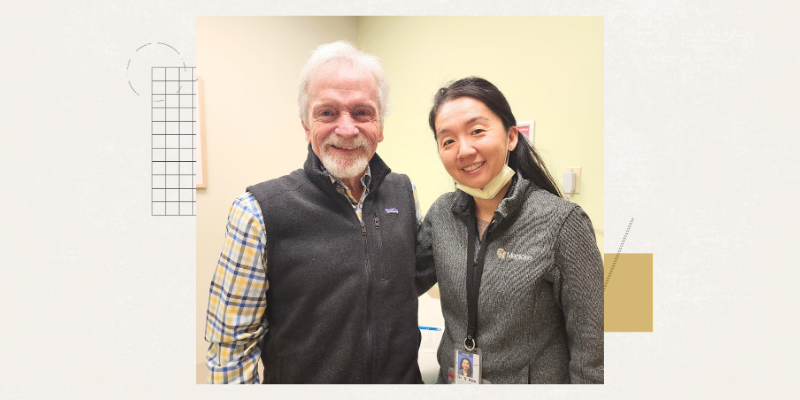
Koenig, whose alteration was in the ALK gene, was eventually connected with another CU Cancer Center member, Tejas Patil, MD, who was the site principal investigator at CU of a clinical trial for a fourth-generation ALK inhibitor.
“The sad thing, in most cases of pancreatic cancer, is that even when you do surgery and other heroic measures, the long-term survival rate is still in the 10% range,” says Patil, assistant professor of medical oncology in the CU Anschutz School of Medicine. “Just by blind luck, her cancer happened to have this rare ALK fusion, which we were able to use to our advantage by putting her on a novel trial.”
Patil initially had to convince Koenig’s insurance company to let her enroll in the trial.
“The insurance denied it, and Dr. Patil wrote them a letter on my behalf, saying, ‘Hey, this is a really rare and incredible opportunity for this person,’” Koenig recalls. “We submitted it, and the head of the company’s western division called me and said, ‘We can't deny this. This is too incredible.’”
Per Patil: “I told them, ‘Look, you're paying tens of thousands of dollars to cover an off-label drug that is suboptimal in addressing her cancer, and we have a clinical trial drug that is far superior that the company sponsoring the trial is covering in its entirety.’ It was one of the strangest letters I've had to write, because I was begging her insurance to put her on a trial that would actually save them money, because I knew this drug was going to be highly effective for the patient.”
Cancer under control
One year later, Koenig still takes the ALK inhibitor — an oral drug, taken once a day — and her cancer remains under control. Her antigen numbers are in the normal range, and her nodules haven’t grown. Patil emphasizes that the cancer isn’t cured, but it’s being highly controlled.
“I scan every two months, and the nodules never grow,” Koenig says. “We're hoping that I continue to tolerate the drug and it’s successful. I ride my bike on the High Line Canal and think, ‘This is unbelievable. Who would have thought, five years later, that I'd be doing this?’ To travel, to go out to dinner, to have my kids over — everything is a gift.”
.png?width=450&height=748&name=KOENIGCC_0840%20(1).png)
Koenig with her daughter Colleen and dog, Yogi, at the City Park Classic, a fundraising event for pancreatic cancer research.
Patil, meanwhile, is happy to see the ALK inhibitor having positive results not just in pancreatic cancer patients like Koenig, but patients with other cancers as well.
“This treatment will likely work for anyone who has an ALK gene alteration,” he says. “I have another patient with a colorectal cancer with the same ALK gene fusion who is also doing really well. We are getting to the point where the molecular alteration matters much more than the underlying site of origin. It's less relevant that Ann had pancreatic cancer and more relevant that she had this gene alteration, which we can target with precision medicine tools.
“This therapy is not only prolonging her life, but improving the quality of her life,” he says.
Featured image: Ann Koenig with her husband, Tom, and sons Griffin and Andrew at their beloved Lambeau Field in Green Bay, Wisconsin.