
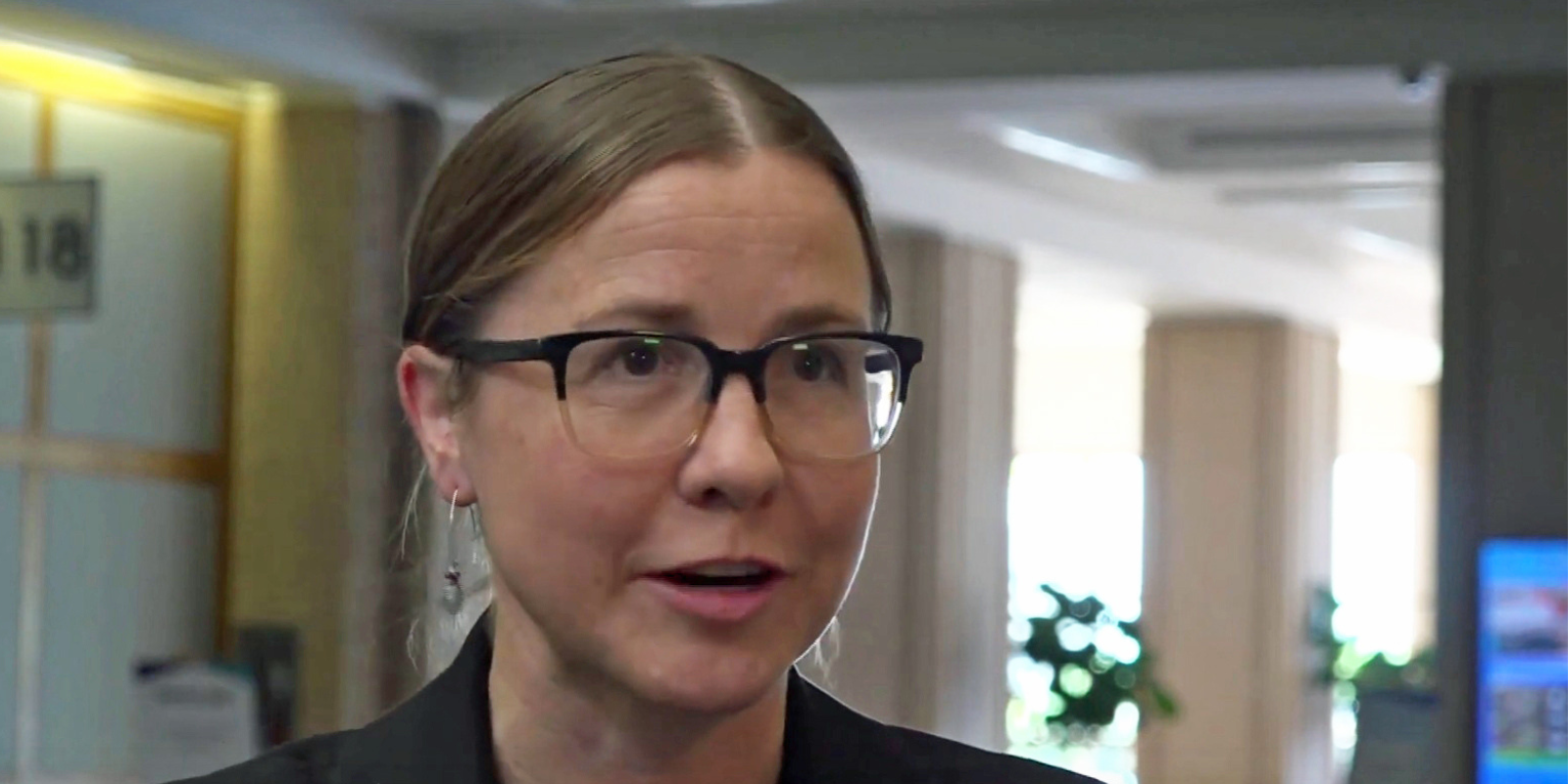
A University of Colorado Cancer Center gynecologic oncologist has received a competitive early career investigator research pilot grant to support her search for new opportunities to treat a deadly type of ovarian cancer.
If successful, the international research led by Lindsay Brubaker, MD, could help transform ovarian cancer treatment by finding ways to optimize precision medicines for more patients.
Brubaker is an assistant professor in the CU Department of Obstetrics and Gynecology who collaborates closely with CU Cancer Center colleague Benjamin Bitler, PhD, on research to overcome chemotherapy resistance in ovarian cancer. Her focus is on drugs that target epigenetics – changes to gene expression.
The pilot grant – Brubaker calls it “a hypothesis generating award” – comes from what might seem like an unlikely source: The U.S. Department of Defense. Its Ovarian Cancer Research Program was established in 1997 to help women in the military and veterans. “It’s been incredible to have this support from the DoD, because gynecologic cancers are often overlooked in major funding mechanisms,” she says.
→ CRISPR Study Lays Groundwork for Overcoming Ovarian Cancer
An exciting new approach
An estimated 20,890 women in the United States will receive a new diagnosis of ovarian cancer this year, and about 12,730 deaths are expected, according to American Cancer Society projections. While ovarian cancer rates and deaths have been declining in recent decades, it remains the fifth most common cause of cancer-related deaths in women in the U.S.
Brubaker’s latest study focuses on high-grade serous carcinoma (HGSC), the most common and aggressive type of ovarian cancer. HGSC most often originates in the fallopian tubes, then spreads to the ovaries. It is associated with poor outcomes, as “it tends to present at an advanced stage,” she says.
A combination of surgery and chemotherapy is the standard of care for HGSC, but Brubaker says that about 80% of patients with HGSC eventually become resistant to chemotherapy through multiple resistance mechanisms in tumors. “It's a real limitation in terms of what treatment options we have available, so there’s an urgent need to develop novel therapeutic approaches” to chemo-resistant HGSC, she says.
Brubaker sees potential in antibody-drug conjugates, or ADCs, a class of cancer therapy that combines the targeting ability of monoclonal antibodies with the cell-killing power of chemotherapy drugs. The antibody component finds and attaches to specific proteins on cancer cells, then releases the chemotherapy where it’s needed, minimizing damage to healthy cells. She calls ADCs “the most exciting new therapeutic approach in gynecologic cancer care.”
→ Ovarian Cancer Experience Leads to Helping Others on Their Journey
Flipping switches
An ADC called mirvetuximab (marketed as Elahere) was approved in 2024 by the U.S. Food & Drug Administration as a treatment for chemo-resistant HGSC in patients who have high expression of folate receptor alpha, a protein found on cell membranes that binds to folate. Studies that evaluated mirvetuximab suggest that high folate receptor alpha expression is necessary for it to work. The problem is, only 40% of HGSC tumors are folate receptor high.
Brubaker is interested in understanding the epigenetic “switches” involved in expression of the folate receptor alpha protein, as well as other potential targets for ADCs. She proposes to explore the epigenetic drivers that flip these switches on, making cancer cells present more folate receptors.
“If we could understand the epigenetic drivers of ADC target presentation, there may be a way to target them,” she says.
Her hope is that by targeting epigenetic drivers of folate receptor alpha presentation, patients already getting mirvetuximab will see better results, and that patients whose tumors currently don’t present enough folate receptors could become candidates for ADC treatment.
→ Putting Early Ovarian Cancer Detection to the Test
An Australian collaborator
In her 12-month research project, Brubaker plans to study tumor samples to understand how target protein levels vary across different cancer sites. She will also use advanced CRISPR/Cas9 genetic screening to identify exactly which epigenetic switches control target proteins and then test combinations of epigenetic drugs with ADCs in laboratory models.
Brubaker’s collaborator on the project is Elizabeth Christie, PhD, of the Peter MacCallum Cancer Centre in Victoria, Australia. “She’s an incredible ovarian cancer scientist who has built out a resource of donated patient tumor specimens, and she’s able to do multiple levels of multi-omic analysis.”
The project will specifically analyze high-grade serous carcinoma cell lines with varying levels of folate receptor. “This will give us an abundance of data to have a better understanding of the regulation of the folate receptor, so we know which epigenetic pathways we can target to change the expression of the folate receptor,” Brubaker says. “If we can increase expression in tumors of patients that are low expressing, we might be able to broaden the set of patients for whom this therapeutic approach is relevant.”
The goal, she says, is to lay the foundation for a clinical trial.
Bitler and David Bowtell, FAA, FAHMS, of the MacCallum Center are supporting the project as mentors.
→ Innovations in Ovarian Cancer Research
‘I’ve never been able to turn away’
Brubaker knew by her third year of medical school that she wanted to do cancer care. “I wanted to see my patients through the course of their diagnosis, treatment, and life,” she says. “And in residency, seeing what a career looked like for a gyn oncologist and working with this patient population, I’ve never been able to turn away.”
Then, Brubaker says, “my love of science started when I became a fellow at CU and started working with Dr. Bitler.” She says the CU Cancer Center is “an incredible place to do translational research. Dr. Bitler has developed a comprehensive research team looking at all gynecologic cancers. And the cancer center has exceptional core resources that we use in all our work. We have a unique opportunity here to do practice-changing research.”
Brubaker says that ovarian cancer research has been hampered by a shortage of robust funding sources, “so it doesn’t have the same sort of research momentum as the most common cancers. But I do think we’re making progress.”
Photo at top: Courtesy of Society of Gynecologic Oncology