When University of Colorado Cancer Center member Kian Behbakht, MD, MBA, was named the Emily McClintock Addlesperger Endowed Chair in Ovarian Cancer in 2020, the funding came with a mandate: work to develop an early detection tool for ovarian cancer similar to the ones used to detect breast and colorectal cancer.
“The endowment came from a couple whose daughter passed away unexpectedly from ovarian cancer for the specific aim of an early detection test, so that nobody would have to suffer from this again,” says Behbakht, professor of gynecologic oncology in the CU School of Medicine. “I told them that people had been working on this for 30 years, and it's not an easy task; however, all of these endeavors are technology dependent, and as the technology improves, things that weren't possible become possible.”
Local collaboration
Behbakht is now working on making the previously impossible possible, collaborating with Denver-based AOA Dx to validate the company’s blood test for ovarian cancer. AOA used the Division of Gynecologic Oncology and CU Cancer Center’s Gynecologic Tissue and Fluid Bank to test the accuracy of its tool before beginning to test it on patients.
“This is the very first step that companies often do to validate their test, and then once they have a valid test, they test it on a prospective group of patients at risk for ovarian cancer to see if they can detect it earlier,” Behbakht says.
At the CU Cancer Center and other sites nationwide, women experiencing vague abdominal symptoms — such as bloating, abdominal pain, early satiety (feeling full quickly), and urinary issues — are enrolling in a clinical trial where their blood samples are being collected for future testing with AOA’s diagnostic technology. These samples will be tested in the future to help evaluate the test’s performance and support a FDA submission and future real-world clinical use.
Focus on symptoms
It’s important to focus on women with those symptoms both to identify those at higher risk and to rule out those at lower risk, says Behbakht, who recently published research in the journal Gynecologic Oncology Reports showing the effectiveness of using the electronic medical record patient portal to ask women if they have experienced any of the listed symptoms as a way to pre-select women who should receive a blood test such as AOA’s.
“One of the issues with ovarian cancer is that it's rare,” he says. “When a disease that you're studying is rare, the tests have to be extremely sensitive and specific for you to not have a high rate of false positives. To do that, you need to raise the incidence of a disease. How do you raise the incidence of a disease? By targeting whom you specifically screen.”
For the research, Behbakht and his team added a four-symptom questionnaire for women to answer when they came in for a general gynecologic exam. It asked about each specific symptom, if they had experienced it in the past year, and if so, how often.
“Quite a few had at least one of these symptoms, and about 2% or so had all four of the symptoms within the past year,” Behbakht says. “Many of the women had other reasons for having those symptoms, such as fibroids, adnexal cysts, endometriosis, adenomyosis, and pelvic organ prolapse. Even when women have all of these symptoms, there's often another explanation for it, but women with all four symptoms probably should be given the option of a more specific, targeted screening for ovarian cancer, because presumably their risk is much higher.”
Working together
That’s where AOA Dx comes in. The company initially reached out to the CU Cancer Center about using the tissue bank, and Behbakht ended up helping design its clinical trial. CU Cancer Center member Benjamin Bitler, PhD, a researcher who worked with AOA on its early experiments with the tissue bank, says there is value in collaborating with a local company on this important research.
“They're wonderful,” says Bitler, the Kay L. and Thomas Dunton Endowed Chair in Ovarian Cancer. “We participate in joint scientific sessions; we interact at national meetings. They presented their results in London this summer, so we are internationally prominent. This collaboration brings national and international prominence not just to the company, but also to our program here at the University of Colorado. And it gets us on the world stage as a player in this really important field.”
For Bitler, an associate professor of basic reproductive science, the collaboration also raises new research questions.
“As some of these new markers for tumor monitoring go online in the clinical space, we in the research space need to understand: are there confounding factors that can shift these biomarkers so you get false positives? Are there potential ways of using the biomarker as a therapeutic target?” he says. “What happens to those markers in terms of the levels after chemotherapy or during chemotherapy or during a therapeutic regimen that's already standard of care? Those are the types of questions we'll have to come back to the lab to answer.”
A better blood test
Once all the questions have been answered, Behbakht says, he’s excited to have a new tool to potentially detect ovarian cancer earlier. There is an existing blood test, for a protein called CA125 that can indicate ovarian cancer, but it doesn’t work well enough, he says.
“The current testing protocol has been shown to be ineffective,” he says. “National societies such as the Society of Gynecologic Oncology and the American College of Obstetricians and Gynecologists specifically say that it should not be used for screening. “The current tests are insufficient and not recommended, which means we need a better test.”
A more reliable test like the one AOA is evaluating in the clinical trial, paired with the symptoms questionnaire Behbakht proposes in his research, could be a life-saving development.
“Presumably, with these tests, women who have abdominal pain would be offered this cancer test, and once it's negative, they know that ovarian cancer is not something they need to worry about,” he says. “The problem is that ovarian cancer often gets missed, and the reason it gets missed is because its symptoms overlap with so many other conditions that it's not the first thing in the mind of the practitioner when they see a women with abdominal pain, difficulty eating, trouble with urination. They're thinking urinary tract infections or inflammatory bowel disease.
“If there can be an alert screen in the EHR that says, ‘Your patient has these symptoms. Have you considered this test that will rule out an ovarian cancer?,’ my guess is that most providers would order that test,” he continues. “If they do so, then maybe we will diagnose ovarian cancer early and prevent women from dying."
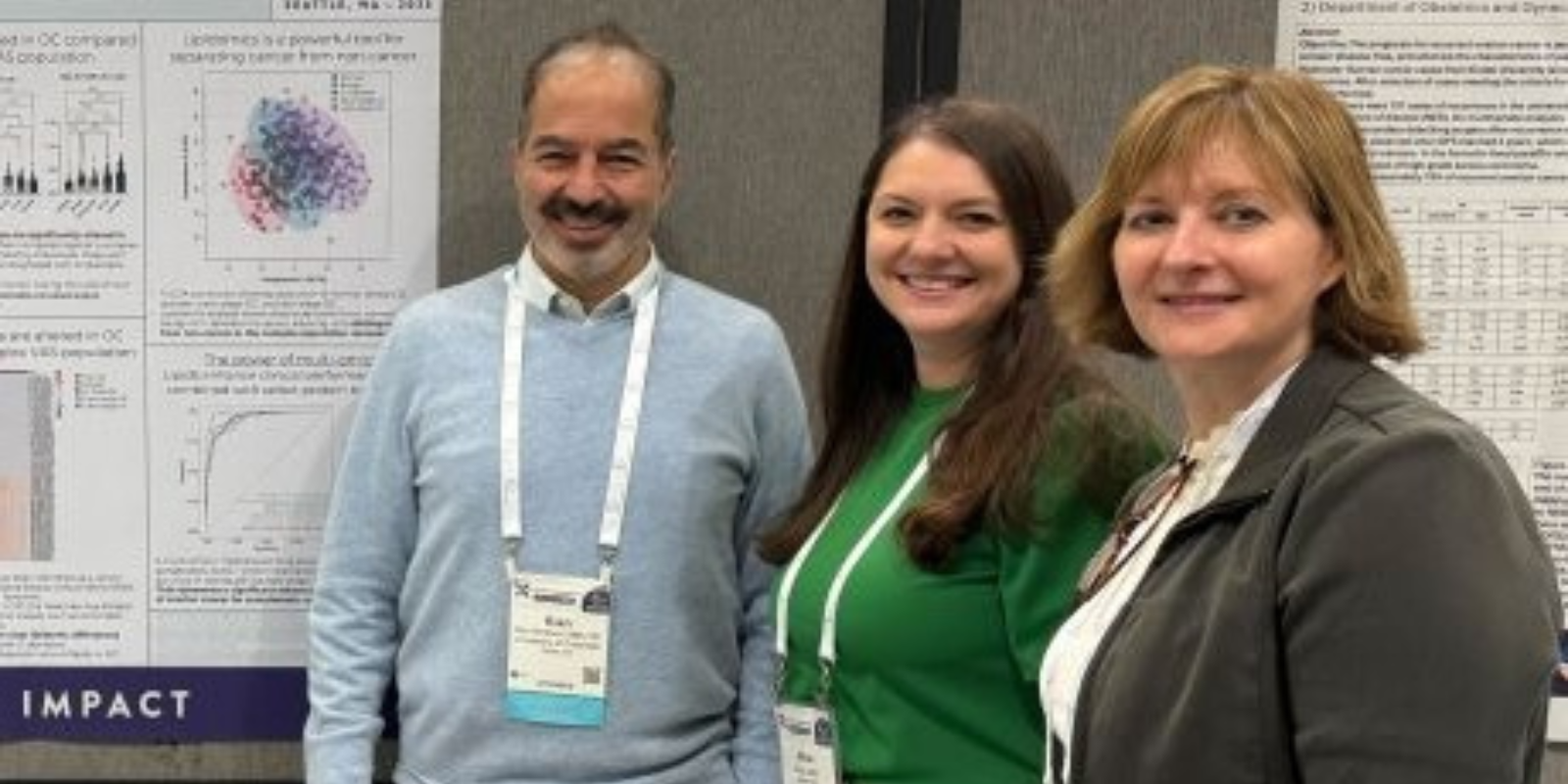
Featured image: Kian Behbakht, MD, left, with Abby McElhinny, AOA’s chief scientific officer, and Anna Jeter, AOA’s chief regulatory officer.